Key Takeaways
- The global metaverse in gaming market was valued at USD 24.79 billion in 2024 and is projected to reach around USD 648.24 billion by 2034, growing at a CAGR of 38.59% from 2025 to 2034, driven by increased adoption of VR, AR, and blockchain technologies across games in the metaverse.
[1] - Play-to-earn metaverse games like Axie Infinity let players collect, breed, and battle NFT creatures called Axies, with the game building an entire economy around AXS and SLP tokens that players can earn and trade for real money.
- Roblox reported 79.5 million daily active users and approximately 380 million monthly active users as of Q2 2024, hosting around 40 million user-created games and experiences that cover nearly every metaverse game category.
[2] - Travis Scott’s Fortnite virtual concert attracted over 45.8 million peak viewers, making it one of the biggest virtual events ever held inside a metaverse gaming platform and showing how social and event-based games are reshaping entertainment.
[3] - Sandbox metaverse games combine creativity with economics by allowing players to design, build, and trade in game assets as NFTs, with platforms like The Sandbox and Decentraland enabling players to buy virtual land, create experiences, and earn cryptocurrency.
- North America contributed more than 43% of the metaverse in the gaming market share in 2024, while Asia Pacific is growing at the fastest rate, driven by high smartphone use, 5G rollout, and a young population interested in metaverse gaming.
[4]
The gaming world has changed in a way that nobody could have predicted even ten years ago. What used to be simple 2D games on a screen has now grown into massive virtual worlds where millions of people play, create, earn money, and hang out together. This shift is what we call metaverse gaming, and it is one of the fastest-growing areas in the entire tech space. The global metaverse in gaming market was valued at USD 24.79 billion in 2024, and experts believe it will reach USD 648.24 billion by 2034. That kind of growth tells us one thing clearly: metaverse games are not a trend. They are the future of how people play and interact online.
But here is the thing. Not all games in the metaverse are the same. There are many different types of metaverse games, and each one offers a completely different experience. Some let you earn real money. Some let you build anything you want. Some drop you into a story-driven adventure, and some are all about hanging out with friends in a virtual world. If you are curious about what kinds of metaverse game categories exist and how they work, this blog will walk you through all of them in a simple, easy-to-understand way.
What Are Metaverse Games and Why Do They Matter?
Before we jump into the different types of metaverse games, let us first understand what a metaverse game actually is. A metaverse game is basically a video game that exists inside a shared, persistent virtual world. Unlike regular games, where you play a mission and leave, metaverse games keep running even when you log out. Other players are still playing, trading, and building in the same world. Think of it like a digital city that never sleeps.
What makes metaverse gaming different from traditional gaming is the use of technologies like virtual reality (VR), augmented reality (AR), blockchain, and NFTs. These technologies let players own their in-game items for real, trade assets with other players, and even earn money while playing. In traditional games, if you buy a skin or weapon, it belongs to the game company. In games in the metaverse, those items belong to you because they are stored on the blockchain as NFTs.
Major companies like Meta, Epic Games, Roblox Corporation, Microsoft, and Tencent are all investing billions of dollars into this space. The reason is simple. Metaverse gaming platforms offer something no traditional game can: a living, breathing digital world where players do not just play but actually participate in and shape the experience.
The Major Types of Metaverse Games Explained
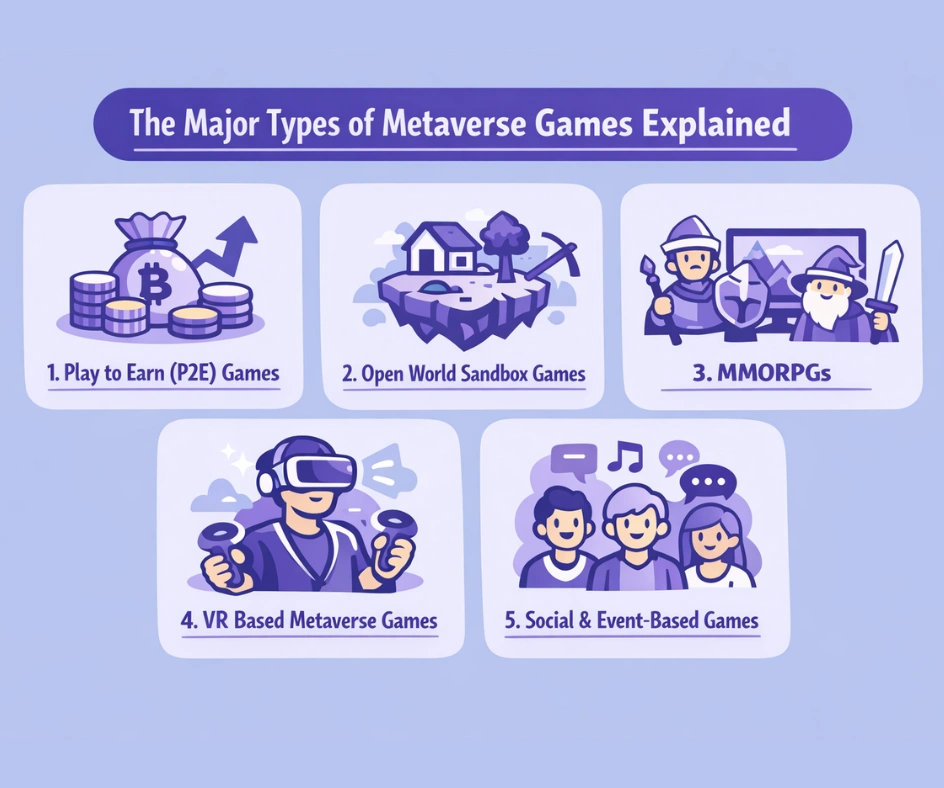
Now, let us get into the core of this blog. There are several metaverse game categories, and each one appeals to a different kind of player. Some people want to build, some want to fight, some want to earn, and some just want to explore. Here is a breakdown of every major type of game you will find in the metaverse.
1. Play to Earn (P2E) Games
Play-to-earn games are one of the biggest reasons why metaverse games became so popular. The idea is simple: you play the game, complete tasks, win battles, or trade items, and you earn cryptocurrency or NFTs that have real-world value. This was a completely new concept when it first came out, because in traditional games, only the company makes money. In P2E metaverse games, the players themselves can earn.
The most well-known example is Axie Infinity. In this game, players collect, breed, and battle digital creatures called Axies. Each Axie is an NFT, meaning players truly own them. The game uses two tokens: AXS for marketplace transactions and SLP (Smooth Love Potion), which players earn during gameplay. At its peak, Axie Infinity had millions of active users, and many players in countries like the Philippines were earning full-time incomes just by playing the game.
Other popular P2E games in the metaverse include Alien Worlds, where players mine for Trilium tokens across six alien planets, and MOBOX, which combines gaming with DeFi (decentralized finance). These games also often include features like staking, where players lock up their tokens to earn passive rewards. Play-to-earn games, sometimes called GameFi (a blend of “Game” and “Finance”), represent one of the most exciting types of metaverse games for people who want to earn while they play.
Recommended Reading:
2. Open World Sandbox Games
Sandbox games are all about creativity and freedom. In these metaverse games, there is no fixed storyline or set of missions you have to complete. Instead, you get a virtual world with tools, and you build whatever you want. Think of it like a digital version of playing with building blocks, except your creations can be shared with millions of people, and you can even sell them for real money.
The Sandbox is the most famous example of this category. Originally launched in 2012 as a simple mobile game, it has transformed into a full blockchain-powered platform where users can create 3D objects using VoxEdit, sell them in a marketplace, and build entire virtual worlds. Players use the SAND token for all transactions, from buying virtual land to trading digital items. The platform has partnered with major brands and celebrities, creating a massive user-generated ecosystem.
Decentraland is another major sandbox platform. Here, players can purchase virtual land (measured in 16 square meter parcels), build anything from art galleries to casinos, and host events like concerts and exhibitions. The platform runs on its own cryptocurrency called MANA. One plot of land in Decentraland was famously sold for $2.43 million, showing just how valuable virtual real estate can become. Sandbox metaverse games are perfect for creative people who want to build, own, and profit from their digital creations.
3. Massively Multiplayer Online Role Playing Games (MMORPGs)
MMORPGs have always been popular in gaming, from World of Warcraft to Final Fantasy. But when you add metaverse elements to them, they become something completely different. In metaverse MMORPGs, players get the same deep storytelling and adventure, but with blockchain-powered ownership of items, NFT-based characters, and real economies where in-game assets have real value.
Illuvium is a perfect example. Built using Unreal Engine 5, it is an open-world RPG where players explore alien landscapes, capture creatures called Illuvials, and use them in PvP (player versus player) battles. Every Illuvial is an NFT, and rare ones can be worth a lot. The game officially launched in July 2024 and has been expanding with new game modes and features. Its native token is ILV, which players earn through tournaments and quests.
Star Atlas takes the MMORPG concept even further by setting it in space. Players build crews, manage ships, form alliances, and engage in combat across a massive universe. The game uses two tokens: ATLAS for in-game transactions and POLIS for governance decisions. All ships, crew members, and equipment exist as NFTs that can be traded on the open market. These kinds of metaverse gaming experiences offer hours of deep gameplay combined with the ability to earn and own digital assets.
4. Virtual Reality (VR) Based Metaverse Games
Virtual reality takes metaverse gaming to the next level by putting players physically inside the virtual world. Instead of looking at a screen, you wear a headset and become part of the game. You can look around, walk, interact with objects, and talk to other players as if they were standing right next to you.
Meta’s Horizon Worlds is one of the most well-known VR-based metaverse gaming platforms. It allows players to create virtual spaces, play games, and hang out with friends, all in an immersive VR environment. Meta’s Quest line of headsets captured 73% of all headset shipments in 2024, making it the most popular way for people to access VR-based metaverse games.
Somnium Space goes a step beyond by combining VR with blockchain technology. Players can buy virtual land, build on it, and trade assets, all while being fully immersed in a VR world. The platform allows users to monetize their creations and even earn income through asset trading. Revomon is another VR metaverse game that takes inspiration from Pokémon but adds blockchain and DeFi features, letting players hunt, collect, and battle monsters in full virtual reality. As VR hardware becomes more affordable and powerful, this category of games in the metaverse is expected to grow rapidly.
5. Social and Event-Based Metaverse Games
Not every metaverse game is about fighting enemies or earning tokens. A huge portion of metaverse gaming is about social interaction. Social metaverse games are platforms where people go to meet friends, attend events, watch concerts, and just hang out in a virtual world. These are the games where the metaverse concept truly comes alive because they mimic real-life social experiences in a digital space.
Fortnite is the biggest example of how a traditional game can evolve into a social metaverse platform. While Fortnite started as a battle royale shooter, it has become a hub for massive virtual events. Travis Scott’s virtual concert in Fortnite attracted 45.8 million peak viewers. Ariana Grande’s Rift Tour drew 27.7 million unique visitors. Marshmello’s concert in 2019, the first-ever in-game concert in Fortnite, was attended by 10.7 million players. These events have turned Fortnite into much more than a game. It is now a cultural platform.
Roblox is another major social metaverse gaming platform. With around 380 million monthly active users and over 40 million games and experiences, Roblox is essentially a metaverse in itself. Players can play games, create content, attend virtual events, and socialize. Lil Nas X held a concert in Roblox that attracted 33 million viewers. The platform also hosted performances by Twenty One Pilots, Charli XCX, and others, further proving that social and event-based metaverse games have become a major entertainment category.
Popular Metaverse Games by Category
| Game Category | Top Examples | Key Features |
|---|---|---|
| Play to Earn (P2E) | Axie Infinity, Alien Worlds, MOBOX | Earn crypto tokens and NFTs through gameplay, battles, and trading |
| Open World Sandbox | The Sandbox, Decentraland, NFT Worlds | Build, create, own virtual land, sell digital assets as NFTs |
| MMORPG | Illuvium, Star Atlas, Ember Sword | Deep storytelling, creature collection, PvP battles, NFT-based items |
| VR-Based Games | Horizon Worlds, Somnium Space, Revomon | Full immersion through VR headsets, 3D world exploration, and social VR |
| Social and Event Based | Fortnite, Roblox, VRChat | Virtual concerts, social hangouts, user-created content, brand events |
| Simulation and Strategy | My Neighbor Alice, Gala Games, Solera X | Resource management, virtual farming, business simulation, energy exploration |
| Sports and Racing | Sorare, Wilder World, Zed Run | Fantasy sports, digital collectible cards, virtual horse racing, and car customization |
More Types of Metaverse Games Worth Knowing
Beyond the five major categories we discussed above, there are several more types of metaverse games that are gaining popularity. Let us go through them one by one.
6. Simulation and Strategy Games
Simulation games in the metaverse are designed for players who enjoy planning, managing resources, and building things step by step. These are not fast-paced action games. Instead, they require thinking, patience, and smart decision-making. The development of these games follows careful planning to create believable economic systems inside virtual worlds.
My Neighbor Alice is a great example. It is a multiplayer builder game where players can buy virtual islands, grow crops, build structures, and interact with other players. The ecosystem is powered by the ALICE token, which is used for everything from buying land to trading NFTs. The game is designed to be family-friendly and easy to pick up, making it one of the more accessible metaverse games on the market.
Gala Games operates as a full studio that is developing blockchain-based games across multiple genres. Their Town Star game is a competitive farming simulation where players build and manage a virtual town. The better your town does, the more rewards you earn. Gala Games has over one million active users and has sold more than 25,000 NFTs across its games. The development of strategy games like these shows how metaverse gaming is expanding well beyond just action and adventure titles.
7. Sports and Racing Metaverse Games
Sports games in the metaverse bring the excitement of real-world sports into digital environments. These games combine the thrill of competition with the economic benefits of blockchain, where in-game items, teams, and even individual athletes are represented as tradeable NFTs.
Sorare is one of the most popular sports-based metaverse games. It is a fantasy football (soccer) game where players collect digital cards of real-world athletes. These cards are NFTs, and their value changes based on how well the real player performs. You can build squads, compete in tournaments, and win rare cards. The game brings together the world of traditional sports fandom and blockchain in a very engaging way.
Wilder World offers a different take. It is an immersive 3D metaverse where racing is a core activity. Players can customize cars and race through virtual landscapes. The development of these games focuses on creating visually stunning experiences that feel like a mix between a racing game and a virtual world. Zed Run, another metaverse game in this category, lets players breed, race, and trade virtual horses. Each horse is an NFT with unique DNA, and players can earn by winning races or breeding champion horses.
Recommended Reading:
8. User-Generated Content Platforms
Some metaverse gaming platforms put all the power in the hands of the players. Instead of the company making the games, the players themselves build the experiences. These are user-generated content (UGC) platforms, and they have become some of the biggest names in metaverse gaming.
Roblox is the king of this category. It is not just one game but a platform that hosts over 40 million games and experiences, all created by its users. Anyone can learn to build games on Roblox, and if their game becomes popular, they can earn real money. In the first half of 2024, Roblox paid out $410.68 million to its developers and creators. The development of Roblox as a platform demonstrates how user-generated content can power an entire metaverse ecosystem.
The Sandbox also falls into this category, as it provides tools like VoxEdit and Game Maker that let anyone create 3D assets and game experiences without needing to know coding. Players who create popular experiences can monetize them using the SAND token. Core (formerly known as Manticore Games) is another UGC platform that allows people to create and publish games using simple drag-and-drop tools. These platforms show that the future of metaverse games is not just about playing, but about creating.
How Blockchain Technology Powers Metaverse Games
You cannot talk about metaverse games without talking about blockchain. Blockchain is the technology that makes true digital ownership possible. In traditional games, the game company owns everything. In blockchain-based metaverse games, the players own their items because those items are recorded on a public, unchangeable digital ledger.
Here is how it works in simple terms. When you earn a sword, a piece of land, or a character in a blockchain metaverse game, that item gets minted as an NFT. This NFT is stored on the blockchain, and it has your digital wallet address on it. That means you, and only you, own that item. You can sell it, trade it, or even take it to a different game if both games support the same blockchain. The development of these systems requires smart contracts, which are self-executing programs on the blockchain that handle transfers, payments, and ownership changes automatically.
Most metaverse gaming platforms use Ethereum as their primary blockchain, though many are also built on Solana, Polygon, and Binance Smart Chain because of their lower transaction fees and faster processing times. Over 62% of game developers in this space now use blockchain and AR/VR technologies in their development process, which shows just how central blockchain has become to modern metaverse gaming.
The Role of Virtual Economies in Metaverse Games
Every great metaverse game needs a strong economy. Virtual economies are what make games in the metaverse feel real and alive. Players can earn tokens through gameplay, buy and sell items on marketplaces, invest in virtual land, and even earn passive income by renting out their digital properties.
In Decentraland, for example, the entire economy runs on MANA tokens. Players spend MANA to buy land, pay for goods and services, and participate in governance votes. Landowners can earn money by hosting events, renting out space, or building businesses on their virtual property. In The Sandbox, the economy runs on SAND tokens, and creators can earn by selling the assets they build using the platform’s tools.
What makes these economies special is that they are decentralized. There is no single company setting prices or controlling the supply. Instead, the value of items is determined by players through supply and demand, just like in the real world. This is a fundamental shift from traditional gaming, where the economy is fully controlled by the development company. The growth of virtual economies is one of the biggest reasons why metaverse games are attracting not just gamers, but also investors and entrepreneurs.
Metaverse Gaming Market: Regional Breakdown
| Region | Market Share / Highlights | Key Growth Drivers |
|---|---|---|
| North America | 43% market share in 2024, US projected at $11.1B in 2025 | Strong tech infrastructure, early VR/AR adoption, major company investments |
| Asia Pacific | Fastest growing region, China has 300M+ active metaverse gamers | High smartphone use, 5G rollout, young population, mobile-first gaming culture |
| Europe | 28% market share driven by NFT integration | NFT adoption, strong gaming culture, and growing VR headset sales |
| Latin America | Rising engagement with Brazil and Mexico is leading | Increasing internet access, P2E game popularity, and regional game development |
| Middle East and Africa | 5% share with steady expansion | Government digital transformation investments, esports events, and improving infrastructure |
Key Technologies Behind Metaverse Gaming Platforms
The different types of metaverse games we discussed above are made possible by several core technologies working together. Let us look at each one.
1. Virtual Reality (VR) and Augmented Reality (AR)
VR and AR are the technologies that make metaverse gaming feel immersive. VR puts players inside a completely digital world through headsets like Meta Quest, PlayStation VR, and Apple Vision Pro. AR overlays digital elements onto the real world, like what Pokémon Go does. VR headset penetration increased by 42% in the past year, and Apple’s Vision Pro generated USD 1.75 billion from 500,000 units. The development of more affordable and comfortable headsets will continue to drive the growth of VR-based metaverse games.
2. Blockchain and Smart Contracts
Blockchain provides the foundation for ownership, trading, and economic activity in games in the metaverse. Smart contracts automate processes like transferring ownership of digital land, distributing rewards, and managing NFT sales. Platforms like Ethereum, Solana, and Polygon are the most commonly used blockchains for metaverse game development. The development of smart contracts ensures that all transactions are transparent and cannot be tampered with.
3. Artificial Intelligence (AI)
AI is becoming a major part of metaverse gaming. In 2024, approximately 42% of leading metaverse games adopted AI algorithms to adapt storylines in real time. AI helps create smarter non-player characters (NPCs), personalize gameplay experiences, and generate dynamic content that keeps players engaged. Some games use AI to create entire virtual environments that change based on player behavior, making every playthrough unique.
4. Cloud Gaming and 5G
Cloud gaming allows players to access metaverse games without needing expensive hardware. Instead of running the game on your device, it runs on powerful servers in the cloud and streams to your screen. Combined with 5G networks that offer faster speeds and lower delays, cloud gaming is making the metaverse accessible to anyone with an internet connection. The development of cloud infrastructure is especially important for mobile-first markets in Asia and Latin America.
5. Cross-Platform Compatibility
Over 68% of active metaverse gamers in 2025 play across multiple devices, including consoles, PCs, and mobile phones. Cross-platform play means that a player on their phone can interact with someone using a VR headset or a gaming PC, all in the same virtual world. This feature is essential for the growth of metaverse gaming platforms because it removes barriers and lets more people join the experience.
Recommended Reading:
The Future of Metaverse Development with AR, VR and Blockchain
How to Choose the Right Metaverse Game for You
With so many metaverse game categories to choose from, it can be hard to decide where to start. Here are some things to think about.
If you want to earn money while playing, play-to-earn games like Axie Infinity or Alien Worlds are the way to go. If you are a creative person who loves building things, sandbox games like The Sandbox or Decentraland will give you the freedom to express yourself. If you want deep storytelling and adventure, MMORPGs like Illuvium or Star Atlas will keep you engaged for hours. If you want full immersion, VR games like Somnium Space are your best bet. And if you just want to hang out with friends and attend cool events, platforms like Fortnite and Roblox offer the best social metaverse gaming experiences.
For most blockchain-based metaverse games, you will need a crypto wallet like MetaMask to store your tokens and NFTs. Some games are free to start, while others require an initial investment to buy characters or land. Always do your research before putting money into any game, and make sure you understand how the game’s economy works.
The Future of Metaverse Games
The metaverse gaming industry is still in its early stages, but the potential is enormous. Here is what we can expect in the coming years.
First, the line between different types of metaverse games will start to blur. We will see games that combine elements of P2E, sandbox building, MMORPG adventure, and social interaction all in one platform. Instead of choosing between different game types, players will be able to do everything in a single virtual world.
Second, interoperability between different metaverse gaming platforms will improve. Right now, if you buy an item in The Sandbox, you cannot use it in Decentraland. But as blockchain technology evolves and cross-chain bridges become more common, players will be able to move their assets freely between different metaverse games.
Third, AI will play a much bigger role. We will see AI-generated NPCs that can hold real conversations, AI-created worlds that adapt in real time, and AI-powered game masters that create personalized quests for each player. The development of AI in gaming is advancing rapidly, and it will transform how we experience games in the metaverse.
Fourth, enterprise and brand involvement will increase. Companies like Nike, Gucci, and Samsung are already creating virtual experiences in metaverse platforms. In the future, shopping, learning, working, and even attending doctor appointments could all happen inside metaverse gaming platforms. The metaverse is becoming much more than just games.
Blockchain Gaming and Metaverse Implementations in the Real World
The following projects show how blockchain technology and metaverse concepts are already being applied in real-world gaming, NFT ecosystems, and decentralized platforms. Each implementation reflects the same principles discussed throughout this article, from blockchain-powered asset ownership and token economies to immersive virtual world development and community-driven ecosystems.
🎮
Phantasma: Blockchain Gaming Ecosystem
Built a complete blockchain platform with an NFT Gaming Hub, DApps, wallets, and token swaps. The platform includes tools for creating, managing, and trading NFTs within gaming environments, letting gamers own, trade, and use digital assets across multiple games with a full decentralized ecosystem supporting developers and players alike.
⛏️
Athene Network: Decentralized Mining Platform
Created a decentralized mining platform where users participate in crypto mining with a community-driven approach. The platform uses Proof of Stake consensus and token holder governance, enabling participants to mine tokens, stake rewards, and shape platform direction, reflecting the same play-to-earn and governance models seen in top metaverse games.
Build Your Metaverse Game with Expert Blockchain Development:
Our specialized team at Nadcab Labs handles everything from smart contract creation and NFT integration to full metaverse world development. Whether you want to launch a play-to-earn game, a sandbox platform, or a VR-based virtual world, we deliver blockchain-powered solutions that bring your vision to life.
Conclusion
The world of metaverse games is vast, exciting, and full of opportunity. From play-to-earn games that let you earn real money to sandbox worlds where you can build anything you imagine, from deep MMORPGs with rich stories to VR experiences that transport you to entirely new realities, the types of metaverse games available today offer something for everyone. The market is growing at an incredible rate, with the global metaverse in gaming market expected to grow from USD 24.79 billion in 2024 to USD 648.24 billion by 2034.
What makes metaverse gaming truly special is that it puts the power in the hands of the players. Through blockchain technology, players can own their in-game items, earn from their skills and creativity, and participate in virtual economies that mirror real-world markets. Whether you are a casual gamer, a creative builder, a competitive player, or an entrepreneur looking for new opportunities, games in the metaverse offer a world of possibilities that did not exist even a few years ago.
The metaverse gaming platforms we see today are just the beginning. As VR headsets become more affordable, blockchain networks become faster, and AI makes games smarter, the line between the virtual world and the real world will continue to fade. The different metaverse game categories will merge, evolve, and create entirely new experiences that we cannot even imagine yet. One thing is certain: the metaverse is here to stay, and the games being built inside it are going to shape the future of entertainment, work, and social interaction for decades to come.
Frequently Asked Questions
Metaverse games are video games that exist inside shared, persistent virtual worlds where players can explore, build, socialize, trade, and earn using technologies like VR, AR, blockchain, and NFTs. Unlike traditional games, metaverse games keep running even when you are not playing.
There are several major types of metaverse games, including play-to-earn games, open-world sandbox games, MMORPGs, VR-based games, social and event-based games, simulation and strategy games, sports and racing games, and user-generated content platforms.
Yes, many metaverse games use a play-to-earn model where players earn cryptocurrency tokens and NFTs that can be sold or traded for real money. Games like Axie Infinity and Alien Worlds are well known for letting players earn income through gameplay.
Roblox is one of the most popular metaverse gaming platforms, with around 380 million monthly active users and over 40 million games. Fortnite, The Sandbox, and Decentraland are also among the most widely used platforms for metaverse gaming.
No, most metaverse games can be played on a regular computer, gaming console, or mobile phone. VR headsets are only needed for VR-specific metaverse games like Horizon Worlds, Somnium Space, or Revomon. Many games offer cross-platform play across multiple devices.
Blockchain records ownership of in-game items as NFTs on a public digital ledger. This means players truly own their virtual assets and can buy, sell, or trade them freely. Smart contracts automate transactions like NFT transfers and reward distributions without needing any middleman.
Reviewed & Edited By

Aman Vaths
Founder of Nadcab Labs
Aman Vaths is the Founder & CTO of Nadcab Labs, a global digital engineering company delivering enterprise-grade solutions across AI, Web3, Blockchain, Big Data, Cloud, Cybersecurity, and Modern Application Development. With deep technical leadership and product innovation experience, Aman has positioned Nadcab Labs as one of the most advanced engineering companies driving the next era of intelligent, secure, and scalable software systems. Under his leadership, Nadcab Labs has built 2,000+ global projects across sectors including fintech, banking, healthcare, real estate, logistics, gaming, manufacturing, and next-generation DePIN networks. Aman’s strength lies in architecting high-performance systems, end-to-end platform engineering, and designing enterprise solutions that operate at global scale.