Every cryptocurrency has a set of rules that decide how it works, how it gains value, and why people want to hold it. These rules are called tokenomics. When you invest in any digital asset, you are not just buying a token. You are entering an economic system that has its own supply limits, reward structures, and distribution methods. Understanding tokenomics helps you see which projects have a solid foundation and which ones might struggle over time.
Tokenomics combines the words “token” and “economics.” It covers everything from how many tokens exist to how they are distributed, burned, or staked. A well-designed tokenomics model can attract investors, encourage long-term holding, and support a healthy crypto token ecosystem. On the other hand, poor tokenomics can lead to inflation, sell pressure, and a loss of trust. This guide explains tokenomics in simple terms, covering its key components, why it matters, and how to evaluate any token before investing.
Key Takeaways
- Token Economics Defined: Tokenomics refers to the economic model governing a cryptocurrency, including supply, distribution, utility, and incentive mechanisms.
- Supply Matters: Circulating supply, total supply, and max supply directly affect a token’s scarcity and long-term value potential.
- Distribution Impact: How tokens are allocated to teams, investors, and the community influences price stability and investor confidence.
- Utility Drives Demand: Tokens with real use cases like staking, governance, or transaction fees tend to hold value better than purely speculative assets.
- Burn Mechanisms: Token burning permanently removes tokens from circulation, creating scarcity and potentially increasing value over time.
- Vesting Schedules: Token unlock schedules prevent large sell-offs and align team incentives with long-term project success.
- Incentive Structures: Staking rewards, liquidity mining, and governance participation encourage users to hold and engage with the network.
- Risk Assessment: Analyzing tokenomics helps investors identify projects with sustainable models versus those designed for short-term speculation.
- Good vs Bad Tokenomics: Strong tokenomics balances scarcity with utility, while weak tokenomics often leads to inflation and declining prices.
Tokenomics Explained: The Foundation of Every Crypto Project
Tokenomics is the study and design of economic systems surrounding cryptocurrencies and blockchain projects. The development of good tokenomics includes everything from how tokens are created and distributed to how they are used and removed from circulation. Just as traditional economics examines how resources are produced and consumed, crypto tokenomics explores how digital tokens function within their ecosystems.
When a blockchain project launches, its founders publish a whitepaper that outlines the token’s purpose, supply details, and economic rules. This document serves as a blueprint for how the token will operate. Investors who understand tokenomics can use this information to evaluate whether a project has long-term potential or if it is designed primarily for short-term gains.
Blockchain tokenomics differs from traditional economics in one important way. The rules are written into smart contracts and cannot be easily changed. Once a token’s supply cap or burn mechanism is set in the code, it operates automatically. This creates transparency and predictability that traditional financial systems often lack.
Token Supply: Understanding Scarcity and Value
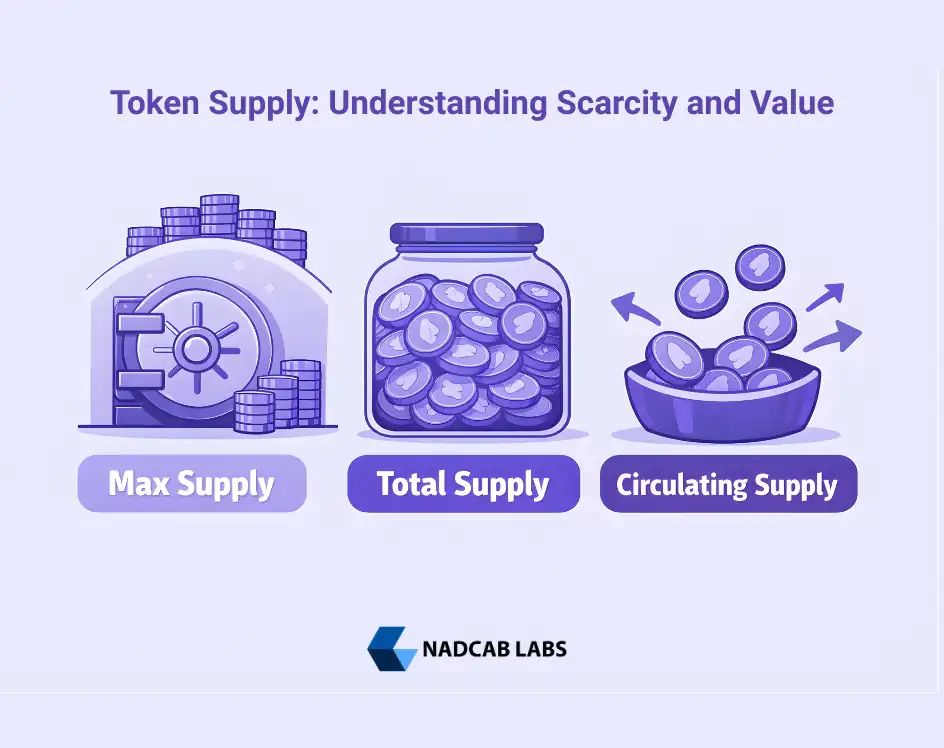
Token supply is one of the most important factors in cryptocurrency tokenomics. The development of proper supply mechanics determines how scarce or abundant a token is, which directly affects its price potential. There are three main types of token supply that every investor should understand.
Max Supply
Max supply refers to the maximum number of tokens that can ever exist. This limit is usually set at the project launch and cannot be changed. Bitcoin, for example, has a max supply of 21 million coins. This hard cap creates scarcity, which is one reason why Bitcoin is often compared to digital gold. Not all tokens have a max supply. Some projects intentionally leave this open to allow for future flexibility.
Total Supply
Total supply is the number of tokens that have been created minus any tokens that have been burned or permanently removed. This number includes tokens that are locked, vested, or held in reserves. It represents all tokens that currently exist, whether or not they are available for trading.
Circulating Supply
Circulating supply is the number of tokens that are currently available in the market. This is the most relevant number for determining a token’s market capitalization. If a large portion of the total supply is locked or held by the team, the circulating supply will be much lower. This can create what traders call a “token supply overhang,” where future unlocks could increase selling pressure.
The relationship between these three numbers matters. A token with a low circulating supply relative to its total supply could face significant sell pressure when locked tokens are released. Understanding this dynamic is essential for evaluating tokenomics.
Token Distribution: Who Owns What and Why It Matters
Token distribution refers to how a project allocates its tokens among different groups. The development of fair distribution models includes allocations for founders, early investors, the community, and reserve funds. The way tokens are distributed can significantly impact a project’s stability and investor confidence.
Token Allocation Models
Most crypto projects divide their token supply into several categories. Team and founder allocations typically range from 10% to 25% of the total supply. Early investors who participated in private sales or seed rounds often receive another 10% to 20%. Community allocations, including airdrops and rewards programs, may account for 30% to 50%. The remaining tokens usually go to treasury reserves, ecosystem development, or liquidity pools.
A project where a small group of wallets holds most of the tokens carries higher risk. If these holders decide to sell, it can cause significant price drops. A more distributed token allocation creates stability because no single group can easily manipulate the market.[2]
Token Vesting Schedules
Token vesting controls when allocated tokens become available. Most projects use vesting schedules for team and investor tokens to prevent immediate selling. A typical schedule includes a “cliff” period of 6 to 12 months, followed by gradual monthly unlocks over 2 to 4 years.
Token unlocks are events that traders watch closely. Large unlocks can create selling pressure, especially if the tokens go to early investors who bought at much lower prices. Tracking these events helps investors anticipate potential price movements.
Fair Launch vs Pre-Sale Launch
Some projects use a fair launch model where no private sales occur before the public release. Other projects use pre-sale or ICO models where early investors get tokens at discounted prices. Fair launches promote equality but may limit initial funding. Pre-sales raise more capital but can create sell pressure when early investors take profits.
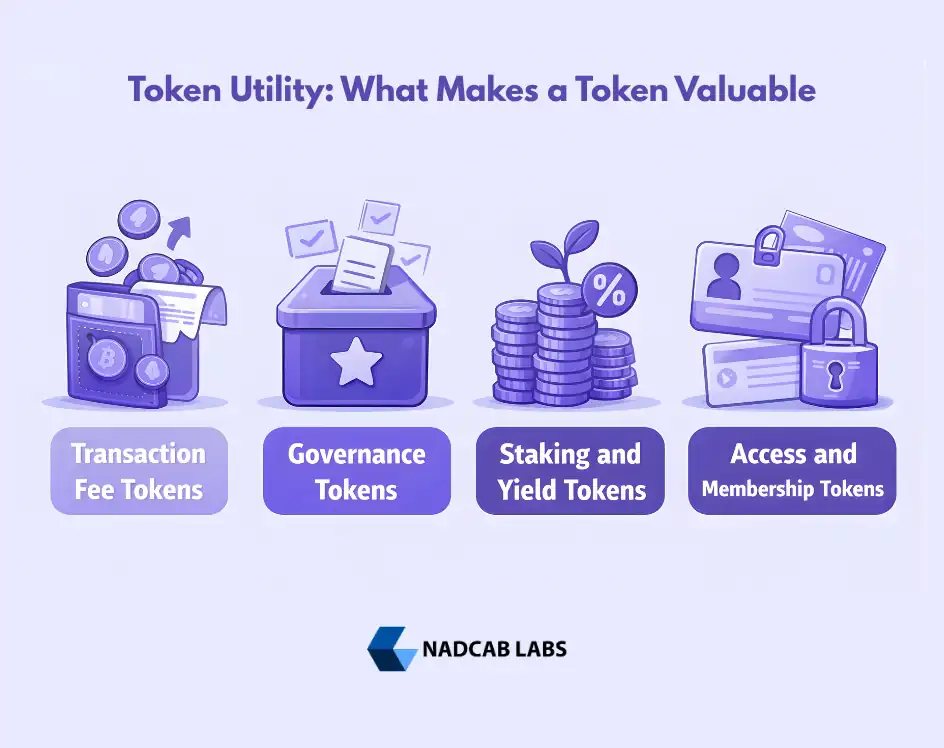
Token Utility: What Makes a Token Valuable
Token utility refers to the practical uses a token provides within its ecosystem. A token with strong utility is more likely to maintain its value because people need it. Tokens with weak or no utility rely purely on speculation, which makes them riskier.
Transaction Fee Tokens
Many blockchain networks require their native token to pay for transaction fees. Ethereum uses ETH for gas fees, Solana uses SOL, and Polygon uses MATIC. This creates constant demand because anyone using these networks needs the token. The development of applications on these blockchains further increases utility as more transactions require more tokens.
Governance Tokens
Governance tokens give holders the right to vote on protocol decisions. This includes changes to fee structures, treasury allocations, and protocol upgrades. The development of decentralized governance through projects like Uniswap (UNI), Aave (AAVE), and Compound (COMP) has transformed how blockchain protocols make decisions. Holders who stake their governance tokens often receive voting power proportional to their holdings. Some protocols also implement features like soulbound tokens for identity verification in governance processes.
Staking and Yield Tokens
Many tokens offer staking rewards to incentivize holding. When users stake their tokens, they lock them up to help secure the network or provide liquidity. In return, they earn additional tokens as rewards. This creates a strong incentive to hold rather than sell. The development of liquid staking has made this even more attractive, as users can stake tokens while still maintaining access to their capital through derivative tokens like stETH or rETH.
Access and Membership Tokens
Some tokens provide access to exclusive features, communities, or services. This might include premium content, early access to new products, or special discounts. Projects that build strong communities around their tokens often see sustained demand.
Token Incentive Mechanisms: Encouraging the Right Behavior
Token incentive mechanisms are rules that encourage users to act in ways that benefit the network. The development of well-designed incentives attracts users, secures the network, and creates sustainable growth. Poorly designed incentives can lead to exploitation or user abandonment.
Staking Rewards
Proof-of-Stake networks reward users who stake their tokens to validate transactions. These staking rewards compensate users for locking up capital and helping secure the network. Annual yields vary from 3% to 15% for major networks. Restaking through platforms like EigenLayer has created additional earning opportunities by allowing staked assets to secure multiple protocols.[3]
Liquidity Mining
Liquidity mining programs reward users who provide liquidity to decentralized exchanges. Users deposit tokens into liquidity pools and receive rewards in the form of platform tokens or a share of trading fees. This practice, often called yield farming, can offer high returns but also carries risks like impermanent loss.
Token Buybacks and Burns
Buyback and burn mechanisms have become common in crypto tokenomics. Projects use revenue to buy tokens from the market and permanently remove them. This reduces supply and can support prices. Major protocols have spent significant amounts on buybacks recently, with Hyperliquid allocating over $700 million and Raydium burning over $100 million worth of tokens.[4]
Token burning can also happen automatically. Ethereum’s EIP-1559 burns a portion of every transaction fee, making ETH potentially deflationary during high network activity.
How to Evaluate Tokenomics: A Practical Framework
Understanding how tokenomics works is only the first step. Knowing how to analyze crypto tokenomics helps you make better investment decisions. Here is a practical framework for evaluating any token.
Check the Supply Metrics
Start by examining the token’s supply structure. What is the max supply? How much is in circulation? What percentage is locked? Calculate the ratio of circulating to total supply. A token where only 20% is circulating could face significant dilution as the remaining 80% enters the market.
Analyze the Distribution
Look at how tokens are allocated. What percentage goes to the team, investors, and community? Use blockchain explorers to check concentration of holdings. Projects where the top 10 wallets hold over 50% of supply carry higher centralization risks.
Understand the Unlock Schedule
Find out when locked tokens will be released. Calculate how much new supply will enter circulation over the next 6 to 12 months and compare to current supply. Projects planning to list your token should have clear vesting schedules published.
Evaluate Token Utility
Ask yourself: what can this token actually do? Is it required for transactions? Does it provide governance rights? Can it be staked for rewards? Tokens with multiple use cases tend to have stronger demand. Tokens that only serve as speculative vehicles carry higher risk.
Assess the Tokenomics Model
Determine whether the token is inflationary or deflationary. Inflationary tokens add new supply through mining or staking. Deflationary tokens reduce supply through burns. Neither model is inherently better, but a token with 20% annual inflation needs significant demand growth just to maintain price.
Look for Red Flags
Be cautious of projects where team allocations exceed 25%, vesting schedules are absent, token supply is unlimited without any burn mechanism, or a large portion of tokens is concentrated in a few wallets, these conditions can significantly increase the risk of manipulation. When evaluating a token development solution, make sure the provider emphasizes transparent and well-structured tokenomics design to ensure long-term stability and trust.
Build a Token with Strong Economic Foundations
Nadcab Labs helps blockchain projects design sustainable tokenomics models that balance utility, scarcity, and incentives for long-term success and community growth.
Good vs Bad Tokenomics: Real-World Examples
The best way to understand tokenomics is to compare projects with strong models to those with weak ones.
Examples of Strong Tokenomics
Bitcoin has a fixed supply of 21 million coins with a predictable emission schedule that halves every four years. This creates scarcity and predictability. Ethereum’s tokenomics evolved with EIP-1559, which burns a portion of transaction fees. During high network activity, more ETH is burned than created, making it deflationary. These crypto economic models have supported the development of both projects into leading digital assets.
Examples of Weak Tokenomics
Some meme coins launch with unlimited or extremely high supplies, offering no utility beyond speculation. While projects like Dogecoin have defied expectations due to community support, most tokens with poor tokenomics eventually fade. High inflation without utility, concentrated holdings, and no burn mechanisms typically lead to declining prices over time.
Why Tokenomics Matters for Your Investment Decisions
Tokenomics affects everything from short-term price movements to long-term project viability. Understanding digital asset economics helps you avoid projects designed to benefit insiders at the expense of regular investors. It helps you identify tokens with sustainable models.
Before investing in any token, take the time to read the whitepaper and understand the tokenomics. Look beyond the marketing and examine the actual economic structure. This due diligence can help you make better decisions and avoid projects that are likely to fail.
Conclusion
Tokenomics is the backbone of every cryptocurrency project. It determines how tokens are created, distributed, used, and valued within a blockchain ecosystem. The development of strong tokenomics models separates sustainable projects from those built on speculation alone. By understanding token supply, distribution, utility, and incentive structures, investors can make informed decisions about which projects deserve their attention.
Whether you are evaluating a new DeFi protocol or launching your own token, focus on scarcity, utility, fair distribution, and sustainable incentives. Projects that balance these elements create lasting value for their communities. Take time to analyze these factors before investing, and you will navigate the crypto market with confidence.
Frequently Asked Questions
Tokenomics is the study of how a cryptocurrency’s economic model works. It covers token supply, distribution, utility, and incentives that determine a token’s value and how it functions within its blockchain ecosystem.
Limited supply creates scarcity, which can increase value if demand remains steady. High or unlimited supply often leads to inflation and declining prices unless strong utility or burn mechanisms offset the new tokens entering circulation.
Token burning permanently removes tokens from circulation by sending them to an unusable address. This reduces total supply, increases scarcity, and can support price appreciation if demand remains constant or grows.
Vesting schedules control when allocated tokens become available for trading. They prevent early investors and teams from selling immediately after launch, reducing sell pressure and aligning incentives with long-term success.
Staking rewards compensate users who lock up tokens to help secure the network. Users receive additional tokens as payment for validating transactions or providing liquidity, creating incentives for holding rather than selling.
Good tokenomics balances scarcity, utility, and fair distribution with sustainable incentives. Bad tokenomics features unlimited supply, concentrated holdings, no utility, or team allocations that create excessive sell pressure.
Author

Aman Vaths
Founder of Nadcab Labs
Aman Vaths is the Founder & CTO of Nadcab Labs, a global digital engineering company delivering enterprise-grade solutions across AI, Web3, Blockchain, Big Data, Cloud, Cybersecurity, and Modern Application Development. With deep technical leadership and product innovation experience, Aman has positioned Nadcab Labs as one of the most advanced engineering companies driving the next era of intelligent, secure, and scalable software systems. Under his leadership, Nadcab Labs has built 2,000+ global projects across sectors including fintech, banking, healthcare, real estate, logistics, gaming, manufacturing, and next-generation DePIN networks. Aman’s strength lies in architecting high-performance systems, end-to-end platform engineering, and designing enterprise solutions that operate at global scale.