
Key Takeaways
- Bitcoin Taproot is the most significant upgrade to the Bitcoin network since Segregated Witness (SegWit) in 2017, introducing Schnorr signatures, MAST, and Tapscript to enhance functionality.
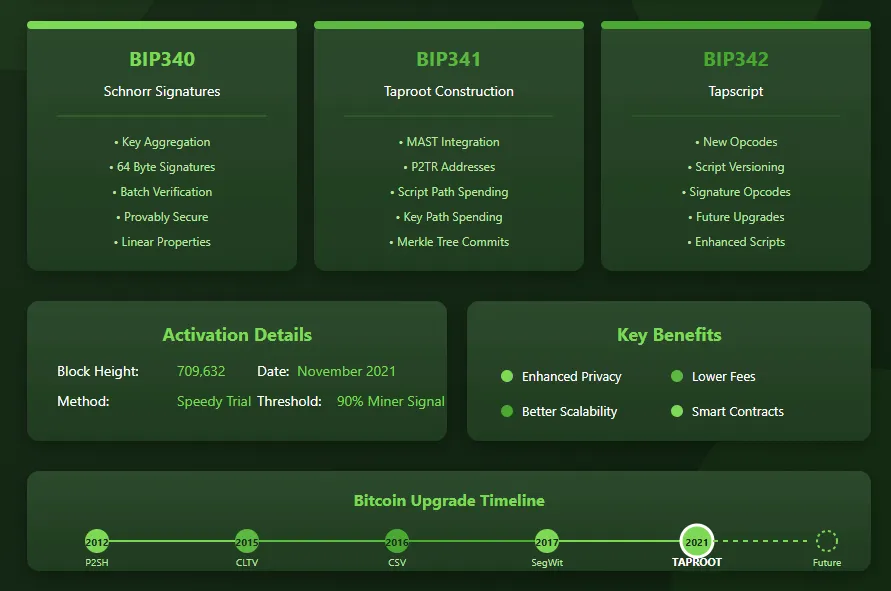
- The upgrade was activated at block 709,632 in November 2021 through the innovative Speedy Trial activation method after achieving 90% miner signaling support.
- Schnorr signatures enable key aggregation, allowing multiple participants in a transaction to combine their signatures into a single signature, significantly improving efficiency.
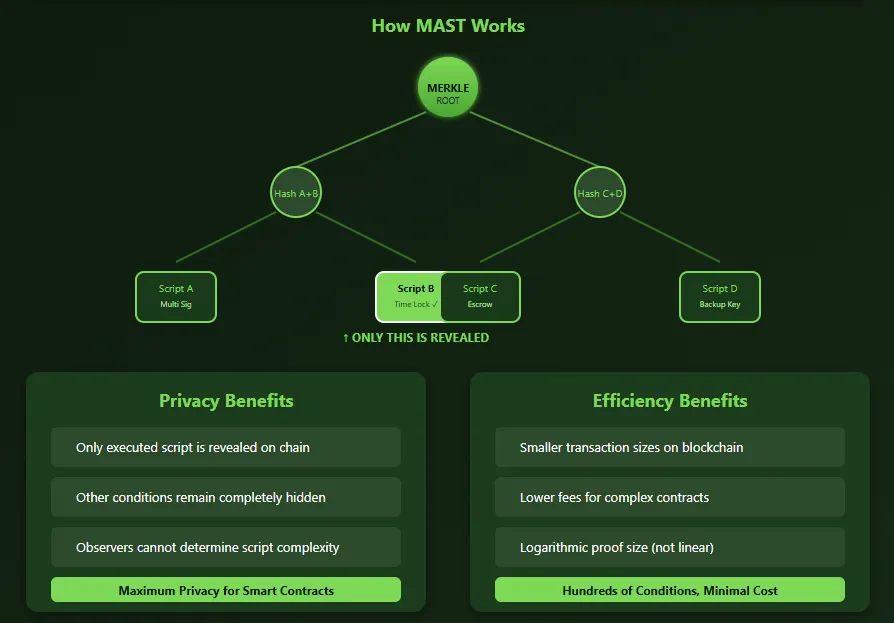
- MAST (Merkelized Abstract Syntax Trees) allows complex smart contracts to reveal only the executed conditions, dramatically enhancing transaction privacy.
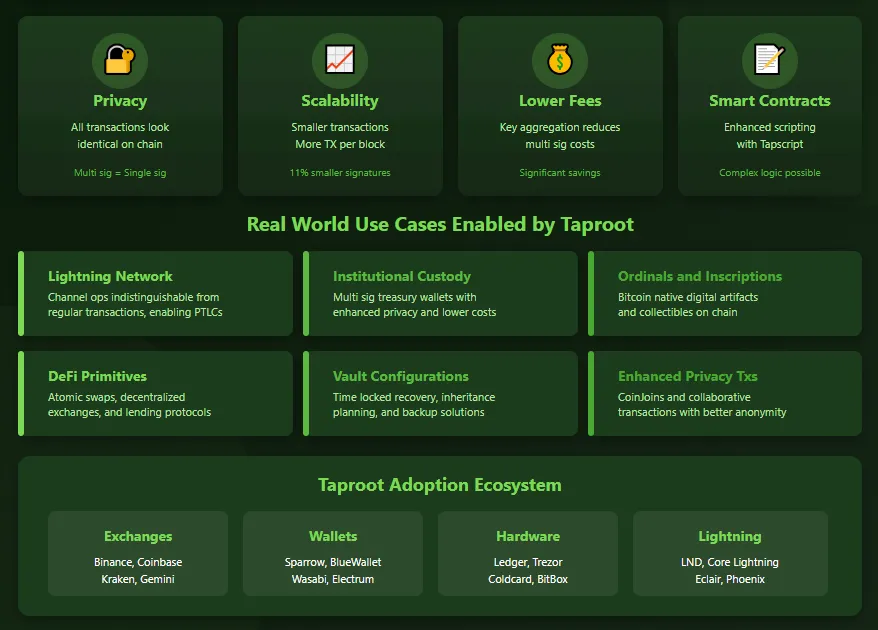
- Taproot makes all transactions appear identical on the blockchain, whether simple payments or complex multi signature contracts, providing unprecedented privacy benefits.
- The upgrade reduces transaction sizes and verification times, leading to lower fees and improved scalability for the Bitcoin network.
- Lightning Network operations benefit substantially from Taproot, enabling more efficient channel openings, closures, and routing with enhanced privacy.
- Taproot enables more sophisticated smart contract capabilities on Bitcoin while maintaining the network’s fundamental principles of security and decentralization.
- The upgrade introduces new address formats beginning with “bc1p” known as Pay to Taproot (P2TR) addresses, offering improved functionality over legacy formats.
- Taproot adoption continues to grow across wallets, exchanges, and services, with new innovations like Ordinals demonstrating its expanding capabilities.
1. Introduction to Bitcoin Taproot
Bitcoin Taproot stands as a watershed moment in the evolution of decentralized cryptocurrency technology. At its core, Taproot is a soft fork upgrade that bundles three distinct Bitcoin Improvement Proposals (BIPs) into a unified enhancement package: BIP340 introducing Schnorr signatures, BIP341 defining Taproot itself, and BIP342 establishing Tapscript for improved scripting capabilities. This trifecta of improvements works synergistically to address several longstanding limitations within the Bitcoin protocol while opening doors to functionalities that were previously impractical or impossible to implement efficiently.
The significance of Taproot extends beyond mere technical improvements. It represents a philosophical commitment to preserving user privacy while simultaneously expanding Bitcoin’s utility as a programmable monetary system. Unlike earlier upgrades that focused primarily on addressing immediate scalability concerns, Taproot takes a more holistic approach by improving privacy, efficiency, and flexibility concurrently. This multi faceted enhancement positions Bitcoin more competitively against alternative blockchain platforms that have traditionally offered more sophisticated smart contract capabilities.
2. What Is Taproot in Bitcoin?
Taproot is fundamentally a method of structuring Bitcoin transactions that leverages Schnorr signatures to make complex spending conditions indistinguishable from simple single signature transactions when viewed on the blockchain. The name “Taproot” derives from the concept of a taproot in botany, a primary root that grows vertically downward and from which smaller roots branch out. In the Bitcoin context, this metaphor represents how a transaction can have multiple potential spending paths (branches) while presenting only the single path that was actually used (the taproot) to the public ledger.
The technical implementation of Taproot centers on a clever cryptographic construction that combines a public key with a Merkle root of alternative spending scripts. When all parties agree and sign cooperatively, the transaction appears as a simple single signature payment. Only when cooperation fails and an alternative script path must be used does any complexity become visible, and even then, only the specific script being executed is revealed rather than all possible spending conditions. This elegant design maximizes privacy while maintaining Bitcoin’s security guarantees.
3. Why Bitcoin Needed the Taproot Upgrade
Prior to Taproot, Bitcoin faced several interconnected challenges that limited its potential as both a payment system and a platform for more sophisticated financial applications. The most pressing concerns centered on privacy vulnerabilities, scalability constraints, and smart contract limitations that made Bitcoin less competitive compared to newer blockchain platforms. Understanding these challenges provides essential context for appreciating Taproot’s transformative impact on the ecosystem.
Privacy Concerns in Pre Taproot Bitcoin
Before Taproot, different transaction types left distinct fingerprints on the blockchain. Multi signature wallets, time locked contracts, and other complex arrangements were easily identifiable through blockchain analysis, compromising user privacy and making certain transaction types targets for surveillance. This transparency, while initially considered a feature, increasingly became a liability as blockchain analysis tools grew more sophisticated.
Scalability and Efficiency Issues
Complex transactions required larger data footprints, consuming more block space and resulting in higher fees. The signature verification process for multi signature transactions was computationally intensive, and the existing ECDSA signature scheme did not support native signature aggregation. These inefficiencies created friction for users and limited the practical utility of Bitcoin’s more advanced features.
Smart Contract Limitations
Bitcoin’s scripting language, while intentionally limited for security purposes, lacked the flexibility needed for many modern decentralized applications. The requirement to reveal all possible spending conditions when creating a transaction made complex contracts impractical and privacy compromising. Taproot addresses these concerns by enabling more sophisticated contracts while maintaining Bitcoin’s security focused design philosophy.
4. Brief History of Bitcoin Soft Fork Upgrades
Bitcoin’s development history is marked by carefully considered upgrades that have progressively enhanced the network’s capabilities while preserving backward compatibility. Understanding this evolutionary timeline contextualizes Taproot within Bitcoin’s broader technical trajectory and highlights the deliberate, security focused approach that characterizes Bitcoin development.
Major Bitcoin Soft Fork Timeline
| Upgrade | Year | Primary Enhancement | Impact |
|---|---|---|---|
| P2SH (BIP16) | 2012 | Pay to Script Hash | Enabled complex scripts with simpler addresses |
| OP_CLTV (BIP65) | 2015 | Check Lock Time Verify | Time-locked transactions |
| OP_CSV (BIP68/112/113) | 2016 | Check Sequence Verify | Relative time locks |
| SegWit (BIP141) | 2017 | Segregated Witness | Increased capacity, fixed malleability |
| Taproot (BIP340/341/342) | 2021 | Schnorr, MAST, Tapscript | Privacy, efficiency, smart contracts |
Each upgrade built upon previous improvements, creating a foundation for increasingly sophisticated capabilities. The four year gap between SegWit and Taproot reflects the careful deliberation that characterizes Bitcoin development, ensuring thorough review and broad consensus before implementation. This methodical approach, while sometimes frustrating for those eager for rapid innovation, has proven essential for maintaining Bitcoin’s reliability and security.
5. How Taproot Was Activated (Speedy Trial Explained)
The activation of Taproot introduced an innovative mechanism called “Speedy Trial” that represented a significant evolution in how Bitcoin upgrades achieve consensus. This method emerged from lessons learned during the contentious SegWit activation period and aimed to provide a faster, less divisive path to implementing widely supported improvements while still respecting the decentralized nature of Bitcoin governance.
The Speedy Trial Mechanism
Speedy Trial operates by giving miners a defined signaling period during which they can indicate support for the upgrade by including a specific signal in the blocks they produce. For Taproot, this period began in May 2021 and consisted of multiple difficulty adjustment periods. If 90% of blocks within any single period included the Taproot signal, the upgrade would lock in and activate after a predetermined delay, allowing all network participants time to prepare.
The mechanism proved remarkably successful for Taproot. Mining pools quickly coordinated their signaling, and the required 90% threshold was achieved in June 2021, representing one of the smoothest major upgrades in Bitcoin’s history. The final activation occurred at block 709,632 in November 2021, giving the ecosystem several months to update software and prepare for the new capabilities. This approach demonstrated that the Bitcoin community could implement significant changes efficiently when broad consensus existed.
6. Understanding Schnorr Signatures
Schnorr signatures, named after their inventor Claus Schnorr, represent a cryptographic breakthrough that underpins many of Taproot’s benefits. Despite being mathematically simpler and more efficient than the ECDSA signatures Bitcoin originally used, Schnorr signatures were covered by patents until 2008, making them unavailable for Bitcoin’s initial design. With patents expired and extensive cryptographic review completed, Schnorr signatures now provide Bitcoin with substantial advantages over the legacy signature scheme.
Key Aggregation: The Game Changer
The most revolutionary property of Schnorr signatures is their native support for key aggregation. This means that multiple parties can combine their individual public keys into a single aggregate public key and collectively produce a single signature that validates for this combined key. For a ten party multi signature transaction, instead of requiring ten separate signatures taking up significant block space, key aggregation produces just one compact signature indistinguishable from a regular single signature transaction.
Linearity and Verification Efficiency
Schnorr signatures possess a mathematical property called linearity that enables efficient batch verification. When a node validates a block containing multiple Schnorr signature transactions, it can verify them together more quickly than validating each individually. This property reduces the computational burden on network nodes and contributes to overall network scalability. The elegance of Schnorr’s mathematical foundation also provides stronger security proofs compared to ECDSA under standard cryptographic assumptions.
7. Taproot vs ECDSA: Key Differences
Understanding the differences between Taproot’s Schnorr signatures and Bitcoin’s original ECDSA (Elliptic Curve Digital Signature Algorithm) helps clarify why this upgrade represents such a significant advancement. While both algorithms rely on elliptic curve cryptography and provide equivalent security guarantees, their practical characteristics differ substantially in ways that matter for real world usage.
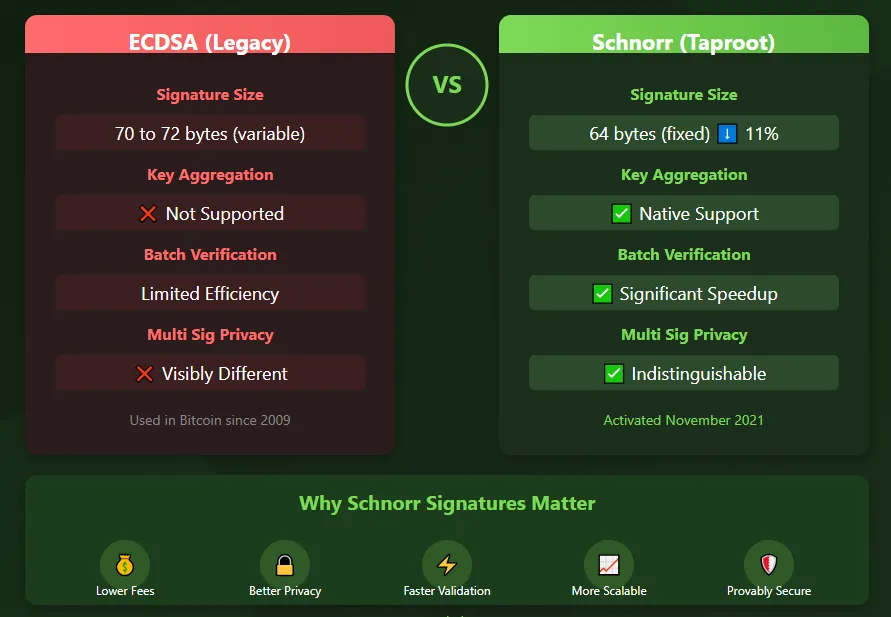
| Parameter | ECDSA (Legacy) | Schnorr (Taproot) |
|---|---|---|
| Signature Size | 70 to 72 bytes | 64 bytes (fixed) |
| Key Aggregation | Not supported natively | Native support |
| Batch Verification | Limited efficiency gains | Significant speedup |
| Multi Signature Privacy | Visibly different | Indistinguishable |
| Security Proof | Standard model | Provably secure in random oracle model |
| Implementation Complexity | More complex | Mathematically simpler |
These differences compound when considering real world applications. A corporate treasury using a 3 of 5 multi signature setup, for example, would see their transactions appear identical to individual user transactions under Taproot, protecting their privacy while reducing their transaction costs. This alignment of privacy benefits with cost savings creates powerful incentives for adoption.
8. What Is MAST (Merkelized Abstract Syntax Trees)?
MAST represents one of Taproot’s most intellectually elegant components, drawing on Merkle tree data structures to enable sophisticated conditional spending while maintaining privacy and efficiency. The concept allows a transaction to commit to multiple alternative spending conditions while only revealing the specific condition used when the funds are spent. This selective disclosure fundamentally changes what is possible with Bitcoin smart contracts.
How MAST Works
Consider a complex spending arrangement with ten different conditions under which funds could be released. Under the pre Taproot approach, all ten conditions would need to be included in the transaction, visible to anyone examining the blockchain, and consuming block space regardless of which condition was ultimately used. With MAST, only the Merkle root of these conditions is committed on chain. When spending, only the actually used condition and its Merkle proof are revealed, keeping the other nine conditions completely private.
This architecture enables contracts with potentially hundreds of spending conditions without proportionally increasing transaction size or compromising privacy. The Merkle proof required to validate a spending path grows only logarithmically with the number of conditions, making even highly complex arrangements practical. This efficiency gain opens possibilities for sophisticated financial instruments, inheritance planning, and business logic that were previously impractical on Bitcoin.
9. How Taproot Improves Bitcoin Privacy
Privacy enhancement stands as one of Taproot’s most celebrated benefits, addressing longstanding concerns about blockchain surveillance and transaction analysis. The upgrade achieves privacy improvements through multiple mechanisms that work together to obscure transaction details from observers while maintaining the transparency necessary for network validation.
Transaction Uniformity
Perhaps Taproot’s most significant privacy contribution is making different transaction types appear identical on the blockchain. When cooperative spending occurs (which represents the vast majority of real world transactions), a multi signature transaction, a Lightning channel closure, or a simple payment all look the same. This uniformity dramatically complicates the work of blockchain analysts attempting to identify transaction types or spending patterns.
Selective Script Disclosure
Through MAST, Taproot ensures that complex contracts reveal only the minimum necessary information when spent. If a will stipulates that funds can go to heirs after a time lock or immediately with executor approval, only the actually used path becomes visible. The existence of alternative conditions remains hidden, protecting family financial arrangements and business contingency plans from public scrutiny.
Enhanced Fungibility
By making transactions indistinguishable, Taproot improves Bitcoin’s fungibility, the property that makes one bitcoin equivalent to any other bitcoin. When transaction histories become harder to trace and categorize, the risk of certain bitcoins being “tainted” or discriminated against diminishes, strengthening Bitcoin’s utility as a medium of exchange. This progress toward improved fungibility supports Bitcoin’s foundational goal of serving as sound, censorship resistant money.
10. Taproot’s Impact on Bitcoin Scalability
Scalability remains one of Bitcoin’s most discussed challenges, and Taproot contributes meaningfully to addressing this concern through multiple efficiency improvements. While not a complete solution to all scaling limitations, the upgrade significantly improves how efficiently the network can process transactions, effectively increasing capacity within existing constraints.
Reduced Transaction Sizes
Schnorr signatures consume less space than ECDSA signatures, and key aggregation means multi signature transactions no longer require multiple separate signatures. Combined with MAST’s ability to commit to complex conditions using only a compact Merkle root, Taproot transactions can be substantially smaller than their pre Taproot equivalents. Smaller transactions mean more transactions can fit in each block, effectively increasing network throughput without changing the block size limit.
Faster Verification
The batch verification capability of Schnorr signatures reduces the computational resources required for nodes to validate blocks. As the network grows and blocks consistently fill with transactions, this efficiency gain becomes increasingly important for maintaining decentralization by keeping node operation accessible to participants with modest hardware resources.
11. Smart Contracts on Bitcoin with Taproot
While Bitcoin has always supported basic smart contracts through its scripting system, Taproot dramatically expands what is practically achievable. The combination of Schnorr signatures, MAST, and the new Tapscript scripting updates enables more sophisticated programmable money applications while maintaining Bitcoin’s security focused design philosophy.
Tapscript Enhancements
Tapscript, defined in BIP342, modifies Bitcoin’s scripting language specifically for Taproot transactions. It introduces new opcodes and adjusts existing ones to work optimally with Schnorr signatures. Importantly, Tapscript also establishes a versioning system that allows future scripting improvements to be added without requiring entirely new soft forks, providing a pathway for ongoing enhancement of Bitcoin’s smart contract capabilities.
Practical Smart Contract Applications
Taproot enables more practical implementations of various smart contract patterns including escrow arrangements with multiple resolution paths, decentralized oracle integrations for external data feeds, complex inheritance structures with multiple beneficiaries and time conditions, trustless exchange protocols with atomic swap capabilities, and sophisticated vault configurations for institutional custody. These applications become more private, less expensive, and more flexible than was previously possible on Bitcoin.
12. Taproot and Lightning Network Enhancements
The Lightning Network, Bitcoin’s primary layer two scaling solution, stands to benefit enormously from Taproot’s improvements. As a system built on multi signature channels and time locked contracts, Lightning was specifically designed with future improvements like Taproot in mind, and the upgrade delivers on this promise by enhancing privacy, reducing costs, and enabling new channel management capabilities.
Channel Operation Improvements
Lightning channels are fundamentally 2 of 2 multi signature contracts between channel partners. With Taproot, opening and cooperative closing of channels appear as ordinary single signature transactions, eliminating the distinctive fingerprint that previously identified Lightning activity on the blockchain. This privacy enhancement protects Lightning users from targeted surveillance and improves the network’s overall anonymity properties.
Point Time Locked Contracts (PTLCs)
Taproot enables the evolution from Hash Time Locked Contracts (HTLCs) to Point Time Locked Contracts (PTLCs) for Lightning routing. PTLCs use Schnorr signature properties to improve payment privacy across multi hop routes, preventing routing nodes from correlating payments across the path. This upgrade, still being implemented across Lightning software, represents a significant privacy enhancement for the payment network.
13. Benefits of Taproot for Developers and Businesses
Taproot creates significant opportunities for developers building Bitcoin applications and businesses operating within the ecosystem. The upgrade’s combination of privacy, efficiency, and flexibility improvements translates into tangible benefits for those building products and services on Bitcoin infrastructure.
Developer Opportunities
For developers, Taproot provides new tools for building sophisticated applications. The improved scripting capabilities enable more complex logic without the privacy and cost penalties previously associated with such complexity. Libraries and frameworks supporting Taproot construction are maturing rapidly, reducing the barrier to entry for building advanced Bitcoin applications. The upgrade also simplifies certain development patterns, as the uniformity of Taproot transactions reduces the edge cases and special handling required in application code.
Business Advantages
Businesses benefit from reduced transaction costs when using multi signature custody arrangements, improved privacy for treasury operations, and enhanced capabilities for building Bitcoin based financial products. Exchange operations become more efficient, custody solutions more flexible, and payment processing more private. The ability to implement complex business logic on Bitcoin while maintaining privacy opens new product possibilities across financial services, gaming, and digital commerce sectors.
14. Taproot’s Role in Future Bitcoin Upgrades
Taproot is not merely an endpoint but rather a foundation for continued Bitcoin development. The upgrade was specifically designed to facilitate future improvements, incorporating versioning mechanisms and leaving room for additional capabilities to be added through subsequent soft forks. Understanding this forward looking design illuminates Bitcoin’s technical roadmap and potential future capabilities.
Proposed Future Enhancements
Several proposals build upon Taproot’s foundation. Cross Input Signature Aggregation (CISA) would extend Schnorr aggregation across multiple transaction inputs, further reducing transaction sizes. New opcodes like OP_CHECKTEMPLATEVERIFY (CTV) and OP_VAULT are being discussed to enable covenants and enhanced custody capabilities. These proposals demonstrate how Taproot creates pathways for ongoing protocol evolution while maintaining Bitcoin’s conservative, security first development approach.
Tapscript Versioning
Tapscript includes a versioning mechanism that allows new script versions to be introduced without entirely new soft forks. This design decision reflects lessons learned from previous upgrades and provides a more elegant path for adding scripting capabilities over time. Future improvements can potentially be deployed more smoothly using this versioning infrastructure.
15. Real World Use Cases Enabled by Taproot
Since its activation, Taproot has enabled numerous practical applications that demonstrate its transformative potential. These real world implementations showcase how theoretical improvements translate into tangible benefits for users and businesses operating within the Bitcoin ecosystem.
Ordinals and Inscriptions
The Ordinals protocol, which emerged in 2023, leverages Taproot’s capabilities to enable the inscription of data onto individual satoshis, creating Bitcoin native digital artifacts often compared to NFTs. While controversial within the community, Ordinals demonstrate Taproot’s ability to support use cases not explicitly anticipated by its designers. The protocol utilizes Taproot’s witness data space and scripting flexibility to embed images, text, and other content directly on the Bitcoin blockchain.
Enhanced Custody Solutions
Institutional custody providers have implemented Taproot based solutions that improve both security and privacy. Multi signature arrangements protecting billions of dollars in Bitcoin now benefit from Taproot’s efficiency gains and privacy improvements. These implementations demonstrate enterprise readiness and growing institutional confidence in Taproot infrastructure.
Decentralized Finance Primitives
Various DeFi protocols are exploring how Taproot enables new financial primitives on Bitcoin. Atomic swaps, decentralized exchanges, and lending protocols can leverage Taproot’s improved smart contract capabilities to build more sophisticated financial products while maintaining Bitcoin’s security guarantees. These developments position Bitcoin more competitively in the broader decentralized finance landscape.
16. Challenges and Limitations of Taproot
Despite its significant benefits, Taproot is not without limitations and challenges. Understanding these constraints provides a balanced perspective on the upgrade and highlights areas where continued development and adoption efforts are needed.
Adoption Dependencies
Taproot’s privacy benefits depend significantly on widespread adoption. When only a small percentage of transactions use Taproot addresses, those transactions remain somewhat distinguishable despite their internal uniformity. Maximum privacy benefits require broad ecosystem adoption, including wallets, exchanges, and payment processors all supporting and defaulting to Taproot transactions.
Implementation Complexity
While Taproot simplifies certain aspects of Bitcoin development, implementing full Taproot support requires significant engineering effort. Wallet developers must update key derivation, address generation, and transaction construction code. This complexity has contributed to slower adoption among some wallet providers and exchanges, particularly those with legacy codebases or limited development resources.
Backward Compatibility Trade offs
The soft fork nature of Taproot, while preserving network continuity, means that old transaction types remain supported indefinitely. This backward compatibility, necessary for not breaking existing functionality, means that distinguishable legacy transaction types will continue to exist on the network, potentially limiting the ultimate privacy achievable even with universal Taproot adoption for new transactions.
17. Taproot Adoption Status in the Bitcoin Ecosystem
Since activation in November 2021, Taproot adoption has grown steadily across the Bitcoin ecosystem. Tracking this adoption provides insight into how quickly the benefits are being realized and where continued efforts are needed to achieve widespread implementation.
Adoption Metrics and Trends
Taproot transaction usage has increased substantially since activation, though it represents a minority of total Bitcoin transactions. Major exchanges including Binance, Coinbase, and Kraken have implemented Taproot support for withdrawals. Leading wallet software including Bitcoin Core, Sparrow, and BlueWallet now support Taproot address generation and spending. Hardware wallet manufacturers including Ledger and Trezor have added Taproot support to their devices.
| Category | Adoption Status | Notable Implementers |
|---|---|---|
| Major Exchanges | Widely Supported | Binance, Coinbase, Kraken, Gemini |
| Software Wallets | Strong Support | Sparrow, BlueWallet, Wasabi |
| Hardware Wallets | Supported | Ledger, Trezor, Coldcard |
| Lightning Implementations | In Progress | LND, CLN, Eclair |
| Payment Processors | Growing | BTCPay Server, OpenNode |
Ready to Implement Bitcoin Taproot Solutions?
Partner with experts who understand the full potential of Bitcoin’s latest technology upgrades.
18. Conclusion: Why Taproot Is a Major Milestone for Bitcoin
Bitcoin Taproot doesn’t directly enable NFTs but creates foundational infrastructure for them. The Ordinals protocol, which emerged after Taproot, leverages its capabilities to inscribe data onto individual satoshis, enabling Bitcoin native NFTs. Taproot’s improved script flexibility and data embedding capabilities made such innovations possible. While controversial, this development demonstrates Taproot’s role in expanding Bitcoin’s use cases beyond simple value transfer.
Frequently Asked Questions
Taproot enhances privacy but does not make Bitcoin fully anonymous. It improves confidentiality by making complex transactions appear identical to simple ones on the blockchain. However, Bitcoin remains a pseudonymous network where transaction patterns can still be analyzed. For complete anonymity, users would need additional privacy layers. Taproot simply makes it harder to distinguish between transaction types, offering improved privacy rather than true anonymity.
Once activated, Taproot cannot be easily reversed without a hard fork, which would require overwhelming consensus from the Bitcoin community. Soft forks like Taproot are backward compatible, meaning nodes that haven’t upgraded still accept Taproot transactions. Removing it would require splitting the network, which goes against Bitcoin’s decentralized governance model. The activation process ensures widespread agreement before implementation, making reversal practically impossible.
Upgrading your wallet is not mandatory but highly recommended to utilize Taproot benefits. Older wallets still function normally since Taproot is backward compatible. However, to enjoy lower fees, enhanced privacy, and new address formats starting with “bc1p,” you should update to a Taproot enabled wallet. Most major wallet providers have released updates supporting Taproot functionality since its November 2021 activation.
Taproot has minimal direct impact on Bitcoin mining operations. Miners continue validating blocks using the same proof of work consensus mechanism. The upgrade primarily affects transaction processing efficiency rather than mining difficulty or rewards. Miners benefit from smaller transaction sizes, allowing more transactions per block, potentially increasing fee revenue. The Schnorr signature verification is also slightly faster, marginally improving block validation times.
While Taproot is a technical upgrade, it indirectly supports institutional adoption by improving Bitcoin’s functionality. Enhanced smart contract capabilities and better privacy features make Bitcoin more attractive for corporate treasury management and financial products. Several institutions have cited Taproot’s improvements when considering Bitcoin investments. However, ETF approvals depend on regulatory decisions rather than technical upgrades like Taproot.
Taproot contributes to efficiency but doesn’t directly reduce Bitcoin’s energy consumption from mining. The upgrade allows more transactions to fit in each block through signature aggregation and smaller transaction sizes. This means the same energy expenditure processes more transactions, improving energy efficiency per transaction. However, overall network energy usage depends on mining difficulty and hash rate, not transaction efficiency.
Old Bitcoin addresses (Legacy, SegWit, Native SegWit) continue working normally after Taproot activation. Users can still send and receive Bitcoin using existing addresses without any issues. Taproot introduces new addresses starting with “bc1p” called Pay to Taproot (P2TR) addresses. There’s no requirement to migrate funds, though using new address types offers privacy and fee benefits for future transactions.
Taproot doesn’t directly enable NFTs but creates foundational infrastructure for them. The Ordinals protocol, which emerged after Taproot, leverages its capabilities to inscribe data onto individual satoshis, enabling Bitcoin native NFTs. Taproot’s improved script flexibility and data embedding capabilities made such innovations possible. While controversial, this development demonstrates Taproot’s role in expanding Bitcoin’s use cases beyond simple value transfer.
Taproot’s development spanned approximately three years from initial proposal to activation. Pieter Wuille formally proposed the upgrade in January 2020, building on earlier Schnorr signature research. Community discussions, code reviews, and testing continued through 2020. The Speedy Trial activation method was deployed in April 2021, with miners signaling support through June. Final activation occurred at block 709,632 in November 2021.
Taproot’s impact on Bitcoin’s price is indirect and not guaranteed. Technical upgrades improve Bitcoin’s utility and long term value proposition but don’t directly affect supply or demand dynamics driving price. Market sentiment around major upgrades can cause short term price movements. Long term, improved functionality may attract more users and developers, potentially supporting price appreciation, but cryptocurrency prices depend on numerous factors beyond technical improvements.
Reviewed & Edited By

Aman Vaths
Founder of Nadcab Labs
Aman Vaths is the Founder & CTO of Nadcab Labs, a global digital engineering company delivering enterprise-grade solutions across AI, Web3, Blockchain, Big Data, Cloud, Cybersecurity, and Modern Application Development. With deep technical leadership and product innovation experience, Aman has positioned Nadcab Labs as one of the most advanced engineering companies driving the next era of intelligent, secure, and scalable software systems. Under his leadership, Nadcab Labs has built 2,000+ global projects across sectors including fintech, banking, healthcare, real estate, logistics, gaming, manufacturing, and next-generation DePIN networks. Aman’s strength lies in architecting high-performance systems, end-to-end platform engineering, and designing enterprise solutions that operate at global scale.