Key Takeaways
- ✓Slippage in DeFi refers to the difference between the expected price and the actual execution price of a cryptocurrency trade.
- ✓Slippage occurs most commonly on decentralized exchanges that use automated market makers and liquidity pools.
- ✓Low liquidity in a trading pair is the primary reason why slippage becomes higher during trades.
- ✓Large trade orders relative to available liquidity always result in greater slippage and less favorable pricing.
- ✓Slippage tolerance is a setting that allows traders to control the maximum acceptable price difference before a transaction fails.
- ✓Setting slippage tolerance too low may cause your transaction to fail, while setting it too high exposes you to unfavorable prices.
- ✓Price impact and slippage are related but different concepts that traders should understand separately.
- ✓Trading during high volatility periods increases the likelihood of experiencing significant slippage.
- ✓Traders can reduce slippage by splitting large orders, choosing liquid pools, and trading during stable market conditions.
- ✓Advanced DeFi platforms work with blockchain developers to design better liquidity mechanisms that minimize slippage for users.
When you trade cryptocurrencies on decentralized exchanges, you might notice that the final price you pay is sometimes different from what you expected. This price difference is called slippage in DeFi, and it is one of the most important concepts every beginner trader needs to understand. Slippage happens when the actual execution price of your trade differs from the price you saw when you clicked the swap button. Whether you are buying tokens, providing liquidity, or exploring decentralized finance for the first time, understanding slippage can help you make smarter trading decisions and protect your investments from unexpected losses.
What is Slippage in DeFi?
Slippage in DeFi is the difference between the price you expect to pay for a cryptocurrency and the actual price you end up paying when your transaction gets executed. Think of it like buying a concert ticket online. You see a price of $100 on your screen, but by the time you complete checkout, the price has changed to $105 because of demand or availability. That $5 difference is similar to what slippage means in decentralized finance.
In traditional finance, when you place an order on a stock exchange, there are order books with buyers and sellers. In DeFi, most decentralized exchanges work differently. They use liquidity pools and automated market makers, which means prices can shift based on available tokens in the pool. When you swap one token for another, you are essentially pulling tokens from these pools, and this action itself can change the price ratio.
For beginners, understanding what is slippage in crypto helps avoid confusion when trades do not execute at the displayed price. It is not a fee or a scam. It is simply a natural consequence of how decentralized exchanges operate without centralized order matching.
Pro Tip: Most DEX platforms display the estimated slippage before you confirm a trade. Always check this value to understand what you are agreeing to before clicking confirm.
Why Does Slippage Happen in Decentralized Exchanges?
Understanding why slippage happens in DeFi requires knowing how decentralized exchanges work. Unlike centralized exchanges where buyers and sellers are matched directly, most DEXs use an automated market maker model. These AMMs rely on liquidity pools that contain pairs of tokens. When you trade, you interact with these pools rather than another person.
The main reasons slippage occurs include:
- Low Liquidity: When there are not enough tokens in a liquidity pool, even a small trade can significantly change the price ratio between tokens.
- Large Order Size: If you try to buy a large amount of a token relative to what is available in the pool, the price will move against you more dramatically.
- Market Volatility: During periods of high price movement, the token price can change between when you submit your transaction and when it gets confirmed on the blockchain.
- Network Congestion: When blockchain networks are busy, transaction confirmation times increase, allowing more time for prices to shift before execution.
- Trading Activity: If many people are trading the same pair simultaneously, each transaction affects the pool balance and therefore the price.
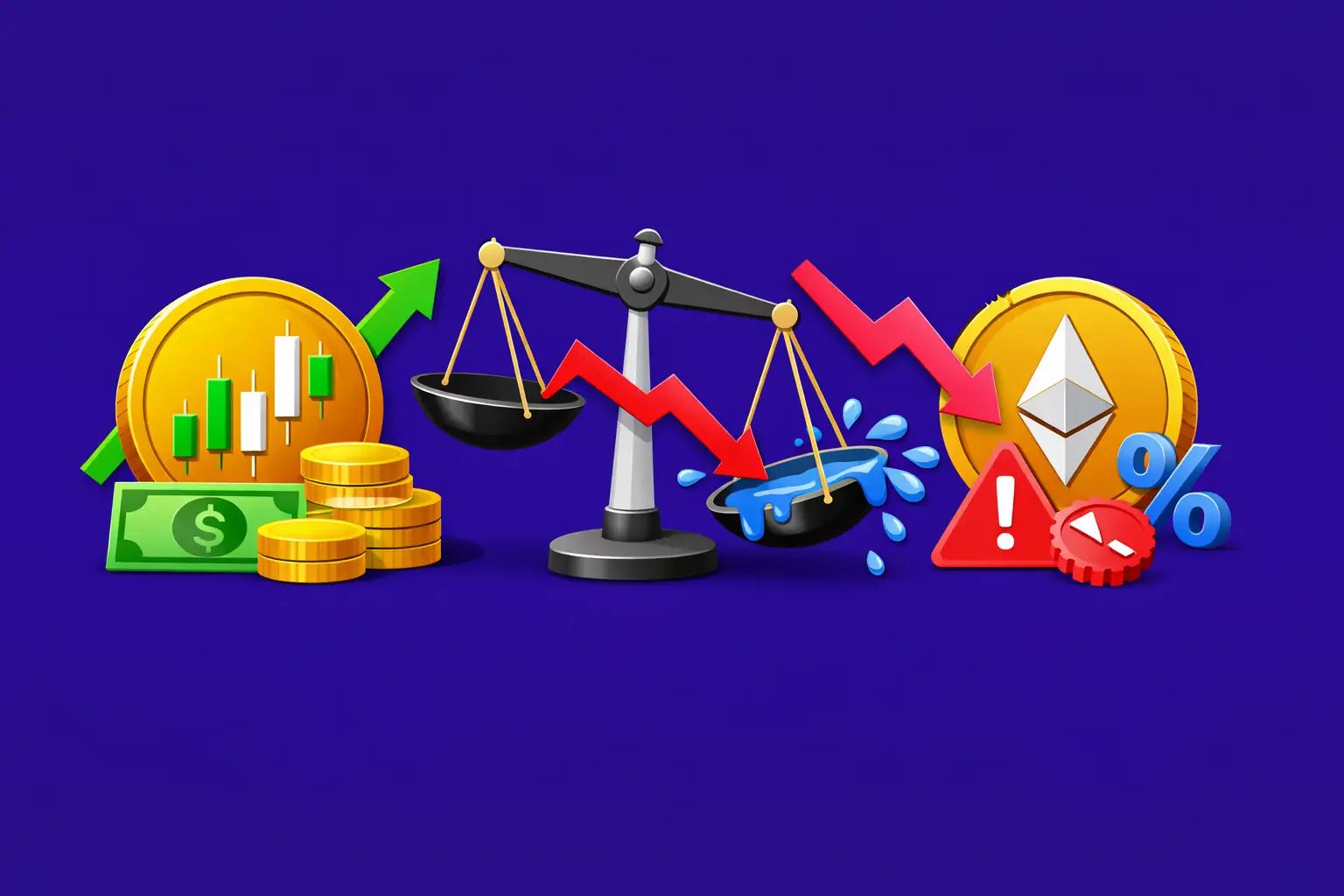
For example, imagine a small swimming pool representing a liquidity pool. If you take out one bucket of water, the level drops slightly. But if you try to take out half the pool’s water, the level drops dramatically. This is similar to how removing tokens from a liquidity pool affects the price ratio.
How Automated Market Makers Cause Slippage
Automated market makers use mathematical formulas to set prices. The most common formula is the constant product formula, which maintains a balance between two tokens in a pool. When you buy Token A using Token B, you add Token B to the pool and remove Token A. This changes the ratio, which automatically adjusts the price.
The AMM slippage explained simply means that every trade moves the price along a curve. The larger your trade compared to the pool size, the further along the curve you move, and the worse your average price becomes. This is why crypto trading slippage meaning is closely connected to the concept of price impact.
Professional blockchain solution providers like Nadcab Labs understand these mechanics deeply when designing DeFi platforms. They focus on implementing efficient liquidity aggregation and smart routing to help minimize slippage for end users.
Step by Step Example of How Slippage Occurs During a Trade
Let’s walk through a practical example to understand price slippage in DEX situations:
Step 1: You visit a decentralized exchange and want to buy 1000 tokens of ABC using your ETH. The interface shows you that 1 ABC costs 0.01 ETH, so you expect to pay 10 ETH total.
Step 2: You click the swap button and submit the transaction to the blockchain network. At this moment, the transaction enters a waiting queue called the mempool.
Step 3: While your transaction waits for confirmation, other traders are also buying ABC tokens. Each purchase removes tokens from the pool and shifts the price higher.
Step 4: When your transaction finally gets confirmed, the liquidity pool now has fewer ABC tokens than before. The price has moved from 0.01 ETH to 0.0105 ETH per ABC token.
Step 5: Instead of receiving 1000 ABC tokens for 10 ETH, you receive approximately 952 ABC tokens. The difference is the slippage you experienced.
This example shows why understanding slippage tolerance DeFi settings is crucial for traders. If you had set your slippage tolerance to 3%, the transaction would have failed because the actual slippage exceeded your acceptable threshold.
Slippage vs Price Impact: Understanding the Difference
Many beginners confuse slippage with price impact, but they are related yet distinct concepts. Price impact refers to how much your trade itself moves the market price, while slippage includes price impact plus any additional changes that happen between order submission and execution.
| Aspect | Price Impact | Slippage |
|---|---|---|
| Definition | The immediate effect your trade has on the market price | The difference between expected and actual execution price |
| Predictability | Calculated before trade execution | Cannot be known exactly until trade completes |
| Main Cause | Trade size relative to pool liquidity | Price impact plus market movements during execution |
| Control | Can be reduced by trading smaller amounts | Can be limited using slippage tolerance settings |
| Visibility | Usually shown by DEX interface before confirming | Only known after transaction completes |
Think of price impact as the guaranteed cost of moving through a liquidity pool, while slippage includes that cost plus any surprise changes from market activity. Both contribute to DEX price impact that traders experience.
What is Slippage Tolerance and How Does it Work?
Slippage tolerance is a user controlled setting on decentralized exchanges that determines the maximum amount of slippage you are willing to accept before your transaction automatically fails. When you set your slippage tolerance to 2%, you are telling the DEX that you accept up to 2% price difference from your expected price. If the actual slippage exceeds 2%, the transaction will revert and no trade will occur.
This setting exists to protect traders from executing trades at unexpectedly poor prices. Imagine ordering a product online for $50, but the seller charges you $100 at checkout without warning. Slippage tolerance prevents this from happening in DeFi trades.
Most DEX platforms default to slippage tolerance between 0.5% and 1%, but users can adjust this based on their needs. Understanding slippage tolerance DeFi mechanics helps you balance between transaction success rate and price protection.
Benefits and Drawbacks of Slippage Tolerance Settings
Like any trading tool, slippage tolerance settings come with advantages and limitations that traders should understand.
✅ Benefits
- Protects from extremely unfavorable prices
- Gives control over acceptable price variation
- Prevents losses from front running attacks
- Customizable based on token volatility
- Maintains predictable trading outcomes
⚠️ Drawbacks
- Too low causes frequent transaction failures
- Too high exposes to significant losses
- Failed transactions still cost gas fees
- May miss opportunities in fast markets
- Requires constant adjustment
Finding the right balance in your slippage tolerance settings depends on the specific token you are trading, current market volatility, and your personal risk tolerance.
How High Slippage Affects Traders and Investors
When you experience high slippage crypto trades, the financial impact can be significant, especially for traders making frequent transactions or dealing with substantial amounts. Understanding these effects helps you develop better trading strategies.
The primary ways high slippage impacts traders include:
- Reduced Profit Margins: When buying tokens, high slippage means you receive fewer tokens than expected for your money. When selling, you receive less value than anticipated. Both scenarios reduce your potential profits.
- Increased Trading Costs: Slippage acts as an invisible cost on top of regular trading fees. For active traders, cumulative slippage across many trades can equal or exceed traditional trading fees.
- Strategy Disruption: High slippage can invalidate trading strategies that depend on precise entry and exit prices, particularly for arbitrage or algorithmic trading approaches.
- Emotional Trading: Unexpected slippage can lead to frustration and emotional decisions, causing traders to make impulsive changes to their strategies.
- Liquidity Exit Problems: During market crashes or emergencies when you need to exit positions quickly, high slippage can significantly reduce the value you extract from your holdings.
For instance, if you are trying to take profits on a token that has increased in value, but the liquidity pool is shallow, you might face 10% to 15% slippage. This means a significant portion of your gains disappears due to poor execution conditions rather than market price movement.
Professional traders and institutional investors pay close attention to liquidity pool slippage characteristics before executing large trades. They often work with experienced blockchain development teams to access better liquidity routes and execution strategies.
The Connection Between Low Liquidity and High Slippage
The relationship between liquidity and slippage is perhaps the most critical concept for DeFi traders to understand. Low liquidity directly causes high slippage, and this connection explains why some tokens are much more expensive to trade than others.
Liquidity refers to the total value of tokens sitting in a liquidity pool available for trading. A pool with $10 million in liquidity can handle much larger trades with minimal price impact compared to a pool with only $100,000 in liquidity. When you try to trade a significant portion of a pool’s liquidity, mathematics forces the price to move dramatically against you.
Real World Analogy: Imagine two currency exchange booths at an airport. Booth A has $100,000 in cash reserves, while Booth B has only $1,000. If you want to exchange $500, Booth B might give you a poor rate because you are requesting half their inventory. Booth A can easily handle your request at fair market rates because you are only requesting a tiny fraction of their reserves. This is exactly how liquidity pool slippage works in DeFi.
Tokens with low liquidity typically include newly launched projects, obscure altcoins, or tokens on smaller blockchain networks. Trading these requires extra caution and accepting higher slippage as the cost of participation.
Practical Ways to Reduce Slippage in DeFi Trades
While you cannot eliminate slippage completely, experienced traders use several techniques to reduce slippage in DeFi and improve their execution quality. These strategies work for both beginners and advanced users.
1️⃣ Trade Smaller Amounts
Instead of executing one large trade, split it into multiple smaller transactions. While this increases your total gas fees, it can significantly reduce your average price slippage. For example, buying 10,000 tokens in one trade might cause 5% slippage, but buying in five batches of 2,000 tokens might only cause 1% slippage per trade for a better overall result.
2️⃣ Choose Liquid Trading Pairs
Always prefer trading pairs with deep liquidity. Major pairs like ETH/USDC or BTC/USDT typically have millions or billions in liquidity, resulting in minimal slippage even for large trades. Check the total value locked in a liquidity pool before trading.
3️⃣ Trade During Stable Market Conditions
Avoid trading during periods of extreme volatility, major news events, or when markets are rapidly moving. Prices change more predictably during calm market conditions, reducing the likelihood of significant slippage between order submission and execution.
4️⃣ Use DEX Aggregators
DEX aggregator platforms search multiple liquidity sources simultaneously to find you the best execution price. They can split your trade across different pools and platforms to minimize overall slippage. Popular aggregators analyze dozens of liquidity pools in seconds.
5️⃣ Pay Higher Gas Fees When Necessary
During network congestion, paying higher gas fees ensures your transaction gets confirmed faster, reducing the time window for prices to move against you. The extra gas cost might be worthwhile compared to the potential slippage from delayed execution.
6️⃣ Set Appropriate Slippage Tolerance
Adjust your slippage tolerance based on the specific token and market conditions. For stable, liquid pairs, use 0.5% to 1%. For volatile or low liquidity tokens, you may need 3% to 5% or higher, but be cautious about exposing yourself to excessive slippage.
7️⃣ Monitor Price Impact Warnings
Most DEX interfaces show price impact estimates before you confirm a trade. If you see warnings about high price impact (typically above 5%), reconsider your trade size or find a more liquid pool. These warnings help you avoid unexpectedly poor execution.
How DeFi Platforms Work to Minimize Slippage
Modern DeFi platforms and protocols continuously innovate to reduce slippage for their users. Understanding these platform level improvements helps you choose better trading venues and appreciate the technical sophistication behind user friendly interfaces.
Advanced platforms implement several technical strategies:
- Concentrated Liquidity: Some AMM designs allow liquidity providers to concentrate their capital within specific price ranges, creating deeper liquidity where most trading occurs and reducing slippage for common trades.
- Multi Path Routing: Smart routing algorithms automatically split large orders across multiple liquidity pools and even multiple DEXs to achieve better overall execution prices.
- Dynamic Fee Structures: Adjustable trading fees based on volatility help maintain adequate liquidity during different market conditions, which indirectly reduces slippage.
- Liquidity Incentive Programs: Platforms offer rewards to liquidity providers to attract more capital into pools, directly increasing available liquidity and reducing slippage.
- Oracle Price Integration: Using external price feeds helps platforms detect and prevent trades that would execute at severely disadvantageous prices compared to market rates.
Companies like Nadcab Labs that build DeFi infrastructure pay special attention to these liquidity optimization techniques. When designing trading platforms for clients, experienced developers implement architectural choices that promote healthy liquidity distribution and minimize user facing slippage. This expertise becomes particularly valuable for businesses entering the DeFi space who want to provide competitive trading experiences.
The goal is creating platforms where users can trade confidently without constantly worrying about execution quality, while still maintaining the decentralization and security that make DeFi valuable.
Business and Platform Design Considerations for Slippage
For businesses and entrepreneurs building DeFi products, understanding slippage implications goes beyond just technical implementation. Poor slippage management can drive users away to competing platforms, while excellent execution quality becomes a competitive advantage.
Key business considerations include:
- User Experience: Platforms that consistently deliver low slippage attract more users and generate higher trading volumes, creating positive feedback loops for growth.
- Liquidity Partnerships: Establishing relationships with major liquidity providers or aggregating liquidity from multiple sources improves execution quality across the board.
- Educational Resources: Providing clear explanations about slippage helps users make informed decisions and builds trust in your platform.
- Transparent Pricing: Showing clear price impact and slippage estimates before trade execution demonstrates honesty and helps users avoid surprises.
- Technical Infrastructure: Robust backend systems that can quickly route orders, update prices, and handle high transaction volumes all contribute to better slippage outcomes.
Startups and established companies alike benefit from partnering with experienced blockchain development firms who understand these nuances. The right technical architecture decisions made during platform design can determine whether your DeFi product succeeds or struggles in a competitive market.
Important Risks and Limitations Traders Should Understand
While understanding slippage helps you become a better trader, it is equally important to recognize situations where slippage creates serious risks or where your expectations might not align with reality.
Critical risks include:
- Front Running and MEV: Sophisticated bots can see your pending transaction in the mempool and place their own trades before yours to profit from the price movement you create. This increases your effective slippage beyond what the liquidity pool alone would cause.
- Sandwich Attacks: Malicious actors can place trades both before and after your transaction to maximize extraction from your trade, essentially manipulating the price against you twice.
- Rug Pulls in Low Liquidity Tokens: Tokens with minimal liquidity are vulnerable to developers or large holders removing liquidity suddenly, leaving remaining traders unable to exit without massive slippage.
- Flash Crash Scenarios: During extreme market stress, cascading liquidations can temporarily drain liquidity pools, causing brief periods of astronomical slippage that trap traders at very poor prices.
- Smart Contract Risks: Complex routing and slippage protection mechanisms depend on smart contract code. Bugs or exploits in these contracts could lead to unexpected losses beyond normal slippage.
Additionally, traders should understand limitations in how slippage protection works. Your slippage tolerance setting only prevents trades from executing beyond that threshold. It does not guarantee you will get a good price, only that you will not get a price worse than specified. A trade with 4.9% slippage will still execute if you set 5% tolerance, even though that represents significant value loss.
Smart traders stay informed about these risks and adjust their strategies accordingly. This might mean avoiding certain tokens entirely, only trading during specific market conditions, or using additional protective measures like limit orders on platforms that support them.
Future Improvements in DeFi Trading Efficiency
The DeFi ecosystem continues to evolve rapidly, with numerous innovations on the horizon that promise to reduce slippage and improve trading efficiency. Understanding these developments helps you anticipate how decentralized trading will improve in coming years.
Emerging technologies and approaches include:
- Cross Chain Liquidity Aggregation: Protocols that can access liquidity across multiple blockchain networks simultaneously will dramatically increase available depth for any given trade, naturally reducing slippage.
- Just In Time Liquidity: Advanced systems where liquidity providers can supply capital at the exact moment a trade needs it, improving capital efficiency and reducing slippage without requiring permanent liquidity deposits.
- Intent Based Trading: New architectures where you specify your desired outcome and sophisticated solvers compete to give you the best execution, potentially across multiple venues and strategies.
- Layer 2 Scaling Solutions: Faster and cheaper blockchain networks enable more frequent rebalancing of liquidity pools and faster transaction confirmation, reducing the time window for price changes.
- AI Powered Routing: Machine learning algorithms that can predict optimal routing paths and timing for trades based on historical patterns and real time market analysis.
- Improved AMM Formulas: More sophisticated mathematical models that can provide better price curves and reduced slippage compared to simple constant product formulas.
These innovations represent active areas of research and development. Leading blockchain development companies actively experiment with and implement these technologies for their clients. As the ecosystem matures, we can expect slippage to become less of a concern for everyday DeFi users, while still remaining an important consideration for large trades and sophisticated strategies.
The ultimate goal is reaching a point where DeFi trading efficiency matches or exceeds that of traditional centralized exchanges, but without sacrificing the security, transparency, and permissionless access that make decentralized finance valuable. While challenges remain, the trajectory of improvement has been consistent and encouraging.
Build Your DeFi Platform with Expert Guidance
Are you planning to launch a decentralized exchange, trading platform, or other DeFi solution? Understanding slippage mechanics is just the beginning. Successful DeFi platforms require sophisticated architecture, optimized liquidity management, and seamless user experiences.
For readers who want to deepen their understanding of slippage in DeFi and related concepts, several authoritative educational resources provide valuable technical insights and practical guidance.
Ethereum.org DeFi resources offer comprehensive explanations of decentralized finance concepts including detailed technical documentation about automated market makers and liquidity pools. These materials help both beginners and advanced users understand the underlying mathematics and economics that drive DeFi protocols.
Binance Academy provides educational content about various trading concepts that complement understanding of slippage, including impermanent loss, liquidity provision, and trading strategies that account for execution quality.
Combining knowledge from authoritative sources with hands on experience trading on test networks helps solidify your understanding before committing significant capital to real trades. Many traders find that experiencing different slippage scenarios personally teaches more than any article can convey.
Conclusion
Understanding slippage in DeFi is essential for anyone participating in decentralized trading, whether you are a beginner making your first swap or an experienced trader executing sophisticated strategies. Slippage represents the difference between your expected trade price and the actual execution price, influenced by factors like liquidity depth, trade size, market volatility, and network conditions.
While slippage cannot be eliminated entirely from DeFi trading, informed traders can minimize its impact through smart practices like trading in liquid pools, splitting large orders, using appropriate slippage tolerance settings, and choosing optimal market timing. Understanding the relationship between liquidity pool size and slippage helps you make realistic expectations about execution quality for different tokens.
As the DeFi ecosystem continues maturing, innovations in liquidity aggregation, routing optimization, and platform design promise to reduce slippage further. For businesses building DeFi solutions, partnering with experienced blockchain developers who understand these complexities ensures your platform can deliver the competitive execution quality users expect.
Whether you are learning about crypto trading slippage meaning for the first time or refining your advanced trading strategies, remember that slippage is a natural characteristic of decentralized markets. With proper knowledge and careful execution, you can navigate DeFi trading successfully while protecting your capital from unnecessary losses. The key is staying informed, practicing good risk management, and continuously adapting your approach as the technology and markets evolve.
Frequently Asked Questions
Yes, positive slippage is possible when the market moves in your favor between order submission and execution. If you are buying and the price drops, or selling and the price rises, you will receive a better rate than expected. However, this is less common than negative slippage, especially in trending markets. Most traders should not count on positive slippage as it is unpredictable.
Slippage can occur on both centralized and decentralized exchanges, though the causes differ. On centralized exchanges with order books, slippage happens when your order size exceeds available liquidity at your desired price level. On DEXs, it occurs due to AMM mechanics and liquidity pool dynamics. Generally, major centralized exchanges have deeper liquidity and experience less slippage for typical trade sizes.
There is no absolute minimum where slippage becomes zero, but extremely small trades in highly liquid pools experience negligible slippage, often less than 0.01%. The key factor is your trade size relative to pool liquidity. A $10 trade in a pool with millions in liquidity will have virtually no slippage, while the same trade in a $1,000 pool could have significant slippage.
Unfortunately, you still pay gas fees even when a transaction fails due to exceeding your slippage tolerance. The blockchain network processes your transaction and attempts to execute it, consuming computational resources. When it fails the slippage check, the transaction reverts, but the gas fees are not refunded. This is why setting appropriate slippage tolerance is important to balance protection against wasted fees.
Some advanced DEX platforms now offer limit order functionality, which allows you to specify an exact price at which you want to trade. Your order only executes when the market reaches that price, eliminating unexpected slippage. However, this comes with trade offs including potential delays in execution, the possibility your order never fills, and sometimes higher fees. Not all DEXs support limit orders yet.
Trading pairs involving stablecoins typically experience lower slippage than volatile crypto pairs because stablecoin prices remain relatively constant. Pools with stablecoins on both sides (like USDC/USDT) have minimal slippage even for large trades. When swapping between a volatile token and a stablecoin, the slippage primarily depends on the volatile token’s liquidity and market conditions rather than the stablecoin.
Yes, the same token can have vastly different slippage across different blockchain networks because liquidity is fragmented. A popular token might have deep liquidity on Ethereum but shallow liquidity on a smaller network. Additionally, different DEXs on the same blockchain can have different liquidity levels. Always check the specific pool you are trading on rather than assuming consistency across networks.
Most modern DEX interfaces show estimated price impact and slippage before you confirm a transaction. Additionally, some third party analytics platforms offer slippage calculators where you can input your trade size and see projected slippage. However, these are estimates only. Actual slippage depends on market conditions at execution time, so predictions cannot be perfectly accurate, especially during volatile periods.
Higher trading volume in a pool generally indicates better liquidity and lower slippage, but this is not always guaranteed. What matters more is the depth of liquidity (total value locked) rather than trading volume alone. A pool can have high volume but still shallow liquidity if the same small amount of tokens is being traded repeatedly. Look at both metrics when evaluating potential slippage.
Beginners making small trades on popular pairs with good liquidity generally do not need to worry excessively about slippage. For trades under a few hundred dollars on major tokens, slippage is usually minimal (under 1%). However, it is still important to understand the concept, check the estimated slippage shown by the DEX interface, and avoid trading obscure tokens with low liquidity where even small trades can experience significant slippage.
Reviewed & Edited By

Aman Vaths
Founder of Nadcab Labs
Aman Vaths is the Founder & CTO of Nadcab Labs, a global digital engineering company delivering enterprise-grade solutions across AI, Web3, Blockchain, Big Data, Cloud, Cybersecurity, and Modern Application Development. With deep technical leadership and product innovation experience, Aman has positioned Nadcab Labs as one of the most advanced engineering companies driving the next era of intelligent, secure, and scalable software systems. Under his leadership, Nadcab Labs has built 2,000+ global projects across sectors including fintech, banking, healthcare, real estate, logistics, gaming, manufacturing, and next-generation DePIN networks. Aman’s strength lies in architecting high-performance systems, end-to-end platform engineering, and designing enterprise solutions that operate at global scale.