Key Takeaways
- Mining pools are essential infrastructure for profitable blockchain mining in 2026, as solo mining on major chains is virtually impractical for individual operators.
- Foundry USA leads all pools with approximately 30% of Bitcoin’s hash rate, but raises decentralization concerns.
- Payout methods (PPS, PPLNS, FPPS, Solo, TIDES) significantly impact your returns — choose based on your risk tolerance and mining consistency.
- Security, uptime, and transparency should weigh as heavily as fees when evaluating mining pools for long-term use.
- OCEAN Pool and Braiins Pool lead the decentralization movement with non-custodial payouts and Stratum V2 support, respectively.
- Binance Pool offers the lowest standard fee at 0.5% but carries regulatory uncertainty depending on your jurisdiction.
- Diversifying your hash power across multiple mining pools is a best practice to reduce custodial and centralization risk.
- The Stratum V2 protocol, green mining incentives, and AI optimization are key trends shaping the future of mining pools.
- Always verify a pool’s actual payouts against expected returns over time to detect hidden fees or opaque revenue practices.
- For broader blockchain deployment and digital contract guidance, consult experienced firms like Nadcab Labs with 8+ years of domain expertise.
Introduction to Blockchain Mining Pools in 2026
The blockchain industry has experienced remarkable growth over the past decade, and mining pools have remained central to this evolution. As of early 2026, the global cryptocurrency mining market is valued at approximately $2.5 billion, with projections to surpass $5.5 billion by 2030 according to a report by Fortune Business Insights. For solo miners, the probability of solving a block independently has dropped to near-zero on major chains, making pooled mining not just a preference but a practical necessity.
At Nadcab Labs, with over 8 years of hands-on experience in blockchain deployment, digital contract engineering, and decentralized infrastructure consulting, we have guided hundreds of enterprises and independent miners toward the most efficient and secure mining strategies. This guide represents our distilled expertise on the best 8 pools for blockchain mining you should consider in 2026 — covering everything from fees and security to reward structures and decentralization philosophy.
These collaborative platforms allow individual miners to combine their computational hash power to increase the likelihood of earning block rewards. Rather than competing alone against industrial-scale operations, pool participants share both the work and the reward proportionally. This collaborative model has become the backbone of proof-of-work blockchain networks worldwide, and understanding how to choose the right pool can be the difference between profitable mining and wasted resources.
Whether you are a seasoned miner upgrading your strategy or a newcomer entering the blockchain ecosystem for the first time, this article will equip you with data-driven insights to make informed decisions about which mining pools align best with your goals. For a broader look at how blockchain technology is shaping enterprises, explore our detailed hub on Enterprise Blockchain Applications.
How Mining Pools Work in Modern Blockchain Networks
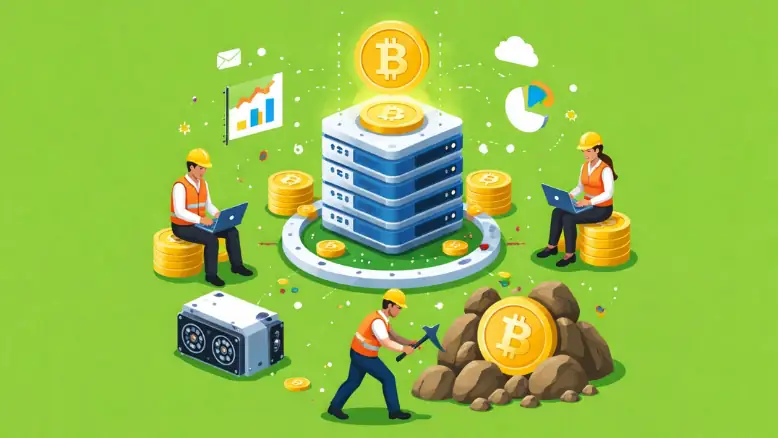
Understanding the inner mechanics of pool-based mining is essential before selecting one. At a fundamental level, a mining pool is a server that coordinates the hashing efforts of multiple miners. When any participant in the pool successfully mines a block, the reward is distributed among all contributors based on the share of work each provided.
The Mining Pool Life Cycle
Step 1 — Registration & Configuration: A miner joins a pool by registering their wallet address and configuring their mining hardware (ASICs, GPUs, or FPGAs) to point to the pool’s stratum server.
Step 2 — Work Distribution: The pool server assigns smaller units of work (shares) to each connected miner. These shares are portions of the total computational puzzle required to find a valid block hash.
Step 3 — Hash Submission: Each miner processes their assigned shares and submits valid proof of work back to the pool. The pool tracks each miner’s contribution.
Step 4 — Block Discovery: When the combined hash power of the pool finds a valid block, the pool broadcasts it to the blockchain network for validation.
Step 5 — Reward Distribution: The block reward (plus transaction fees) is split among participants according to the pool’s chosen payout method — PPS, PPLNS, FPPS, or others.
Step 6 — Payout & Cycle Reset: Miners receive their proportional payout to their configured wallet, and the cycle begins again with fresh work assignments.
In 2026, modern pools have also adopted advanced features like MEV (Miner Extractable Value) optimization for certain chains, real-time analytics dashboards, and multi-coin auto-switching algorithms. These innovations reflect how far the ecosystem has come from the early days of simple pooled hashing. To understand the broader distributed technology underpinning these systems, explore the resource below.
▶ Read Also: Distributed Ledger Technology
Key Factors to Consider When Choosing a Mining Pool
Selecting the right pool requires evaluating several critical parameters. Based on our 8+ years of advising mining operations at Nadcab Labs, these are the factors that consistently determine long-term profitability and satisfaction.
Fee Structure: Pool fees typically range from 0% to 4%. Even a 1% difference compounded over months can significantly impact your net returns. Some pools absorb transaction fees within their structure, while others pass them on to miners.
Payout Method: The reward distribution system matters enormously. PPS (Pay Per Share) offers predictable income but higher fees, while PPLNS (Pay Per Last N Shares) can yield higher returns with more variance. FPPS (Full Pay Per Share) includes transaction fees in the payout, which has become increasingly valuable as on-chain fees grow.
Hash Rate & Pool Size: Larger pools find blocks more frequently but offer smaller individual rewards. Smaller pools find blocks less often but pay more per block. This trade-off is fundamental to your strategy.
Security & Uptime: Look for pools with DDoS protection, SSL encryption, and a strong track record of uptime above 99.9%. A pool that goes offline means your hardware is wasting electricity.
Supported Cryptocurrencies: Multi-coin pools give you flexibility to switch chains based on profitability. In 2026, this has become more relevant with the growth of alternative proof-of-work coins beyond Bitcoin.
Decentralization Philosophy: As the blockchain community pushes for greater decentralization, some miners prefer pools that actively limit their hash rate share to prevent 51% attack risks. This factor reflects the broader values of the ecosystem.
For insight into how interoperability between blockchains affects mining decisions, check out the guide below.
▶ Read Also: Interoperability in Blockchain
Overview of the Top 8 Mining Pools in 2026
Before we dive into individual breakdowns, here is a high-level comparison of the top 8 pools that have earned their place in 2026 through consistent performance, innovation, and community trust. This overview table summarizes the essential data points at a glance.
| Pool Name | Fee | Payout Method | Supported Coins | Est. Hash Rate Share |
|---|---|---|---|---|
| Foundry USA | 0% – 2% | FPPS | BTC | ~30% |
| AntPool | 1% – 4% | PPS+/PPLNS | BTC, LTC, ETH Classic, ZEC | ~16% |
| F2Pool | 2% – 4% | PPS+ | 40+ coins | ~12% |
| ViaBTC | 1% – 4% | PPS+/PPLNS/Solo | BTC, LTC, BCH, KAS | ~11% |
| Braiins Pool | 2% | Score-based | BTC | ~5% |
| OCEAN Pool | 0% (tip-based) | TIDES | BTC | ~2.5% |
| Luxor Mining | 1% – 3% | FPPS | BTC, KAS, SC, HNS | ~4% |
| Binance Pool | 0.5% | FPPS | BTC, ETH Classic, LTC | ~8% |
These eight mining pools collectively represent over 85% of the Bitcoin network hash rate alone, with several also operating across alternative proof-of-work chains. The hash rate share figures above are approximate and fluctuate daily based on market conditions and miner migration. According to Blockchain.com, the Bitcoin network’s total hash rate exceeded 750 EH/s in January 2026, underscoring the immense computational power these pools coordinate.
Pool #1: Foundry USA — Features, Fees, and Performance
Foundry USA has dominated the pool landscape since surpassing AntPool in 2023 and has maintained its leading position into 2026. Operated by Foundry Digital, a subsidiary of Digital Currency Group (DCG), this pool commands approximately 30% of Bitcoin’s total hash rate, making it the single largest pool in the world.
Fee Structure: Foundry operates on an institutional model. For large-scale miners, fees are negotiated on a case-by-case basis and can be as low as 0%. Retail-tier miners typically pay around 2% under the FPPS model. This competitive pricing has been a major driver of adoption.
Performance Metrics: With its massive hash rate share, Foundry finds blocks with exceptional consistency. The pool reported an average uptime of 99.98% in 2025 and has invested heavily in infrastructure across multiple data centers in North America.
Why We Recommend It: From our experience at Nadcab Labs working with enterprise-level mining operations, Foundry USA is the top choice for institutional miners and large farms due to its infrastructure reliability, transparent reporting, and regulatory compliance in the United States. However, critics within the decentralization community have raised concerns about its dominant hash rate share, arguing that such concentration poses theoretical risks to Bitcoin’s censorship resistance.
Expert Statement: “Foundry USA’s dominance among pools reflects the broader trend of mining professionalization. While the pool offers unmatched reliability, the industry must remain vigilant about concentration risks. We always advise clients to diversify across multiple pools where operationally feasible.” — Nadcab Labs Blockchain Advisory Team
Pool #2: AntPool — Supported Coins and Hash Rate Strength
AntPool, operated by Bitmain Technologies, remains one of the most established mining pools in the ecosystem. With over a decade of operation, it holds approximately 16% of Bitcoin’s hash rate in 2026 and supports a diverse range of proof-of-work cryptocurrencies, including Bitcoin, Litecoin, Ethereum Classic, and Zcash.
Multi-Coin Flexibility: AntPool’s strength lies in its breadth. Miners can seamlessly switch between supported coins through the dashboard, and the pool provides profit-switching recommendations based on current network difficulty and coin prices.
Hash Rate Strength: AntPool benefits from a natural advantage through Bitmain’s hardware ecosystem. Many miners running Antminer ASICs default to AntPool due to integrated firmware-level configuration, which contributes to the pool’s consistently strong hash rate. The pool has remained a top-3 Bitcoin mining pool for seven consecutive years.
Payout Options: AntPool offers both PPS+ and PPLNS payout modes. PPS+ carries a 4% fee for Bitcoin but includes transaction fee income. PPLNS operates at a lower 1% fee but introduces payout variance. This dual option gives miners the flexibility to match their risk tolerance.
For miners interested in how the EVM ecosystem connects to mining infrastructure, the following resource provides relevant context.
▶ Read Also: EVM Evolution: From Ethereum to Zero Knowledge
Pool #3: F2Pool — Security Measures and Reliability
F2Pool, founded in 2013 in Beijing, is the oldest active Bitcoin mining pool and one of the most respected mining pools globally. Supporting over 40 cryptocurrencies, F2Pool has processed more than $3 billion in cumulative miner payouts throughout its history.
Security Infrastructure: Security has always been F2Pool’s hallmark. The platform employs enterprise-grade DDoS mitigation through Cloudflare, mandatory two-factor authentication (2FA), SSL-encrypted stratum connections, and cold-wallet storage for accumulated funds before distribution. In an industry where pool hacks have historically caused significant losses, F2Pool’s clean security record spanning 12+ years is a compelling advantage.
Reliability Track Record: F2Pool maintains geo-distributed servers across Asia, North America, and Europe, achieving a verified uptime record exceeding 99.95% over the past 36 months. For miners operating in multiple regions, this global server presence minimizes latency and reduces stale share rates.
Transparency: F2Pool was among the first mining pools to publish real-time block-level reward breakdowns and on-chain proof of payouts. This commitment to transparency has earned it consistent trust from the mining community.
Pool #4: ViaBTC — Reward Systems and Payout Methods
ViaBTC has differentiated itself in the industry by offering the widest range of payout methods in the industry. Founded in 2016, the pool serves miners across multiple proof-of-work chains and has built a reputation for innovation in reward distribution.
ViaBTC Payout Method Comparison
| Payout Method | Fee (BTC) | Risk Level | Best For |
|---|---|---|---|
| PPS+ | 4% | Low (stable income) | Risk-averse miners, beginners |
| PPLNS | 2% | Medium (variable income) | Long-term, consistent miners |
| Solo | 1% | High (winner-takes-all) | High-hash-rate miners seeking full block rewards |
ViaBTC’s Solo mining option is particularly noteworthy in the pool ecosystem. It allows miners to use the pool’s infrastructure while retaining the entire block reward if their hardware solves the block, minus a minimal 1% fee. This hybrid model gives large-scale operators pool-level reliability with solo-level reward upside.
Real-world Example: In December 2025, a solo miner on ViaBTC with approximately 3 PH/s of hash power successfully mined a Bitcoin block worth over $290,000 in a single payout, demonstrating the potential of the Solo model for well-capitalized miners.
Pool #5–8: Comparative Highlights and Unique Advantages
Pool #5: Braiins Pool (formerly Slush Pool)
Braiins Pool holds a special place in blockchain history as the world’s first-ever pool of its kind, launched in 2010 by Marek Palatinus. In 2026, it continues to operate with a focus on transparency and open-source principles. Braiins Pool uses a unique score-based reward system that discourages pool hopping by weighting recent shares more heavily. The pool charges a flat 2% fee and exclusively mines Bitcoin. What sets Braiins apart from other pools is its deep commitment to the open-source Stratum V2 protocol, which gives miners more control over block template construction — a meaningful step toward decentralization.
Pool #6: OCEAN Pool
OCEAN Pool, co-founded by Bitcoin core contributor Luke Dashjr, launched in late 2023 and has grown steadily as one of the most philosophically distinct pools in the space. OCEAN operates on a non-custodial, tip-based fee model — meaning miners receive payouts directly from the coinbase transaction rather than trusting the pool to hold and distribute funds. The pool’s TIDES (Transparent Index of Distinct Extended Shares) reward system is a novel approach to payout transparency. In January 2026, OCEAN held approximately 2.5% of Bitcoin’s hash rate, reflecting growing interest among decentralization-minded miners.
Pool #7: Luxor Mining
Luxor Mining is a North American pool that has carved out a niche by supporting emerging proof-of-work coins alongside Bitcoin. In addition to BTC, Luxor supports Kaspa (KAS), Siacoin (SC), and Handshake (HNS), making it one of the most diversified pools for miners wanting exposure beyond Bitcoin. Luxor operates on FPPS with fees ranging from 1% to 3% depending on the coin. The pool also runs Hashrate Index, a widely-cited mining analytics platform that provides real-time data on network difficulty, hash price, and ASIC market valuations.
Pool #8: Binance Pool
Binance Pool leverages the infrastructure of the world’s largest cryptocurrency exchange to offer competitive pool services. Its standout feature is the ultra-low 0.5% FPPS fee for Bitcoin mining, which is among the lowest in the industry. Miners also benefit from seamless integration with the Binance exchange, allowing instant conversion of mined coins to other assets or stablecoins. As of 2026, Binance Pool holds roughly 8% of Bitcoin’s hash rate. However, regulatory scrutiny of Binance in certain jurisdictions means miners should verify the pool’s availability in their region before committing.
Comparing Fees, Profitability, and Decentralization
One of the most critical evaluations miners must make when choosing among mining pools is balancing fees against profitability and decentralization. The following comparison table provides a side-by-side view of these three dimensions across all eight pools.
| Pool | Lowest Fee | Profitability Rating | Decentralization Score | Ideal User Profile |
|---|---|---|---|---|
| Foundry USA | 0% | ★★★★★ | ★★☆☆☆ | Institutional / Enterprise |
| AntPool | 1% | ★★★★☆ | ★★★☆☆ | Multi-coin miners |
| F2Pool | 2% | ★★★★☆ | ★★★☆☆ | Global / Multi-coin |
| ViaBTC | 1% | ★★★★☆ | ★★★☆☆ | Flexible / Solo miners |
| Braiins Pool | 2% | ★★★☆☆ | ★★★★★ | Decentralization advocates |
| OCEAN Pool | 0% | ★★★☆☆ | ★★★★★ | Cypherpunk / Bitcoin purists |
| Luxor Mining | 1% | ★★★★☆ | ★★★★☆ | Altcoin PoW miners |
| Binance Pool | 0.5% | ★★★★★ | ★★☆☆☆ | Exchange-integrated traders |
An important insight from our advisory work at Nadcab Labs is that profitability and decentralization often exist in tension. The largest pools find blocks more frequently and can offer lower fees through economies of scale, but they also concentrate hash power in ways that concern the broader community. Miners should weigh their financial goals against their values when selecting a pool.
According to a Cambridge University analysis, the top three pools controlled approximately 58% of Bitcoin’s hash rate at the start of 2026 (Source: Cambridge Centre for Alternative Finance, Bitcoin Mining Map, January 2026). This concentration has sparked renewed discussions around the importance of supporting smaller, decentralization-focused alternatives like Braiins and OCEAN.
Risks and Challenges of Using Mining Pools
While pooled mining has democratized access to block rewards, they introduce their own set of risks that every miner should carefully evaluate.
Centralization Risk: The most systemic concern is the concentration of hash power. If any single pool or coordinated group of pools controls over 50% of a network’s hash rate, they could theoretically execute a 51% attack — reordering transactions, double-spending, or censoring blocks. While no major pool has attempted this, the theoretical vulnerability is real. In 2026, the fact that just two pools (Foundry USA and AntPool) together control roughly 46% of Bitcoin’s hash rate underscores this concern.
Custodial Risk: Most traditional pools hold miner earnings until a payout threshold is reached. If the pool operator is compromised or acts maliciously, miners could lose accumulated rewards. Non-custodial alternatives like OCEAN Pool address this but remain a minority in the ecosystem.
Fee Opacity: Some pools advertise low headline fees but recoup revenue through opaque mechanisms such as withholding MEV income, skimming transaction fees, or manipulating share difficulty. Due diligence is essential — miners should compare expected versus actual payouts over time.
Regulatory Exposure: As governments worldwide introduce stricter cryptocurrency regulations, mining pools face increasing compliance requirements. Pools operating in jurisdictions with unclear legal frameworks may abruptly change terms, restrict access, or shut down entirely. This risk is particularly relevant for miners relying on pools based in regions with rapidly evolving regulatory landscapes.
Technical Downtime: Even well-managed pools can experience outages due to server failures, network attacks, or software bugs. During downtime, connected miners waste electricity without earning any rewards. Maintaining backup pool configurations is a best practice we consistently recommend at Nadcab Labs.
To understand how blockchain applications are transforming risk management across sectors, explore the resource below.
Future Trends in Blockchain Mining Pools
The next evolution of mining pools is already taking shape, driven by technological innovation, regulatory shifts, and a growing emphasis on sustainability. Here are the key trends we at Nadcab Labs are tracking closely.
Stratum V2 Adoption: The Stratum V2 protocol is set to transform the relationship between miners and pools. By enabling miners to construct their own block templates rather than relying on pool operators, Stratum V2 significantly reduces censorship risk and enhances decentralization. Braiins Pool and OCEAN have been early adopters, and we expect wider adoption across major pools by late 2026.
Green Mining Incentives: Environmental concerns have pushed multiple pools toward renewable energy partnerships. According to the Bitcoin Mining Council, over 60% of the global Bitcoin mining network now uses sustainable energy sources as of Q4 2025. Future pools may offer fee discounts or priority services for verified green miners.
AI-Optimized Mining: Machine learning algorithms are being integrated into pool management systems to optimize workload distribution, predict network difficulty changes, and maximize hash efficiency. This trend will make these platforms smarter and more profitable for participants.
Cross-Chain Mining Pools: As interoperability between blockchains improves, future platforms may allow miners to simultaneously contribute hash power across multiple compatible chains through merged mining or cross-chain coordination protocols. This would maximize hardware utilization and diversify revenue streams.
Regulatory-Compliant Pools: With increasing government oversight, we anticipate a new category of fully regulated pools that offer features like KYC-verified mining, tax-compliant reporting tools, and integration with institutional custodians. While this runs counter to the pseudonymous ethos of early cryptocurrency, it reflects the practical reality of mainstream adoption.
Frequently Asked Questions
These are collaborative networks where multiple miners combine their computational power to increase the probability of earning block rewards. In 2026, with Bitcoin’s hash rate exceeding 750 EH/s, solo mining is practically impossible for individual miners, making pooled mining essential for consistent returns.
OCEAN Pool operates on a tip-based model with effectively 0% mandatory fees. Among conventional pools, Binance Pool offers the lowest standard fee at 0.5% under its FPPS model. Foundry USA can also negotiate 0% fees for institutional-scale mining operations.
PPS (Pay Per Share) pays a fixed amount per valid share regardless of block discovery. PPLNS (Pay Per Last N Shares) distributes rewards based on shares contributed during a recent window, offering potentially higher but variable returns. FPPS (Full Pay Per Share) includes transaction fee income in addition to the block subsidy, providing the most complete payout.
Most pools are custodial, meaning they hold your earnings until payout thresholds are met. This carries inherent risk. We recommend setting the lowest possible payout threshold and withdrawing regularly to your personal wallet. For zero custodial risk, consider non-custodial pools like OCEAN.
Yes, several pools support multiple coins. F2Pool leads with 40+ supported cryptocurrencies. AntPool, ViaBTC, Luxor Mining, and Binance Pool also support multiple proof-of-work coins. You can typically switch between supported coins through the pool dashboard.
When a small number of pools control a majority of hash power, it creates a theoretical 51% attack vulnerability. In 2026, the top two pools control roughly 46% of Bitcoin’s hash rate, which is a concern. Supporting decentralized pools and distributing hash power across multiple pools helps mitigate this systemic risk.
Stratum V2 is an upgraded mining communication protocol that allows miners to construct their own block templates instead of relying entirely on the pool operator. This reduces censorship risk, improves data efficiency, and enhances miner sovereignty — representing a significant step toward more decentralized pool operations.
Earnings depend on your hash rate, electricity cost, pool fees, and the current Bitcoin price. As a benchmark, a modern Antminer S21 producing ~200 TH/s earns approximately $15–$25 per day after electricity costs at average US power rates, when connected to a low-fee FPPS pool. Profitability calculators like those on Hashrate Index can provide personalized estimates.
For beginners who own mining hardware, mining pools are the recommended approach. Cloud mining services often carry higher costs, less transparency, and historically have included numerous fraudulent operations. Reputable pools with PPS+ payout provide the most beginner-friendly experience with stable, predictable income.
With 8+ years of blockchain deployment and consulting expertise, Nadcab Labs evaluates each client’s hash rate capacity, operational jurisdiction, risk tolerance, and profitability goals to recommend an optimal strategy. We also assist with digital contract integration, multi-pool diversification setup, and ongoing performance monitoring to ensure sustained profitability.
Reviewed & Edited By

Aman Vaths
Founder of Nadcab Labs
Aman Vaths is the Founder & CTO of Nadcab Labs, a global digital engineering company delivering enterprise-grade solutions across AI, Web3, Blockchain, Big Data, Cloud, Cybersecurity, and Modern Application Development. With deep technical leadership and product innovation experience, Aman has positioned Nadcab Labs as one of the most advanced engineering companies driving the next era of intelligent, secure, and scalable software systems. Under his leadership, Nadcab Labs has built 2,000+ global projects across sectors including fintech, banking, healthcare, real estate, logistics, gaming, manufacturing, and next-generation DePIN networks. Aman’s strength lies in architecting high-performance systems, end-to-end platform engineering, and designing enterprise solutions that operate at global scale.