

Key Takeaways
- Liquidity pools in Web3 are smart contract-based token reserves that enable decentralized, trustless trading without traditional order books or intermediaries
- DeFi liquidity pools use automated market makers (AMMs) with mathematical formulas like x*y=k to determine prices algorithmically based on token ratios
- Liquidity providers in Web3 earn passive income through trading fees (typically 0.1-0.3% per trade) and additional protocol incentives distributed proportionally
- Web3 liquidity pools explained simply: they replace centralized exchanges with transparent, permissionless protocols anyone can participate in globally
- Impermanent loss is the primary risk for liquidity providers, occurring when token price ratios diverge significantly from the initial deposit [1]
- How liquidity pools work enables 24/7 trading availability, eliminating downtime and providing continuous market access across time zones
- Web3 DeFi protocols leverage liquidity pools for decentralized exchanges, yield farming, lending platforms, and cross-chain bridges
- Blockchain transaction fee management and capital efficiency are improving through concentrated liquidity and next-generation AMM innovations
What Are Liquidity Pools in Web3 Finance?
The emergence of decentralized finance has fundamentally transformed how we think about trading and market making. At the heart of this revolution are liquidity pools, the innovative mechanism that powers most decentralized exchanges and DeFi applications today. Understanding what are liquidity pools is essential for anyone participating in or building within the Web3 solution.
Liquidity pools definition
Liquidity pools in Web3 are crowdsourced collections of cryptocurrency tokens locked in smart contracts that provide the liquidity needed for decentralized trading. Instead of relying on traditional buyers and sellers to create markets, these pools use contributed assets from many users to enable instant swaps between token pairs. Anyone can contribute tokens to a pool and become a liquidity provider, earning rewards in return.
Think of liquidity pools as shared reserves that are always available for trading. When you want to exchange one token for another on a decentralized exchange, you’re not trading with another person directly. Instead, you’re trading against the pool itself, which uses algorithms to determine fair prices and execute trades instantly.
How liquidity pools work in DeFi
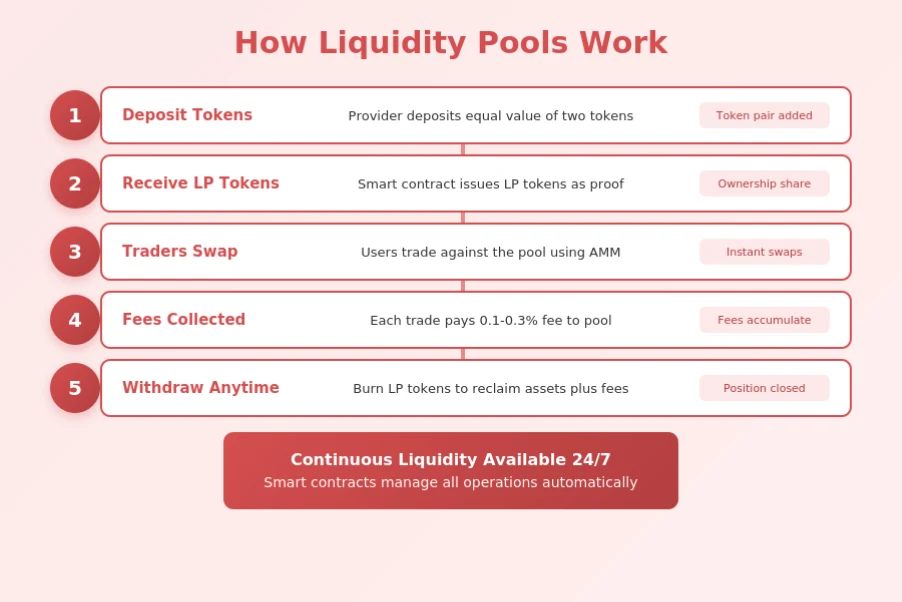
How liquidity pools work begins with users depositing equal values of two tokens into a smart contract. For example, to provide liquidity for an ETH/USDC pool, you would deposit $1,000 worth of ETH and $1,000 worth of USDC. The smart contract tracks your contribution and issues liquidity provider (LP) tokens representing your share of the pool.
When traders want to swap tokens, they interact with the pool rather than individual sellers. The pool uses an automated market maker algorithm to calculate the exchange rate based on the current ratio of tokens. After each trade, the ratio changes slightly, which adjusts the price for subsequent trades. This creates a self-balancing system where prices respond to supply and demand.
Role of smart contracts in liquidity pools
Smart contracts are the foundation that makes liquidity pools in Web3 finance possible. These self-executing programs manage all pool operations automatically: accepting deposits, calculating prices, executing swaps, tracking ownership shares, and distributing fees. No human intervention or centralized authority is needed once the contract is deployed.
The transparency of smart contracts means anyone can verify exactly how a pool operates. The code is public, auditable, and immutable once deployed. This creates trustless systems where participants don’t need to trust the pool operators or each other.
Why Liquidity Pools Matter in Web3 Finance?
Liquidity pools represent more than just a technical innovation; they embody the core principles of decentralization that define Web3. By removing gatekeepers and enabling permissionless participation, they’ve created entirely new financial primitives that weren’t possible in traditional systems. Understanding why liquidity pools matter helps clarify the broader significance of decentralized finance.
Importance of liquidity in decentralized markets
Liquidity is the lifeblood of any market, determining how easily assets can be bought or sold without significant price impact. In decentralized markets, where there’s no central authority to guarantee liquidity, pools solve a fundamental problem. They ensure that traders can always find counterparty liquidity, even for less popular token pairs or during off-peak hours.
Without adequate liquidity, even small trades would cause massive price swings, making decentralized trading impractical. Liquidity pools in Web3 finance have enabled DEXs to handle billions in daily volume with reasonable price stability, proving that decentralized markets can compete with their centralized counterparts.
How liquidity pools enable trustless trading?
Traditional exchanges require users to trust the exchange operator with their funds. Liquidity pools enable trustless trading by keeping assets in transparent smart contracts rather than company-controlled wallets. Users maintain custody of their assets until the moment of trade, and the trade itself is executed by immutable code rather than discretionary operators.
This trustless nature means no registration, no KYC for basic swaps, and no risk of exchange insolvency affecting your funds. The rules are encoded in smart contracts that treat all participants equally, creating a truly open financial system accessible to anyone with an internet connection.
Removing intermediaries in Web3 finance
DeFi liquidity pools have eliminated entire categories of financial intermediaries. There are no market makers taking spreads, no brokers charging commissions, and no custodians holding assets. The smart contract handles everything, and the fees go directly to liquidity providers rather than corporate intermediaries.
This disintermediation creates more efficient markets where the value flows to participants rather than middlemen. A trader in any global market can access the same pools and rates as anyone else, without geographic restrictions or institutional barriers. Professional teams creating comprehensive exchange infrastructure recognize this shift and build systems that embrace decentralized liquidity models.
Liquidity Pools vs Traditional Trading Models
Understanding how liquidity pools differ from traditional trading mechanisms reveals why they’ve become so popular in Web3. Each model has distinct characteristics that make it suitable for different use cases. This comparison helps traders and builders choose the right approach for their needs.
Liquidity pools vs order book systems
Order book systems match specific buy and sell orders at precise prices, requiring a counterparty for every trade. Liquidity pools use algorithmic pricing to provide instant trades against pooled reserves. Order books excel at price discovery and handling large institutional trades, while pools offer simplicity and constant availability for retail-sized transactions.
| Feature | Liquidity Pools (AMM) | Order Book Systems |
|---|---|---|
| Execution Speed | Instant (algorithmic) | Depends on order matching |
| Liquidity Source | Pooled from many providers | Individual market makers |
| Price Discovery | Algorithmic (formula-based) | Market-driven (bids/asks) |
| Large Trade Handling | High slippage possible | Better for large orders |
| Participation Barrier | Anyone can provide | Often requires expertise |
| Availability | 24/7 guaranteed | Depends on active orders |
Limitations of centralized exchanges
Centralized exchanges hold user funds in company-controlled wallets, creating counterparty risk. They can freeze accounts, restrict access based on geography, suffer hacks, or face regulatory shutdowns. Users must complete identity verification, limiting access for those in underserved regions or those valuing privacy.
These limitations drive demand for decentralized alternatives. While centralized exchanges often offer better performance and more features, the trust requirements and access restrictions make them unsuitable for truly open, global finance.
Advantages of AMM-based trading
AMM-based trading through liquidity pools offers several compelling advantages: no registration required, no geographic restrictions, continuous availability, transparent pricing, and the ability for anyone to become a market maker. These features align perfectly with Web3’s vision of open, permissionless financial infrastructure.
Role of Automated Market Makers (AMMs)
Automated market makers are the engines that power liquidity pools, using mathematical formulas instead of human market makers to determine prices. Understanding AMMs is crucial for anyone working with Web3 DeFi protocols, as they define how trades execute and how liquidity providers earn returns.
What are AMMs in DeFi
AMMs are decentralized exchange protocols that use algorithmic pricing instead of order books. Rather than matching buyers with sellers, AMMs let users trade against a pool of tokens, with prices determined by a mathematical formula. This innovation made truly decentralized trading practical by solving the liquidity chicken-and-egg problem.
The first successful AMM, Bancor, launched in 2017, but Uniswap’s 2018 launch popularized the model with its elegant simplicity. Since then, AMMs have become the dominant trading mechanism in DeFi, processing billions in daily volume across multiple blockchains.
AMM pricing algorithms explained
The most common AMM formula is the constant product formula: x * y = k, where x and y represent the quantities of two tokens in a pool, and k is a constant. When someone buys token x, they add token y to the pool and remove token x, but the product must remain constant. This constraint determines the exchange rate.
As trades change the token ratio, prices automatically adjust. Larger trades relative to pool size cause more price movement (slippage). This creates arbitrage opportunities that keep AMM prices aligned with external markets, as traders profit by correcting any price discrepancies.
Popular AMM models in Web3 finance
Different AMM models optimize for different use cases. Uniswap’s constant product works well for volatile pairs. Curve’s stableswap formula minimizes slippage for assets that should trade near 1:1. Balancer allows pools with multiple tokens and custom weights. Each model represents a different approach to the fundamental tradeoffs in automated market making.
Who Are Liquidity Providers?
Liquidity providers are the backbone of the DeFi ecosystem, supplying the assets that make decentralized trading possible. Anyone with tokens can become a liquidity provider, democratizing a role that was previously reserved for institutional market makers. Understanding what motivates LPs helps explain pool dynamics and sustainability.
Liquidity providers in Web3
Liquidity providers in Web3 range from individual holders looking to earn yield on idle assets to sophisticated funds optimizing returns across multiple protocols. Unlike traditional market making, which requires significant capital and expertise, providing liquidity to a pool requires only the tokens and a wallet. This accessibility has attracted millions of participants worldwide.
LPs take on the important role of ensuring market functionality. By depositing tokens, they’re essentially agreeing to buy when others sell and sell when others buy, with the AMM algorithm managing the mechanics. In return, they earn a share of every trade fee generated by the pool.
How users earn from liquidity pools
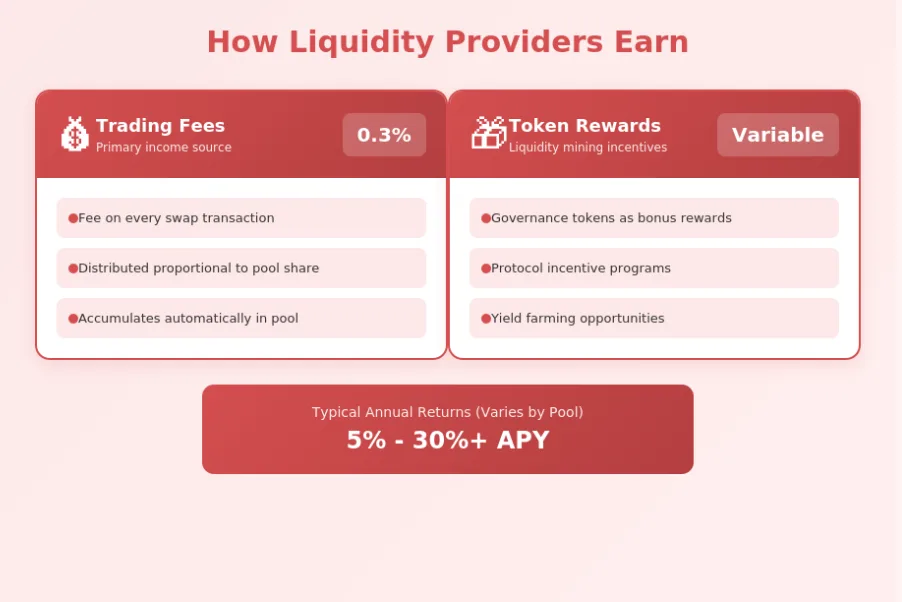
Earnings from liquidity provision come primarily from trading fees. Each time someone swaps tokens using the pool, they pay a fee (typically 0.3% on Uniswap). These fees accumulate in the pool and belong to liquidity providers proportionally to their share. When LPs withdraw, they receive their original tokens plus accumulated fees.
Returns depend heavily on trading volume. A pool handling $1 million daily volume at 0.3% fees generates $3,000 in daily fees. If the pool contains $10 million in liquidity, that’s a 0.03% daily return, or roughly 11% annually. High-volume pools in major markets can be quite profitable.
Incentives and reward mechanisms
Beyond trading fees, many protocols offer additional incentives to attract liquidity. These often come as governance tokens distributed to LPs, a practice called liquidity mining. While these incentives can significantly boost returns, they also tend to attract mercenary capital that leaves when incentives decrease.
LP Earnings Sources
- Trading Fees: 0.1-0.3% of each swap, distributed to all LPs
- Liquidity Mining: Protocol tokens as additional rewards
- Governance Rewards: Voting power and protocol revenue sharing
- Boost Programs: Temporary incentives for specific pools
Benefits of Liquidity Pools
Liquidity pools offer advantages that traditional financial infrastructure simply cannot match. These benefits explain why DeFi has grown so rapidly and why pools have become the default mechanism for decentralized trading. Understanding these advantages helps evaluate when pools are the right solution.
Continuous liquidity availability
Unlike traditional markets that close for nights, weekends, and holidays, liquidity pools operate 24/7/365. Smart contracts don’t sleep, take vacations, or observe banking hours. This continuous availability is crucial for global markets serving users across all time zones and for applications requiring reliable programmatic access to liquidity.
Transparent and permissionless trading
Every aspect of liquidity pool operations is transparent and verifiable on-chain. Anyone can see the pool’s reserves, recent trades, fee accumulation, and smart contract code. This transparency builds trust and enables informed decision-making. The permissionless nature means no gatekeepers can deny access.
Capital efficiency in Web3 finance
Modern AMMs have dramatically improved capital efficiency. Uniswap V3’s concentrated liquidity lets providers focus capital in specific price ranges, often achieving 4000x better efficiency than basic pools. This means better rates for traders and higher returns for providers using the same capital.
Risks and Challenges of Liquidity Pools
While liquidity pools offer significant opportunities, they also carry real risks that participants must understand. Informed decision-making requires acknowledging both the potential rewards and the ways things can go wrong. Responsible participation in DeFi means understanding these risks before committing capital.
Impermanent loss explained
Impermanent loss is the most significant risk for liquidity providers. It occurs when the price ratio of tokens in a pool changes from when you deposited. Due to how AMMs work, your position effectively sells the appreciating asset and buys the depreciating one. If prices diverge significantly, you could end up with less value than simply holding.
The loss is called “impermanent” because it only materializes if you withdraw while prices have diverged. If prices return to the original ratio, the loss disappears. However, prices rarely return exactly, and the opportunity cost of not simply holding can be substantial in trending markets.
Smart contract risks
Smart contracts, while transparent, can contain bugs or vulnerabilities. The DeFi space has seen numerous exploits where attackers drained pools through code vulnerabilities, flash loan attacks, or economic exploits. Even audited contracts aren’t guaranteed safe, as auditors can miss issues.
Market volatility impact on pools
Extreme market volatility amplifies impermanent loss and can create challenging conditions for LPs. During market crashes, pools may experience heavy one-directional trading, leaving LPs holding mostly the depreciating asset. Blockchain transaction fee management becomes critical during volatile periods when gas costs can spike dramatically.
| Risk Type | Description | Mitigation |
|---|---|---|
| Impermanent Loss | Value loss from price divergence | Use stablecoin pairs, monitor positions |
| Smart Contract Bugs | Code vulnerabilities exploited | Use audited, established protocols |
| Rug Pulls | Malicious project drains liquidity | Research thoroughly, check liquidity locks |
| Market Volatility | Rapid price swings amplify losses | Avoid highly volatile pairs |
Common Use Cases of Liquidity Pools
Liquidity pools power a diverse range of Web3 applications beyond simple token swaps. Understanding these use cases reveals the versatility of the liquidity pool model and its central role in decentralized finance infrastructure.
Decentralized exchanges (DEXs)
Decentralized exchanges are the primary application of liquidity pools. Platforms like Uniswap, SushiSwap, and PancakeSwap process billions in trading volume using pool-based AMMs. Users can swap any supported token pair instantly, without accounts, without counterparties, and without trusting the exchange with custody of their funds.
Yield farming and DeFi rewards
Yield farming protocols use liquidity pools to generate returns through various strategies. LPs deposit into pools that the protocol then uses for lending, arbitrage, or other yield-generating activities. These protocols often offer higher returns than simple LP positions but carry additional smart contract risk.
Token swaps and on-chain liquidity
Beyond trading interfaces, liquidity pools provide on-chain liquidity that other smart contracts can access. DeFi applications integrate pool swaps for features like automatic token conversions, collateral adjustments, and arbitrage. This composability makes pools fundamental infrastructure for the broader ecosystem.
Liquidity Pools in the Broader Web3 Ecosystem
Liquidity pools don’t exist in isolation; they’re deeply integrated with the broader Web3 ecosystem. Understanding these connections reveals how liquidity flows through decentralized finance and why pools are essential infrastructure for the entire space.
Liquidity pools and DeFi protocols
Web3 DeFi protocols rely heavily on liquidity pools for various functions. Lending protocols use pool liquidity for instant borrowing. Derivatives platforms use pools for collateral and settlement. Aggregators route trades through multiple pools for best execution. The interconnected nature of DeFi means pool health affects the entire ecosystem.
Cross-chain liquidity solutions
As Web3 expands across multiple blockchains, cross-chain liquidity becomes increasingly important. Bridge protocols use liquidity pools on different chains to facilitate asset transfers. Some projects are building unified liquidity layers that aggregate pools across chains, improving capital efficiency and user experience.
Role of liquidity in Web3 scalability
Adequate liquidity is essential for Web3 scalability. Layer 2 solutions and new chains need liquidity pools to be useful. Without pools enabling trading and DeFi, new networks struggle to attract users and applications. Liquidity is often the limiting factor in blockchain ecosystem growth.
| Step | Stage | Action | Result |
|---|---|---|---|
| 1 | Pool Creation | Deploy smart contract with parameters | Empty pool ready |
| 2 | Initial Liquidity | First LP deposits token pair | Trading enabled |
| 3 | Growth Phase | More LPs join, trading volume increases | Pool matures |
| 4 | Active Trading | Users swap tokens, fees accumulate | LP earnings grow |
| 5 | Withdrawal | LPs redeem tokens plus fees | Position closed |
Liquidity Pool Solutions for Businesses
Businesses looking to leverage liquidity pools have multiple options, from using existing protocols to building custom solutions. Understanding the available approaches helps organizations choose the right path for their specific needs and resources.
DeFi liquidity pool creation services
Specialized services help businesses create and manage liquidity pools tailored to their requirements. These services handle smart contract architecture, security audits, deployment, and ongoing management. For organizations needing custom pool configurations or integration with existing systems, professional services accelerate time to market while ensuring best practices.
AMM protocol integration
Many businesses integrate existing AMM protocols rather than building from scratch. This approach leverages battle-tested code and existing liquidity while allowing custom interfaces and user experiences. Integration can range from simple front-end wrappers to complex multi-protocol aggregation strategies.
Teams providing complete trading platform infrastructure often combine AMM integration with additional features like advanced order types, portfolio management, and cross-chain capabilities to create comprehensive solutions.
Web3 finance infrastructure solutions
Comprehensive Web3 finance infrastructure goes beyond individual pools to include the entire stack: wallet integration, transaction management, analytics, compliance tools, and user interfaces. Businesses entering the space often need end-to-end solutions that handle complexity while presenting simple experiences to users.
Future of Liquidity Pools in Web3 Finance
Liquidity pool technology continues evolving rapidly, with innovations addressing current limitations and enabling new use cases. Understanding these trends helps participants and builders prepare for what’s coming and identify emerging opportunities.
Innovations in liquidity mechanisms
New liquidity mechanisms are addressing persistent challenges. Concentrated liquidity (pioneered by Uniswap V3) improves capital efficiency dramatically. Time-weighted average market makers reduce manipulation. Proactive market making adjusts parameters based on external signals. These innovations make pools more competitive with traditional market making.
Next-generation AMM models
Next-generation AMMs incorporate features that were previously impossible. Some use oracles to inform pricing, reducing impermanent loss. Others implement dynamic fees that adjust to market conditions. Hybrid models combine AMM liquidity with order book features. Expert teams building advanced trading platforms and exchanges monitor these developments to incorporate the most promising innovations.
Evolving role of liquidity in Web3 finance
The role of liquidity in Web3 continues expanding beyond trading. Liquidity powers lending, derivatives, insurance, and emerging applications not yet imagined. As the ecosystem matures, efficient liquidity allocation becomes increasingly important, driving innovation in routing, aggregation, and cross-chain solutions.
Understand Liquidity in Web3 Finance
Discover how liquidity pools drive trading, yield, and decentralization in Web3.
Conclusion
Liquidity pools in Web3 have transformed how we think about trading and market making. By replacing centralized intermediaries with transparent smart contracts and enabling anyone to become a liquidity provider, they embody the core principles of decentralization. Understanding what are liquidity pools, how they work, and their role in the broader ecosystem is essential for anyone participating in or building for Web3.
From DeFi liquidity pools powering decentralized exchanges to sophisticated AMM models optimizing capital efficiency, the technology continues evolving. While risks like impermanent loss and smart contract vulnerabilities require careful consideration, the benefits of continuous liquidity, permissionless access, and transparent operation make pools fundamental infrastructure for decentralized finance.
Web3 liquidity pools explained in this guide represent just the beginning. As the ecosystem matures, innovations in concentrated liquidity, cross-chain solutions, and hybrid models will continue improving efficiency and reducing risks. For businesses and individuals alike, understanding liquidity pools is key to navigating the future of finance.
Frequently Asked Questions
Liquidity pools are smart contract-based reserves of token pairs that enable decentralized trading without traditional order books. Users deposit equal values of two tokens into these pools, which automated market makers (AMMs) then use to facilitate trades. In exchange for providing liquidity, depositors earn a share of trading fees generated by the pool.
Impermanent loss occurs when the price ratio of tokens in a liquidity pool changes compared to when you deposited them. If one token’s price rises significantly relative to the other, you would have been better off simply holding the tokens. The loss is “impermanent” because it only becomes realized when you withdraw, and prices could return to their original ratio.
Liquidity providers earn money primarily through trading fees, typically ranging from 0.1% to 0.3% of each trade, distributed proportionally based on pool share. Many protocols also offer additional incentives through governance tokens or yield farming rewards. Returns vary based on trading volume, pool size, and market conditions, with higher-volume pools generally offering better returns.
Order books match specific buy and sell orders at exact prices, requiring counterparties for each trade. Liquidity pools use algorithms to provide instant liquidity at calculated prices without needing matching orders. Order books offer more precise pricing and are better for large trades, while pools provide constant availability and work better for smaller, frequent trades.
Most DeFi protocols allow any ERC-20 tokens (or equivalent standards on other chains) to be paired in liquidity pools. Common pairs include stablecoins with volatile assets, major cryptocurrencies like ETH paired with various tokens, and governance token pairs. Some specialized pools support multiple tokens or single-sided liquidity provision.
Reviewed & Edited By

Aman Vaths
Founder of Nadcab Labs
Aman Vaths is the Founder & CTO of Nadcab Labs, a global digital engineering company delivering enterprise-grade solutions across AI, Web3, Blockchain, Big Data, Cloud, Cybersecurity, and Modern Application Development. With deep technical leadership and product innovation experience, Aman has positioned Nadcab Labs as one of the most advanced engineering companies driving the next era of intelligent, secure, and scalable software systems. Under his leadership, Nadcab Labs has built 2,000+ global projects across sectors including fintech, banking, healthcare, real estate, logistics, gaming, manufacturing, and next-generation DePIN networks. Aman’s strength lies in architecting high-performance systems, end-to-end platform engineering, and designing enterprise solutions that operate at global scale.