Key Takeaways
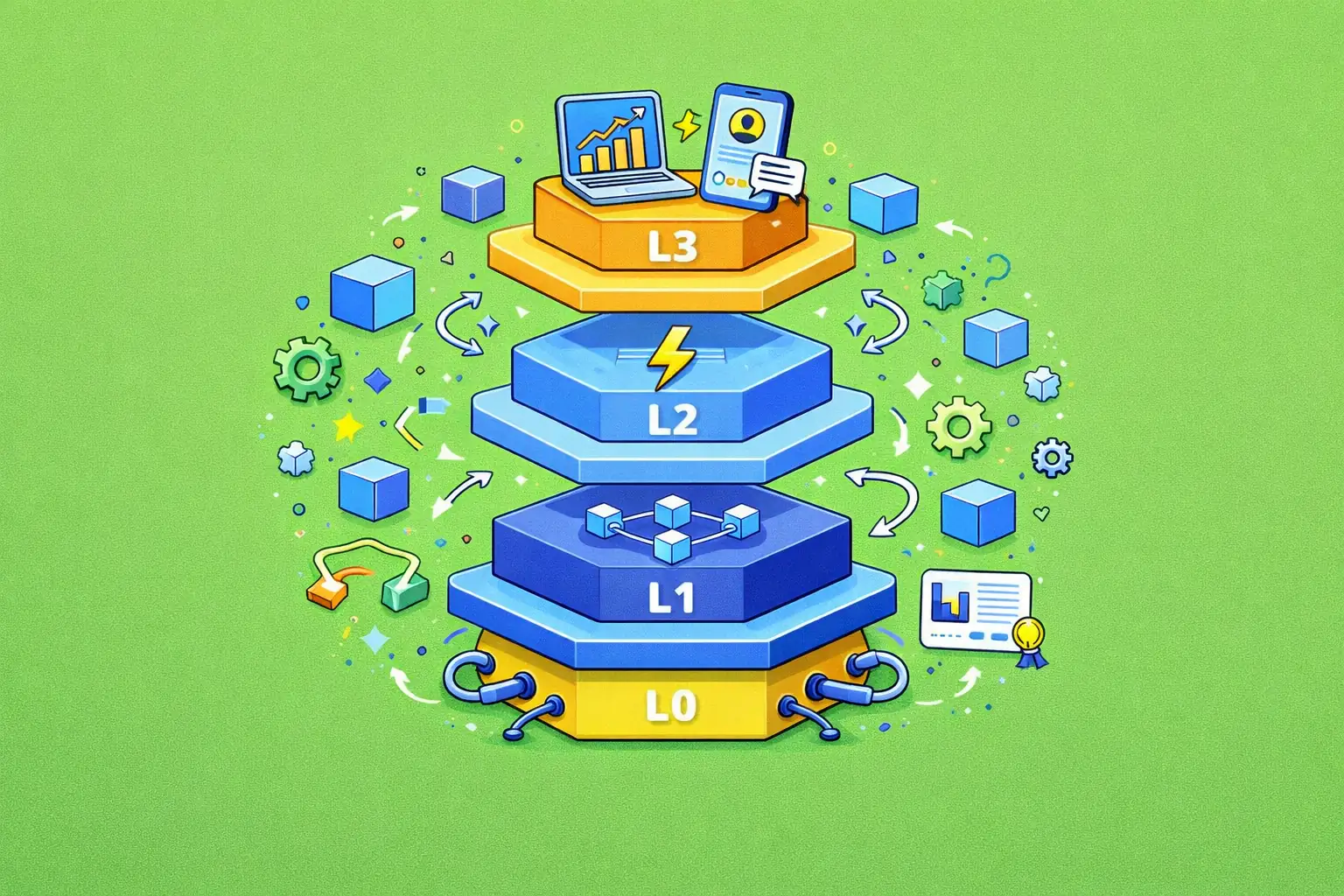
- Blockchain layers refer to the stacked architecture that divides network functions into L0, L1, L2, and L3 components.
- Layer 0 provides the foundational infrastructure that allows multiple Layer 1 blockchains to communicate and operate together.
- Layer 1 is the base blockchain itself, such as Bitcoin, Ethereum, or Solana, responsible for consensus and transaction finality.
- Layer 2 solutions sit on top of Layer 1 to increase transaction speed and reduce fees without compromising security.
- Layer 3 focuses on the application layer, powering decentralized apps, games, DeFi platforms, and user interfaces.
- Each layer solves a specific part of the blockchain trilemma: balancing decentralization, security, and scalability.
- Popular Layer 2 solutions include Lightning Network for Bitcoin and Optimism, Arbitrum, and zkSync for Ethereum.
- Polkadot and Cosmos are leading examples of Layer 0 protocols enabling cross chain interoperability.
- The layered architecture allows developers to build specialized solutions without overloading a single blockchain.
- Enterprises benefit from understanding blockchain layers to choose the right technology stack for their specific use case.
-
Blockchain technology is often described as a single system, but in reality it is built like a layered cake, where each layer serves a unique and essential purpose. Understanding blockchain layers is the key to grasping how decentralized networks achieve speed, security, scalability, and usability all at the same time. From the foundational infrastructure of Layer 0 to the user facing applications of Layer 3, every layer plays a distinct role in the blockchain ecosystem.
If you have ever wondered why some blockchains are faster than others, why Ethereum needs scaling solutions, or what terms like L1, L2, and rollups actually mean, this guide will answer all of those questions. We will walk you through each blockchain layer using simple language, real world examples, visual flowcharts, and practical insights that make this complex topic easy to understand.
Visual Overview: The Blockchain Layer Stack
Before we dive deep into each layer, here is a visual overview of how blockchain layers stack on top of each other. Think of this like floors in a building, where each floor depends on the one below it.
Application Layer
dApps, DeFi, Games, Wallets, User Interfaces
Scaling Layer
Rollups, State Channels, Sidechains, Lightning Network
Base Blockchain
Bitcoin, Ethereum, Solana, BNB Chain, Avalanche
Infrastructure Layer
Polkadot, Cosmos, Internet Protocols, Hardware Nodes
Each layer builds upon the one below it. Layer 0 is the foundation, and Layer 3 is where users interact with blockchain powered products.
Why Does Blockchain Need Layers?
Imagine trying to run an entire city using a single road. At first, the road handles traffic fine. But as the city grows, that one road becomes congested, slow, and unreliable. The solution is not to make the road infinitely wider but to build an entire transportation system with highways, local streets, metro lines, and pedestrian walkways, each handling a different type of traffic.
Blockchain faces the same challenge, known as the blockchain trilemma. Every blockchain must balance three properties:
- Decentralization: No single entity controls the network.
- Security: The network is resistant to attacks and fraud.
- Scalability: The network can handle a large volume of transactions quickly and affordably.
Achieving all three simultaneously on a single layer is extremely difficult. That is why the industry adopted a layered architecture, where each layer specializes in solving one part of the trilemma. This division of labor is what makes modern blockchain ecosystems powerful and flexible.
Layer 0: The Infrastructure Foundation
Layer 0 (L0) is the bedrock of the blockchain ecosystem. It provides the underlying infrastructure, protocols, and frameworks that allow multiple Layer 1 blockchains to be built, connected, and able to communicate with each other.
Think of Layer 0 as the land, plumbing, and electrical wiring beneath a building. You never interact with it directly, but without it, the building cannot function. Layer 0 handles things like internet connectivity between nodes, data transfer protocols, cross chain messaging, and the hardware that runs blockchain software.
Cross Chain Communication
Enables different blockchains to exchange data and assets seamlessly
Shared Security
Provides security guarantees that connected L1 chains can inherit
Custom Chain Creation
Allows developers to launch their own purpose built blockchains
Real World Layer 0 Examples
- Polkadot: Uses a relay chain architecture where multiple parachains (custom blockchains) connect to a central relay chain for shared security and interoperability.
- Cosmos: Built around the Inter Blockchain Communication (IBC) protocol, allowing independent blockchains (called zones) to exchange tokens and data through hubs.
- Avalanche: Provides a platform for creating custom subnets, each functioning as an independent network while sharing the core infrastructure.
Layer 1: The Base Blockchain
Layer 1 (L1) is the main blockchain network itself. It is the chain that processes and finalizes transactions, maintains the distributed ledger, and runs the consensus mechanism. When people talk about “the Bitcoin blockchain” or “the Ethereum network,” they are referring to Layer 1.
Think of Layer 1 as the main highway in a city. It is the primary road that carries the most traffic and connects all the key areas. Everything else in the ecosystem depends on this highway being reliable, secure, and well maintained.
Core Responsibilities of Layer 1
- Transaction validation: Confirming that all transactions follow the network rules.
- Consensus: Running the mechanism (Proof of Work, Proof of Stake, etc.) that keeps all nodes in agreement.
- Data storage: Maintaining the complete history of every transaction on the blockchain.
- Native token management: Issuing and managing the blockchain’s native cryptocurrency (BTC, ETH, SOL, etc.).
- Smart contract execution: Running programmable contracts on platforms like Ethereum and Solana.
How Layer 1 Blockchains Try to Scale
Layer 1 networks use various techniques to improve their own throughput without relying on external layers:
- Increasing block size: Larger blocks can hold more transactions (Bitcoin Cash took this approach).
- Sharding: Splitting the blockchain into smaller parallel segments (shards) that process transactions simultaneously. Ethereum’s roadmap includes sharding.
- Faster consensus: Using more efficient consensus mechanisms like Proof of Stake or Proof of History (Solana) to speed up block production.
Layer 2: The Scaling Powerhouse
Layer 2 (L2) solutions are built on top of an existing Layer 1 blockchain to handle transactions off the main chain, dramatically increasing speed and reducing costs. The key principle is that L2 processes transactions separately but still relies on the security of the underlying L1.
Think of Layer 2 like an express lane or carpool lane on a highway. The main highway (L1) is still there and still secure, but the express lane (L2) lets certain vehicles move much faster without adding congestion to the main road. When the express lane needs to “settle up,” it reports back to the main highway.
How Layer 2 Processing Works: Step by Step Flow
User initiates a transaction on the Layer 2 network
L2 collects and bundles hundreds of transactions together
Bundled transactions are compressed into a single proof or summary
The compressed proof is submitted to the Layer 1 blockchain for final settlement
Layer 1 validates the proof and permanently records the finalized state ✓
Types of Layer 2 Solutions
- Optimistic Rollups: Assume all transactions are valid by default and only run computation if someone challenges a transaction. Examples include Optimism and Arbitrum.
- Zero Knowledge (ZK) Rollups: Use mathematical proofs to verify transaction validity without revealing the underlying data. Examples include zkSync and StarkNet.
- State Channels: Allow two parties to transact repeatedly off chain and only settle the final result on chain. The Lightning Network for Bitcoin is the most well known example.
- Sidechains: Independent blockchains that run parallel to the main chain with their own consensus but are connected via a bridge. Polygon (previously Matic) started as a sidechain solution.
Layer 3: The Application and User Experience Layer
Layer 3 (L3) is the layer that users actually see and interact with. It includes decentralized applications (dApps), DeFi platforms, NFT marketplaces, blockchain games, wallets, and all the interfaces that make blockchain technology usable for everyday people.
If Layer 0 is the land beneath the building, Layer 1 is the building’s structure, and Layer 2 is the elevator system that moves people efficiently, then Layer 3 is the shops, offices, and apartments inside the building where people actually live, work, and do business.
What Layer 3 Includes
DeFi Platforms
Uniswap, Aave, Compound
NFT Marketplaces
OpenSea, Blur, Magic Eden
Blockchain Games
Axie Infinity, Illuvium, Gods Unchained
Wallets and Tools
MetaMask, Trust Wallet, Rabby
Complete Comparison: Blockchain L0 vs L1 vs L2 vs L3
| Feature | Layer 0 | Layer 1 | Layer 2 | Layer 3 |
|---|---|---|---|---|
| Primary Role | Infrastructure and interoperability | Consensus and transaction finality | Scaling and speed | User facing applications |
| Examples | Polkadot, Cosmos | Bitcoin, Ethereum, Solana | Arbitrum, Optimism, Lightning | Uniswap, OpenSea, Aave |
| User Interaction | None (invisible to users) | Indirect (via wallets) | Indirect (via bridges) | Direct (daily usage) |
| Trilemma Focus | Interoperability | Security and Decentralization | Scalability | Usability |
| Transaction Speed | N/A | Low to moderate | Very high | Depends on L1/L2 used |
| Transaction Fees | N/A | Higher (gas fees) | Significantly lower | Varies by platform |
| Security Model | Provides shared security | Self secured (own consensus) | Inherits from L1 | Depends on underlying layers |
How All Four Layers Work Together
The real power of the layered blockchain architecture is not in any single layer but in how they all work together as a unified system. Let us trace a real world example to see this in action.
Example: Swapping Tokens on a DeFi Platform
Imagine you want to swap ETH for USDC on a decentralized exchange. Here is how each layer contributes:
Infrastructure connects all nodes
The underlying network infrastructure ensures your wallet can communicate with the blockchain and that all validator nodes stay synchronized.
Ethereum provides security and finality
The Ethereum mainnet serves as the ultimate settlement layer, ensuring your transaction is permanently recorded and cannot be reversed.
Arbitrum processes the swap cheaply
Instead of paying high Ethereum gas fees, the swap is executed on Arbitrum (Layer 2), reducing costs from several dollars to just a few cents.
Uniswap gives you a clean interface
You interact with the Uniswap dApp (Layer 3), which provides a simple interface to select tokens, set amounts, and click swap, hiding all the complexity underneath.
Layer 2 Solutions Compared: Rollups vs State Channels vs Sidechains
| Feature | Optimistic Rollups | ZK Rollups | State Channels | Sidechains |
|---|---|---|---|---|
| Security | Inherits from L1 | Inherits from L1 | Inherits from L1 | Own consensus (weaker) |
| Speed | High | Very high | Near instant | High |
| Cost | Low | Very low | Minimal | Low |
| Withdrawal Time | 7 day challenge period | Minutes (proof verified) | When channel closes | Minutes via bridge |
| Best Use Case | General dApp scaling | High frequency trading, payments | Micropayments between two parties | Gaming, specialized apps |
| Example | Arbitrum, Optimism | zkSync, StarkNet | Lightning Network | Polygon PoS |
How Layers Solve the Blockchain Trilemma
The blockchain trilemma, first described by Ethereum co founder Vitalik Buterin, states that a single blockchain can only optimize for two out of three properties: decentralization, security, and scalability. The layered approach solves this by letting each layer focus on what it does best.
SECURITY
Handled by L1
SCALABILITY
Handled by L2
DECENTRALIZATION
Handled by L0 + L1
By distributing responsibilities across layers, the overall ecosystem achieves what no single chain can do alone. Layer 1 prioritizes security and decentralization. Layer 2 adds the scalability needed for mass adoption. Layer 0 ensures everything stays connected. And Layer 3 makes it all accessible. You can read more about the blockchain trilemma and scaling approaches on Ethereum.org.
Real World Ecosystem Examples
The Ethereum Ecosystem Stack
Ethereum provides one of the clearest examples of the layered architecture in action:
- L0: Internet protocols and P2P networking (devp2p) that allow Ethereum nodes worldwide to communicate.
- L1: Ethereum mainnet, running Proof of Stake consensus, processing transactions, and executing smart contracts.
- L2: Arbitrum, Optimism, zkSync, Base, and other rollups that handle thousands of transactions per second at a fraction of L1 costs.
- L3: Uniswap, Aave, OpenSea, Lido, and hundreds of dApps that let users trade, lend, borrow, and create digital assets.
The Bitcoin Ecosystem Stack
- L1: Bitcoin mainnet, the most secure and decentralized blockchain, focused on being a store of value and settlement layer.
- L2: Lightning Network enables near instant, low cost Bitcoin payments by processing transactions off chain and settling on L1.
- L3: Apps like Strike, Wallet of Satoshi, and various merchant payment tools that use Lightning for everyday Bitcoin payments.
Why Blockchain Layers Matter for Enterprises
For businesses exploring blockchain technology, understanding layers is essential for making the right architectural decisions. Choosing the wrong layer or ignoring the layered structure can lead to high costs, poor performance, and security vulnerabilities.
- Supply chain tracking: May use Layer 1 for immutable record keeping with Layer 2 for handling high transaction volumes across global partners.
- Financial services: Require Layer 1 security for settlement while using Layer 2 for fast, affordable payment processing.
- Gaming and entertainment: Often built on Layer 2 or Layer 3 for speed, with assets secured on Layer 1.
- Cross industry platforms: May leverage Layer 0 to connect multiple industry specific blockchains for seamless data exchange.
Security Considerations Across Blockchain Layers
Each layer introduces its own security considerations. Understanding these helps developers and enterprises build more resilient systems:
- Layer 0: Vulnerabilities in cross chain bridges or relay mechanisms can expose connected chains to coordinated attacks.
- Layer 1: The primary threats include 51% attacks, consensus bugs, and smart contract vulnerabilities.
- Layer 2: Risks include bridge exploits (moving funds between L1 and L2), sequencer centralization in rollups, and data availability issues.
- Layer 3: Application level risks such as front end attacks, phishing, faulty smart contract logic, and oracle manipulation.
Security is strongest when each layer is properly audited and when the layers interact through well tested interfaces. A weakness at any layer can compromise the entire stack, which is why comprehensive security reviews across all layers are critical. You can explore more about blockchain security best practices on Bitcoin.org.
The Future of Blockchain Layers
The layered architecture of blockchain is still evolving rapidly. Several trends are shaping the future:
- Layer 2 dominance: Most user activity is expected to shift to Layer 2 networks, with Layer 1 serving primarily as a security and settlement backbone.
- Specialized Layer 3 chains: Application specific chains (appchains) are emerging, where an entire L3 blockchain is dedicated to a single application like a game or a DeFi protocol.
- Seamless cross layer experience: Future wallets and interfaces will abstract away layers entirely, so users will not need to know which layer they are transacting on.
- Modular blockchain design: Projects like Celestia are separating data availability, execution, and consensus into independent modular layers, creating even more flexibility.
- ZK technology expansion: Zero knowledge proofs are expected to transform not just Layer 2 but also Layer 1 verification and cross chain communication at Layer 0.
Ready to Build on the Right Blockchain Layer?
Choosing the right blockchain layer for your project can mean the difference between a scalable success and a costly mistake. Whether you need Layer 1 smart contracts, Layer 2 scaling integration, or a full stack Web3 application, Nadcab Labs provides expert blockchain development and consulting to help startups and enterprises build with confidence.
Conclusion
Understanding blockchain layers is fundamental to making sense of the decentralized technology landscape. Layer 0 provides the invisible infrastructure that connects chains. Layer 1 delivers the security and consensus that make blockchain trustworthy. Layer 2 adds the speed and affordability needed for mass adoption. And Layer 3 brings it all to life through the applications and interfaces that millions of people use every day.
The layered approach is not just a technical detail. It is the architectural philosophy that allows blockchain to scale without sacrificing its core values of decentralization and security. As the ecosystem continues to evolve with modular designs, advanced ZK proofs, and seamless user experiences, the importance of understanding each layer will only grow.
Whether you are a developer choosing where to deploy your next smart contract, an investor evaluating which projects have the strongest technical foundations, or a business leader deciding how to integrate blockchain into your operations, knowing how L0, L1, L2, and L3 work together gives you a decisive advantage in the world of Web3.
Frequently Asked Questions
Blockchain layers are different levels of a blockchain system, where each layer handles a specific task like security, scalability, or applications to make the network efficient and usable.
Layer 0 enables blockchain interoperability, Layer 1 is the main blockchain network, Layer 2 improves speed and lowers costs, and Layer 3 is where user-facing applications are built.
Blockchain layers help solve key challenges like scalability, high transaction fees, and usability by dividing responsibilities across multiple layers instead of relying on one network.
Layer 0 is the infrastructure layer that connects multiple blockchains, allowing them to communicate, share data, and transfer value securely across networks.
Popular Layer 2 solutions include Arbitrum, Optimism, zkSync, Polygon, and the Lightning Network for Bitcoin.
Popular Layer 0 protocols include Polkadot, Cosmos, and Avalanche, which enable cross-chain communication and multi-chain ecosystems.
Layer 1 blockchains prioritize security and decentralization, which can limit transaction speed and increase fees during high network activity.
Layer 2 networks process transactions off-chain and then submit compressed transaction data back to the Layer 1 blockchain for final settlement.
Reviewed & Edited By

Aman Vaths
Founder of Nadcab Labs
Aman Vaths is the Founder & CTO of Nadcab Labs, a global digital engineering company delivering enterprise-grade solutions across AI, Web3, Blockchain, Big Data, Cloud, Cybersecurity, and Modern Application Development. With deep technical leadership and product innovation experience, Aman has positioned Nadcab Labs as one of the most advanced engineering companies driving the next era of intelligent, secure, and scalable software systems. Under his leadership, Nadcab Labs has built 2,000+ global projects across sectors including fintech, banking, healthcare, real estate, logistics, gaming, manufacturing, and next-generation DePIN networks. Aman’s strength lies in architecting high-performance systems, end-to-end platform engineering, and designing enterprise solutions that operate at global scale.