
Key Takeaways
- Crypto apps serve as the primary gateway for users to interact with blockchain networks, enabling transactions, trading, and decentralized finance activities.
- DAOs in DeFi Space are transforming how crypto platforms govern themselves, placing decision making power directly in the hands of token holding communities.
- Security layers such as two factor authentication, biometric verification, and cold storage integration are non negotiable requirements for any reliable crypto application.
- The crypto app ecosystem spans wallets, exchanges, DeFi protocols, NFT marketplaces, and portfolio trackers, each catering to distinct user needs and financial goals.
- Blockchain technology forms the backbone of every crypto app, ensuring transparency, immutability, and trustless verification of every transaction recorded on the network.
- Regulatory compliance, including KYC and AML frameworks, is rapidly becoming mandatory for crypto app operators across major global jurisdictions.
- DeFi and Web3 crypto apps enable users to lend, borrow, stake, and earn yields without relying on centralized financial intermediaries or traditional banking systems.
- Choosing the right crypto app requires evaluating factors like security certifications, supported blockchains, fee structures, and the quality of user experience offered.
- Emerging trends like AI powered analytics, cross chain interoperability, and account abstraction are poised to redefine the crypto app landscape in 2026 and beyond.
- Partnering with experienced blockchain specialists like Nadcab Labs ensures your crypto app is built with enterprise grade security, scalable architecture, and full regulatory readiness.
Introduction to Crypto Apps
The global adoption of cryptocurrency has accelerated dramatically over the past several years, bringing millions of new users into the blockchain ecosystem. At the center of this transformation sits the crypto app, a digital tool that bridges everyday users with the vast, decentralized world of digital assets. Whether someone is sending Bitcoin across borders, staking Ethereum for passive income, or participating in DAOs in DeFi Space to vote on protocol governance, crypto apps make all of it possible from a smartphone or desktop browser.
According to industry estimates, the global crypto app market is expected to surpass $2.5 billion in value by 2027, fueled by increasing institutional adoption, evolving regulatory frameworks, and the growing demand for decentralized application solutions. For entrepreneurs, startups, and enterprises, building a crypto app is no longer a niche venture; it is a strategic imperative. This comprehensive guide walks you through everything you need to know about crypto apps, their architecture, security features, types, and why hiring skilled crypto app developers is the smartest move you can make in 2026.
What Is a Crypto App?
A crypto app is a software application specifically designed to facilitate interactions with blockchain networks and cryptocurrency assets. Unlike traditional banking applications that operate through centralized servers controlled by a single institution, crypto apps leverage decentralized blockchain infrastructure where no single entity holds absolute authority over user funds or data.
These applications allow users to perform a wide range of functions, including purchasing and selling digital currencies, storing private keys securely, executing peer to peer transfers, participating in decentralized exchanges, and engaging with smart contracts. The core philosophy behind every crypto app is empowerment: giving individuals direct control over their financial assets without intermediaries.
Crypto apps can be broadly categorized as custodial (where the platform holds your private keys) or non custodial (where you alone control your keys). This distinction is fundamental and influences everything from the app’s security architecture to how users recover their accounts if access is lost.[1]
How Crypto Apps Work
Understanding the operational mechanics of a crypto app helps users and builders alike appreciate the complexity hidden behind a seemingly simple interface. Every crypto application operates through a carefully orchestrated sequence of processes that begins the moment a user creates an account and extends through every transaction they initiate.
The process typically starts with user registration and wallet generation. During registration, the app creates a unique cryptographic key pair consisting of a public key (your blockchain address) and a private key (your secret signature). This key pair is the foundation of all blockchain interactions. When a user initiates a transaction, the app constructs the transaction data, signs it with the user’s private key, and broadcasts it to the blockchain network for validation by nodes and miners or validators, depending on the consensus mechanism used.
Once the network validates and confirms the transaction, the data is permanently recorded on the blockchain, creating an immutable audit trail. This entire flow happens within seconds for many modern blockchains, although confirmation times vary significantly across networks. Ethereum, Solana, BNB Chain, and Polygon each offer different speed and cost trade offs that influence which blockchain a crypto app developer might choose for their project.
Key Features of a Crypto App
A well built crypto application combines several critical features that collectively determine its reliability, usability, and market competitiveness. Below is a detailed overview of the essential features every crypto app should incorporate.
Essential Crypto App Features Overview
| Feature | Description | Priority Level |
|---|---|---|
| Multi Currency Support | Ability to store, send, and receive multiple cryptocurrencies within one interface | Critical |
| Real Time Price Tracking | Live market data feeds displaying current prices, charts, and volume indicators | Critical |
| Two Factor Authentication | Additional security layer beyond passwords, typically via SMS or authenticator apps | Critical |
| Push Notifications | Instant alerts for price movements, transaction confirmations, and security events | Important |
| QR Code Scanner | Simplifies address input for sending and receiving crypto through camera scanning | Important |
| KYC and AML Compliance | Built in identity verification modules that satisfy regional regulatory requirements | Critical |
| Fiat On Ramp and Off Ramp | Integration with payment gateways for converting fiat currency to crypto and vice versa | Critical |
| DAO Governance Integration | Enables users to participate in DAOs in DeFi Space for community driven decisions | Important |
Types of Crypto Apps
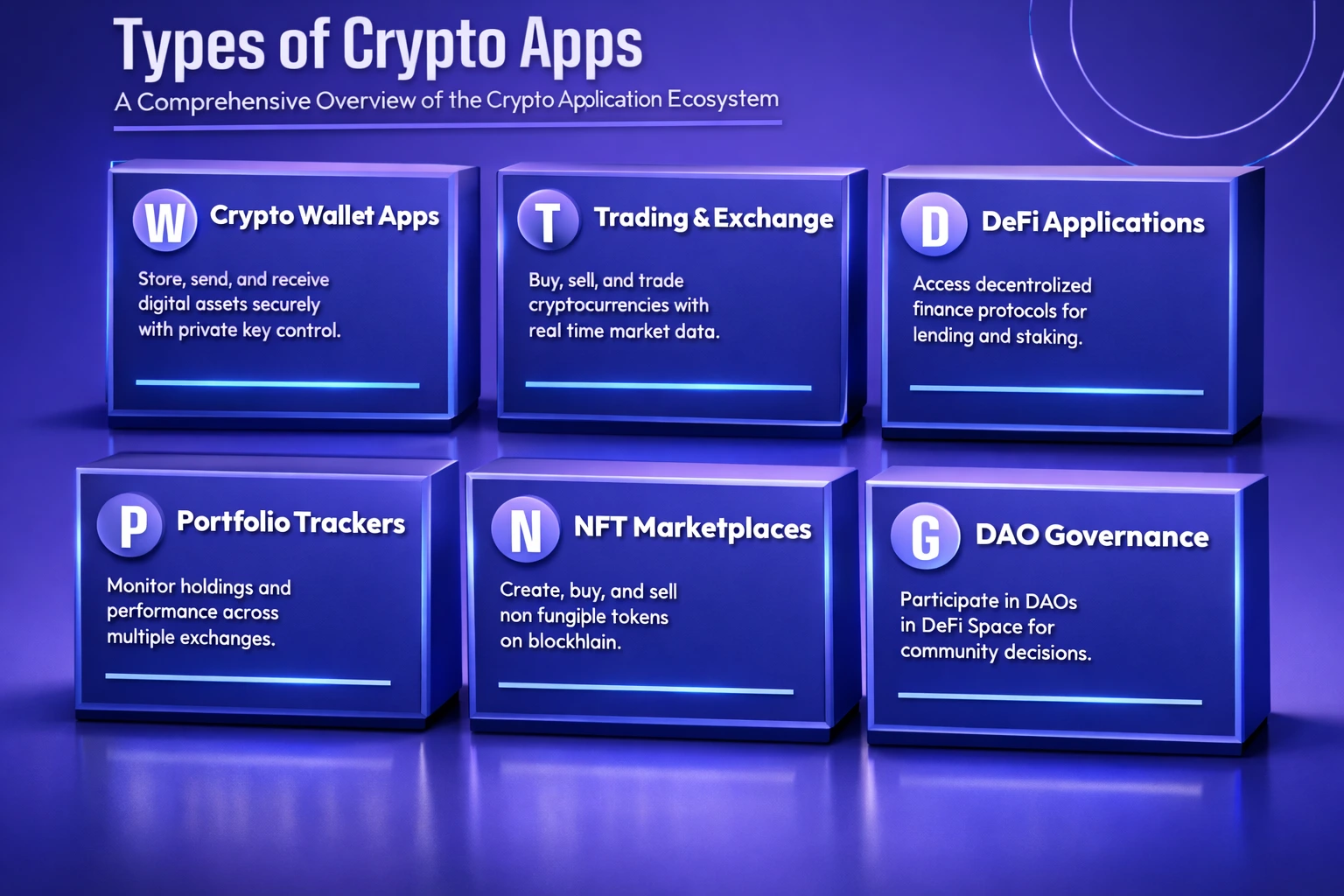
The crypto app ecosystem is diverse, with each category serving a unique purpose in the digital finance landscape. Understanding the various types helps users select the right tool for their needs and helps developers identify which niche to target. From simple wallet apps to complex DeFi protocols, the market offers specialized solutions for every use case.
Crypto Wallet Apps Explained
Crypto wallet apps are the foundational layer of the entire cryptocurrency ecosystem. Every interaction a user has with blockchain technology begins and ends with a wallet. These apps store the cryptographic keys that prove ownership of digital assets and enable users to authorize transactions on blockchain networks.
There are several wallet types, each offering different levels of security and convenience. Hot wallets remain connected to the internet and provide quick access for daily transactions. Cold wallets, on the other hand, store keys offline and are ideal for long term asset storage. Hardware wallets like Ledger and Trezor fall into the cold wallet category, while software wallets like MetaMask and Trust Wallet are popular hot wallet choices.
For businesses looking to build a crypto wallet application, the key consideration is balancing security with user experience. A wallet that is supremely secure but difficult to use will lose users to simpler alternatives. The best wallets combine robust encryption, intuitive interfaces, and multi chain support to deliver a seamless experience.
Custodial vs Non Custodial Wallet Comparison
| Parameter | Custodial Wallet | Non Custodial Wallet |
|---|---|---|
| Key Control | Platform holds private keys | User holds private keys |
| Recovery Options | Password reset through platform | Seed phrase only (12 or 24 words) |
| Security Risk | Centralized hack target | User responsible for key safety |
| User Experience | Beginner friendly, simpler setup | Requires technical understanding |
| DeFi Access | Limited or restricted | Full access to DeFi protocols |
| Examples | Coinbase, Binance, Kraken | MetaMask, Trust Wallet, Phantom |
Crypto Trading and Exchange Apps
Crypto trading and exchange apps represent the most commercially significant segment of the crypto app market. These platforms facilitate the buying, selling, and trading of digital assets, generating revenue through transaction fees, spreads, and premium subscription offerings. The global crypto exchange market processes billions of dollars in daily trading volume, making it one of the most lucrative sectors in the blockchain industry.
Centralized exchanges (CEXs) like Binance and Coinbase operate similarly to traditional stock exchanges, with the platform acting as an intermediary that matches buy and sell orders. Decentralized exchanges (DEXs) like Uniswap and SushiSwap, however, use automated market maker (AMM) protocols powered by smart contracts to enable peer to peer trading without a central authority. The rise of DAOs in DeFi Space has further influenced how decentralized exchanges evolve, as governance token holders can propose and vote on changes to fee structures, liquidity incentives, and supported trading pairs.
For entrepreneurs looking to build a crypto exchange platform, understanding the trade offs between centralized and decentralized models is essential. CEXs offer better performance and user experience, while DEXs offer trustless trading and full asset custody for users.
DeFi and Web3 Crypto Apps
Decentralized Finance, commonly known as DeFi, represents the most transformative application of blockchain technology beyond simple value transfer. DeFi crypto apps replicate traditional financial services such as lending, borrowing, insurance, and yield farming in a completely decentralized manner, removing the need for banks, brokers, and other financial intermediaries.
The total value locked (TVL) in DeFi protocols has fluctuated between $50 billion and $200 billion over recent cycles, illustrating both the massive opportunity and the inherent volatility of this sector. Leading DeFi apps like Aave, Compound, and MakerDAO allow users to earn interest on deposits, borrow against collateral, and participate in liquidity provision, all governed by immutable smart contracts.
What makes DeFi particularly powerful is the integration of DAOs in DeFi Space. These decentralized autonomous organizations enable protocol governance through community voting, ensuring that no single team or company can unilaterally change the rules. For example, MakerDAO’s governance token (MKR) holders vote on critical parameters like collateral ratios, stability fees, and which assets can be used as collateral. This democratized approach to financial governance is a core thesis behind the entire DeFi movement.
Web3 takes this further by envisioning a user owned internet where data, identity, and digital assets are controlled by individuals rather than corporations. Crypto apps that embrace Web3 principles integrate decentralized identity solutions, token gated access, and on chain reputation systems to create entirely new models of digital interaction.
Security Features in Crypto Apps
Security is the single most critical factor that determines the success or failure of a crypto app. The irreversible nature of blockchain transactions means that stolen funds are virtually impossible to recover, making robust security architecture a non negotiable requirement for any legitimate crypto application.
A comprehensive security framework for crypto apps includes multiple layers of protection. Encryption ensures all data transmitted between the user and the server remains confidential, with AES 256 being the industry standard for data at rest and TLS 1.3 for data in transit. Multi signature wallet technology requires two or more private key signatures to authorize a transaction, dramatically reducing the risk of unauthorized access.
Smart contract audits conducted by reputable security firms like CertiK, Trail of Bits, and OpenZeppelin are essential before any DeFi app launches. These audits systematically review the contract code for vulnerabilities, logic errors, and potential exploit vectors. The importance of audits cannot be overstated: some of the largest hacks in crypto history, including the DAO hack of 2016 and multiple bridge exploits, resulted from unaudited or poorly audited smart contracts.
User Authentication and Privacy in Crypto Apps
Authentication in crypto apps has evolved far beyond simple username and password combinations. Modern crypto applications implement layered authentication strategies that balance security with user convenience. Biometric authentication using fingerprint scanning and facial recognition has become standard on mobile crypto apps, providing a fast and secure way for users to verify their identity without typing passwords.
Privacy is another critical dimension, especially as DAOs in DeFi Space and other blockchain governance mechanisms operate on public, transparent ledgers. While transparency is a feature of blockchain, it also means that wallet addresses and transaction histories are visible to anyone. Privacy focused crypto apps address this concern through techniques like zero knowledge proofs (ZKPs), which allow users to prove the validity of a transaction without revealing specific details. Projects like zkSync and StarkNet are pioneering this technology at scale.
For crypto app builders, implementing privacy features while maintaining regulatory compliance requires a careful balancing act. The key is to provide users with privacy options where legally permissible while ensuring the platform can fulfill its obligations under applicable cryptocurrency regulatory frameworks.
Technology Behind Crypto Apps
Building a crypto app requires a sophisticated technology stack that spans blockchain integration, backend infrastructure, frontend frameworks, and security protocols. The technology choices made during the planning phase have long lasting implications for the app’s performance, scalability, and maintenance costs.
On the blockchain side, developers must choose which networks to support. Ethereum remains the most popular choice due to its extensive ecosystem of smart contracts and DeFi protocols. However, high gas fees have driven many projects to explore alternatives like Solana (known for speed and low fees), Polygon (an Ethereum Layer 2 scaling solution), and BNB Chain (popular in Asia). Many modern crypto apps adopt a multi chain strategy, supporting several networks simultaneously to maximize user reach.
The backend typically consists of Node.js or Python services that handle business logic, user management, and API communications. Databases like PostgreSQL and MongoDB store off chain data, while blockchain indexing services like The Graph enable efficient querying of on chain data. Frontend frameworks like React and React Native allow developers to create responsive, cross platform interfaces that work seamlessly on web, iOS, and Android.
Common Technology Stack for Crypto App Building
| Layer | Technologies | Purpose |
|---|---|---|
| Blockchain | Ethereum, Solana, Polygon, BNB Chain | On chain transaction processing and smart contracts |
| Smart Contracts | Solidity, Rust, Move | Automated logic execution on the blockchain |
| Backend | Node.js, Python, Go | Business logic, APIs, user management |
| Frontend | React, React Native, Flutter | User interface for web and mobile platforms |
| Database | PostgreSQL, MongoDB, Redis | Off chain data storage and caching |
| Indexing | The Graph, Covalent, Moralis | Efficient blockchain data querying |
| Security | AES 256, TLS 1.3, HSM | Data encryption and key management |
Role of Blockchain in Crypto Apps
Blockchain is not just a supporting technology for crypto apps; it is the entire foundation upon which these applications are built. Every crypto app, whether it is a simple wallet or a complex DeFi protocol, depends on blockchain networks for transaction processing, data storage, and trust establishment.
The decentralized nature of blockchain eliminates the single point of failure that plagues traditional centralized systems. When a user sends cryptocurrency through a blockchain based app, the transaction is verified by thousands of independent nodes rather than a single company’s server. This distributed verification process ensures that no individual actor can manipulate, censor, or reverse transactions, which is the core thesis behind the entire cryptocurrency movement.
Smart contracts, which are self executing programs stored on the blockchain, extend this trust model further. They enable crypto apps to automate complex financial logic without human intervention. For instance, a DeFi lending protocol uses smart contracts to automatically calculate interest rates, manage collateral, and liquidate positions when required, all without any centralized operator making decisions. The governance of these protocols through DAOs in DeFi Space ensures that even the rules governing the smart contracts can be updated transparently through community consensus.
Benefits of Using a Crypto App
The advantages of crypto apps extend far beyond simple currency speculation. These applications offer a fundamentally different approach to financial services, one that prioritizes individual sovereignty, global accessibility, and programmatic automation.
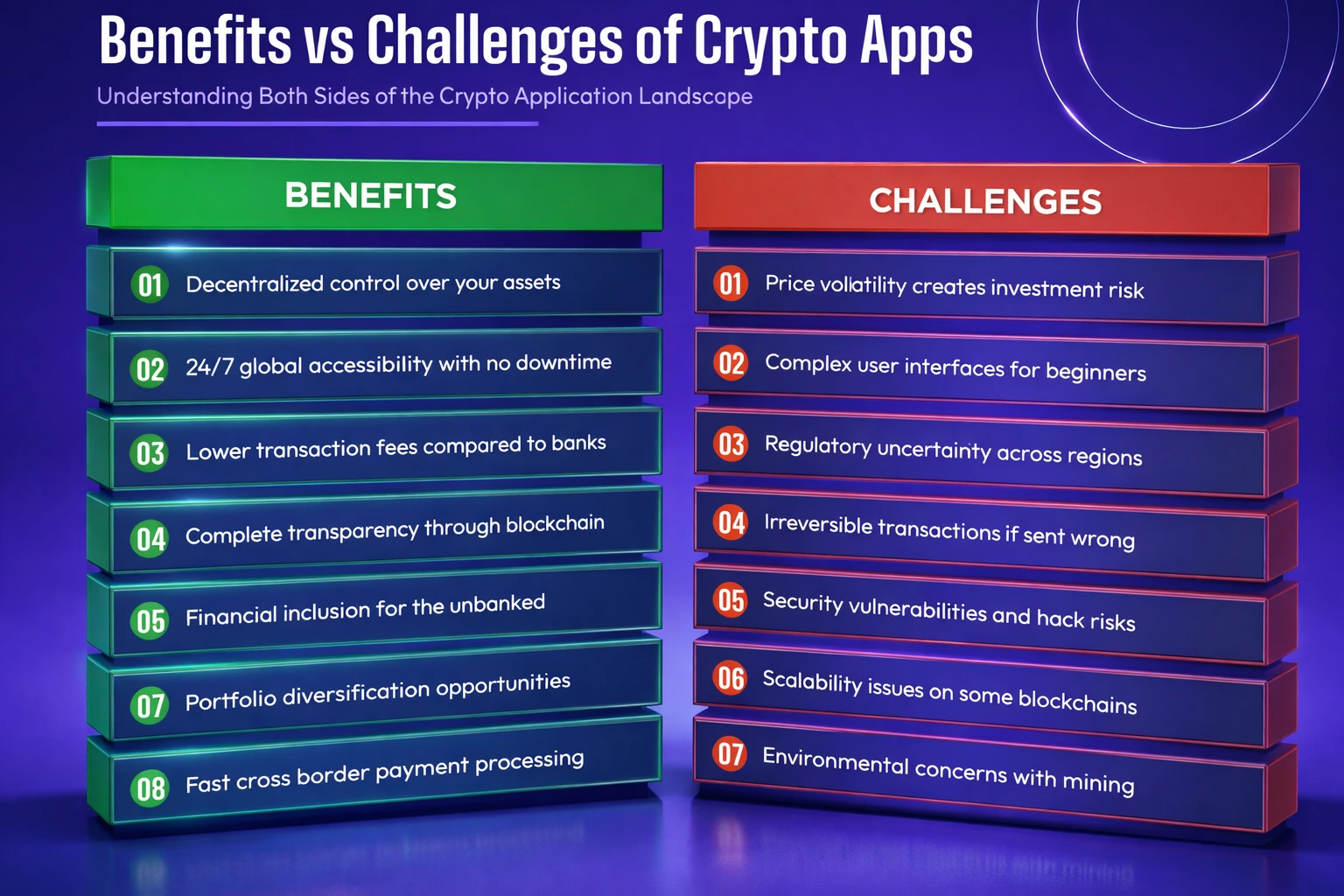
Financial inclusion stands as one of the most compelling benefits. According to the World Bank, approximately 1.4 billion adults globally remain unbanked, lacking access to basic financial services. Crypto apps provide these individuals with a gateway to store value, make payments, and even earn yield on their savings using nothing more than a smartphone and an internet connection. This is particularly impactful in regions with unstable currencies or limited banking infrastructure.
The 24/7 availability of crypto networks is another significant advantage. Unlike traditional financial markets that operate on fixed schedules and close on weekends, blockchain networks process transactions around the clock without interruption. This always on accessibility is especially valuable for international users operating across different time zones.
Lower transaction costs, particularly for cross border transfers, provide tangible savings. Sending money internationally through traditional banking channels can incur fees of 5% to 10% of the transaction amount, along with multi day processing times. Crypto apps can facilitate the same transfer for a fraction of the cost, often settling within minutes. For businesses engaged in international trade and supply chain management, this cost efficiency is transformative.
Challenges and Risks of Crypto Apps
While the potential of crypto apps is immense, users and builders must navigate several significant challenges. Price volatility remains the most visible risk, as cryptocurrency values can fluctuate by double digit percentages within a single day. This volatility affects not only investors but also the perceived stability and trustworthiness of crypto apps among mainstream users.
User experience complexity is another persistent challenge. Despite significant improvements, many crypto apps still require users to understand concepts like gas fees, seed phrases, private keys, and network selection, concepts that are unfamiliar to most people. This complexity creates a barrier to entry that limits mainstream adoption and frustrates new users who are accustomed to the simplicity of traditional banking apps.
Security vulnerabilities, ranging from smart contract exploits to phishing attacks, continue to pose serious threats. The decentralized nature of blockchain means that once funds are stolen, recovery is extremely difficult. In 2024 alone, crypto hacks and exploits resulted in losses exceeding $1.8 billion globally, underscoring the critical importance of comprehensive security measures in every crypto app.
Scalability challenges on popular blockchain networks like Ethereum can result in slow transaction speeds and high gas fees during periods of network congestion. While Layer 2 solutions and alternative blockchains are addressing this issue, scalability remains a technical hurdle that directly impacts user satisfaction.
Crypto App Regulations and Compliance
The regulatory landscape for crypto apps is evolving rapidly across the globe, and compliance has become a defining factor in determining which crypto apps survive and which face enforcement actions. Jurisdictions are approaching regulation differently, creating a complex patchwork of rules that crypto app operators must navigate carefully.
The European Union’s Markets in Crypto Assets (MiCA) regulation, which came into full effect in late 2024, established one of the world’s most comprehensive frameworks for crypto asset service providers. MiCA requires crypto app operators in the EU to obtain proper licensing, implement robust consumer protection measures, and adhere to strict capital requirements. Similar comprehensive frameworks are being adopted or considered in the United Kingdom, Singapore, Japan, and the United Arab Emirates.
In the United States, the regulatory approach has been more fragmented, with the SEC, CFTC, and FinCEN each asserting jurisdiction over different aspects of crypto activity. This overlapping regulatory structure creates uncertainty for crypto app builders, who must ensure their platforms comply with multiple federal and state level requirements simultaneously.
For DAOs in DeFi Space, regulatory compliance presents unique challenges. Because DAOs operate without centralized management, determining who is legally responsible for compliance obligations is an ongoing debate. Some jurisdictions have begun creating legal frameworks for DAOs, such as Wyoming’s DAO LLC law, but the global regulatory picture remains fragmented. Crypto apps that integrate DAO governance must stay informed about these developments and build flexible compliance modules that can adapt to evolving regulations.
How to Choose the Right Crypto App
Selecting the right crypto app requires a systematic evaluation of multiple factors that align with your specific needs, whether you are an individual user, an institutional investor, or a business looking to build your own platform.
Security Credentials: Verify whether the app has undergone independent security audits, implements two factor authentication, offers cold storage options, and maintains a transparent track record regarding past incidents. Look for partnerships with reputable security firms and evidence of regular penetration testing.
Supported Assets and Networks: Evaluate the range of cryptocurrencies and blockchain networks the app supports. A multi chain app that integrates Ethereum, Solana, Polygon, and other popular networks provides greater flexibility and access to a wider range of DeFi opportunities.
Fee Structure: Understand the complete fee schedule, including trading fees, withdrawal fees, deposit fees, and any hidden charges. Some apps advertise zero trading fees but compensate through wider spreads or higher withdrawal costs.
User Interface and Experience: Test the app’s interface for intuitiveness, speed, and reliability. The best crypto apps make complex blockchain interactions feel simple and seamless, regardless of the user’s technical background.
Regulatory Compliance: Choose apps that demonstrate clear compliance with the regulations applicable in your jurisdiction. Licensed and regulated platforms offer better legal protections and are less likely to face sudden shutdowns or enforcement actions.
Community and Governance: For DeFi apps, evaluate the governance model. Platforms that operate through DAOs in DeFi Space typically offer greater transparency and community alignment than those controlled by a centralized team.
Future Trends in Crypto Apps
The crypto app landscape is set for significant evolution in 2026 and beyond, driven by technological innovation, regulatory maturation, and shifting user expectations. Several key trends are shaping the future of this industry.
AI Powered Analytics and Trading: Artificial intelligence is being integrated into crypto apps to provide personalized trading insights, automated portfolio rebalancing, and predictive market analysis. AI algorithms can process vast amounts of on chain and off chain data to identify patterns that human traders might miss, giving users a competitive edge.
Account Abstraction and Gasless Transactions: Ethereum’s ERC 4337 standard is enabling account abstraction, which allows crypto apps to offer gasless transactions, social recovery, and programmable account logic. This breakthrough dramatically simplifies the user experience by removing the need for users to hold native tokens for gas fees and eliminating the risk of permanently losing access to funds if a seed phrase is lost.
Cross Chain Interoperability: As the blockchain ecosystem becomes increasingly multi chain, crypto apps that seamlessly bridge assets and data across different networks will gain a significant competitive advantage. Protocols like LayerZero, Wormhole, and Axelar are building the infrastructure for true cross chain interoperability.
Institutional Grade Features: The entry of major financial institutions into the crypto space is driving demand for enterprise level features such as advanced custody solutions, compliance reporting, white label platforms, and high frequency trading capabilities within crypto apps.
Evolution of DAOs in DeFi Space: Governance models for DAOs in DeFi Space are becoming more sophisticated, with innovations like quadratic voting, delegation frameworks, and reputation based governance gaining traction. These improvements address early criticisms of DAO governance, such as voter apathy and whale dominance, creating more equitable and effective decision making processes for crypto app communities.
Ready to Build Your Crypto App with Expert Blockchain Specialists?
Connect with Nadcab Labs today and turn your crypto vision into a secure, scalable, and market ready application.
Conclusion: The Growing Importance of Crypto Apps
The trajectory of crypto apps is unmistakably upward. As blockchain technology matures, regulatory frameworks solidify, and user expectations evolve, the demand for well built, secure, and feature rich crypto applications will only intensify. From wallet management to complex DeFi interactions, from cross border payments to DAOs in DeFi Space governance, crypto apps are becoming the essential infrastructure layer of the new digital economy.
For businesses and entrepreneurs looking to enter this space, the window of opportunity is wide open. The crypto app market rewards innovation, security, and exceptional user experience. Whether you are building a simple wallet, a comprehensive exchange platform, or a next generation DeFi protocol, partnering with a skilled and experienced blockchain team is the most critical decision you will make.
Nadcab Labs brings over 8 years of dedicated expertise in blockchain, smart contract engineering, crypto app architecture, and decentralized finance solutions. With a track record spanning 500+ successful blockchain projects, Nadcab Labs has established itself as a trusted authority in the crypto space. Their team of seasoned blockchain specialists combines deep technical knowledge with a thorough understanding of regulatory landscapes, security best practices, and market dynamics. From ideation and architecture design to deployment and post launch support, Nadcab Labs delivers end to end crypto app solutions that are built for performance, built for security, and built to scale. When it comes to navigating the complexities of DAOs in DeFi Space, multi chain integration, and enterprise grade security, Nadcab Labs stands as the authoritative partner that turns ambitious crypto visions into thriving digital platforms.
Frequently Asked Questions
The cost of building a crypto app varies based on features, complexity, and the development team’s location. A basic crypto wallet may cost between $30,000 and $60,000, while a full exchange platform can range from $100,000 to $500,000 or more. Factors like blockchain integration, security audits, UI/UX design, and regulatory compliance modules significantly influence the final budget and timeline.
A standard crypto application typically takes 4 to 9 months to develop, depending on its scope. Simple wallet apps may be completed in 3 to 4 months, whereas complex exchange or DeFi platforms can take over a year. The timeline includes planning, smart contract development, frontend and backend coding, rigorous security testing, and deployment across app stores or web platforms.
Yes, modern crypto apps support multi chain integration, allowing users to interact with Ethereum, Solana, BNB Chain, Polygon, and more from one interface. This requires cross chain bridges and multi chain wallet architecture. Multi chain support enhances usability and attracts a broader user base, but it also increases complexity in development, testing, and ongoing maintenance of the application.
KYC requirements depend on the jurisdiction and the type of crypto app. Centralized exchanges usually require KYC to comply with anti money laundering (AML) laws. However, decentralized apps (dApps) and non custodial wallets often operate without mandatory KYC. Regulations are tightening globally, so many projects voluntarily adopt KYC to build trust, attract institutional users, and prepare for future compliance mandates.
Popular programming languages for crypto apps include Solidity for Ethereum smart contracts, Rust for Solana, JavaScript and TypeScript for frontend interfaces, and Python or Go for backend services. Swift and Kotlin are used for native iOS and Android apps respectively. The choice depends on the blockchain network, performance requirements, and whether the team prefers cross platform frameworks like React Native or Flutter.
While no code platforms like Bubble and Thirdweb allow basic crypto app creation, building a professional, secure, and scalable crypto application requires experienced developers. No code tools have limitations in custom smart contract logic, advanced security implementations, and complex blockchain integrations. For production grade apps handling real user funds, hiring skilled blockchain developers is strongly recommended to avoid vulnerabilities and ensure compliance.
Crypto apps use multiple revenue models including transaction fees on trades, withdrawal charges, premium subscription plans, listing fees for new tokens, spread markups on buy and sell prices, staking commissions, and advertising revenue. Some DeFi apps earn through liquidity pool fees and governance token appreciation. The chosen model depends on the app type, target audience, and the competitive landscape within the crypto ecosystem.
If a crypto app is hacked, users may lose funds stored in hot wallets or smart contracts. The app team typically freezes operations, investigates the breach, and works with blockchain security firms to trace stolen assets. Some platforms maintain insurance funds to compensate affected users. This highlights the critical importance of regular security audits, penetration testing, bug bounty programs, and cold storage for the majority of funds.
Crypto apps require internet connectivity to interact with blockchain networks, execute transactions, and update balances in real time. However, some wallets allow users to generate and sign transactions offline, which can then be broadcast when connectivity is restored. This offline signing feature enhances security by keeping private keys on air gapped devices. Portfolio tracking and price alerts also need active internet to function properly.
DAOs in DeFi Space play a growing role in crypto app governance by enabling token holders to vote on protocol upgrades, fee structures, and treasury allocations. Many DeFi crypto apps now integrate DAO frameworks where community members propose and decide changes collectively. This decentralized governance model increases transparency, reduces single points of failure, and aligns platform decisions with the interests of the broader user community.
Reviewed & Edited By

Aman Vaths
Founder of Nadcab Labs
Aman Vaths is the Founder & CTO of Nadcab Labs, a global digital engineering company delivering enterprise-grade solutions across AI, Web3, Blockchain, Big Data, Cloud, Cybersecurity, and Modern Application Development. With deep technical leadership and product innovation experience, Aman has positioned Nadcab Labs as one of the most advanced engineering companies driving the next era of intelligent, secure, and scalable software systems. Under his leadership, Nadcab Labs has built 2,000+ global projects across sectors including fintech, banking, healthcare, real estate, logistics, gaming, manufacturing, and next-generation DePIN networks. Aman’s strength lies in architecting high-performance systems, end-to-end platform engineering, and designing enterprise solutions that operate at global scale.