Key Takeaways
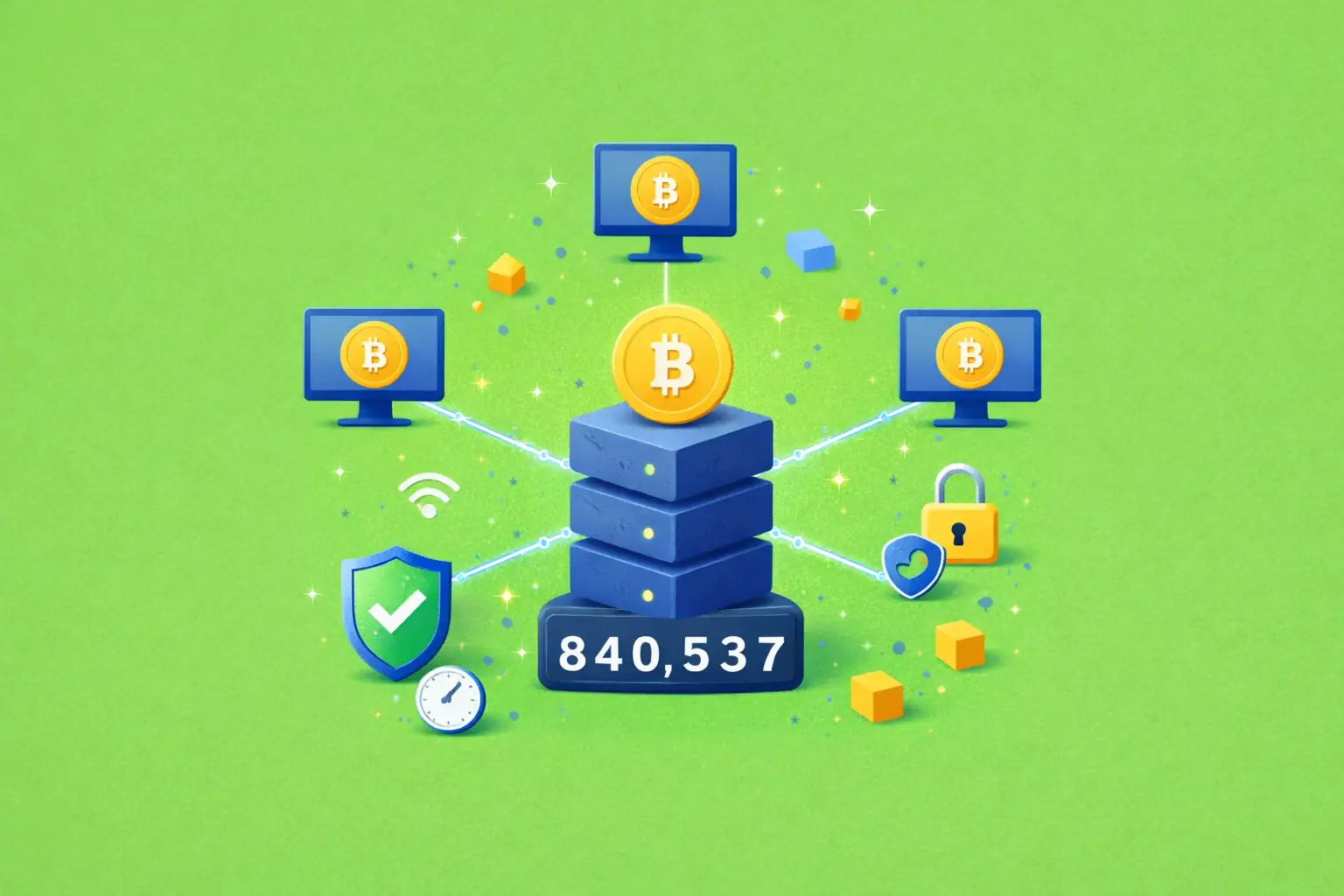
1. A Bitcoin node is a computer that stores a copy of the entire Bitcoin blockchain and helps verify every transaction that takes place on the network.
2. Full nodes download and validate every block and transaction independently, ensuring that no one can cheat or manipulate the system.
3. Light nodes store only a small portion of blockchain data and rely on full nodes for verification, making them suitable for mobile wallets and devices with limited storage.
4. Nodes are the backbone of Bitcoin’s decentralization because they ensure no single entity controls the network’s transaction history or rules.
5. Miners depend on nodes to receive new transactions, and nodes verify the blocks that miners produce before adding them to the blockchain.
6. Businesses such as cryptocurrency exchanges, payment processors, and wallet providers run their own full nodes to independently verify transactions and reduce reliance on third parties.
7. Running a Bitcoin node strengthens the network’s security and gives the operator direct access to trustworthy, unfiltered blockchain data.
8. Bitcoin halving, which cuts the mining reward in half roughly every four years, directly impacts miners and indirectly affects how nodes handle changing network conditions.
9. Blockchain infrastructure providers like Nadcab Labs help organizations deploy and manage robust node setups, ensuring reliability, security, and seamless integration with decentralized applications.
10. As the Bitcoin network evolves with layer 2 solutions and increased adoption, nodes will become even more critical for maintaining scalability, privacy, and trust in the ecosystem.
If you have ever wondered what keeps the Bitcoin network alive and trustworthy, the answer lies in something called a Bitcoin node in blockchain technology. Every time someone sends or receives Bitcoin, a global network of computers quietly works behind the scenes to verify that transaction, record it permanently, and share the information with thousands of other computers. These computers are called nodes, and without them, the Bitcoin blockchain simply would not function.
Think of it this way: if Bitcoin were a massive public library, nodes would be the dedicated librarians who check every book that comes in, make sure nothing is forged, and keep a perfect copy of every record ever created. They do not charge fees for this service, and they do not answer to any single authority. They simply follow a set of rules and work together to maintain honesty and transparency across the entire network.
In this comprehensive guide, we will walk you through everything you need to know about Bitcoin nodes, from the basics of what they do to the advanced role they play in security, decentralization, and the future of the blockchain ecosystem. Whether you are a curious beginner, a developer exploring blockchain architecture, or a business considering running your own node, this article is designed to give you clear, practical, and trustworthy answers.
What Is a Bitcoin Node? A Simple Definition
A Bitcoin node in blockchain terms is any computer that connects to the Bitcoin network, follows the Bitcoin protocol rules, and participates in sharing and validating transaction data. When we say “node,” we simply mean a point in the network that can send information, receive information, and store a copy of the blockchain ledger.
Imagine a neighborhood where every household keeps a copy of the community’s financial records. Whenever someone makes a transaction, say paying rent or lending money, every household checks the record, confirms it is legitimate, and writes it down. No single household is “in charge.” If one household tries to write a fake entry, all the other households will notice the discrepancy and reject it. That is essentially how Bitcoin nodes work together to maintain a shared, tamper proof record of every Bitcoin transaction ever made.
Key Insight: A Bitcoin node does not need to be a powerful supercomputer. Many people run nodes on standard desktop machines or even small devices like a Raspberry Pi. The essential requirement is a stable internet connection and enough storage to hold the full blockchain, which is currently over 500 gigabytes.
Different Types of Bitcoin Nodes
Not all Bitcoin nodes perform the same function. The Bitcoin network is home to several types of nodes, each serving a distinct purpose. Understanding these types is essential for anyone looking to grasp how the Bitcoin node in blockchain architecture supports the entire ecosystem.
Downloads the entire Bitcoin blockchain from the very first block (the genesis block) to the most recent one. It independently verifies every transaction and every block against Bitcoin’s consensus rules. Full nodes are the gold standard of network participation. They do not trust anyone; they verify everything themselves.
Also called a Simplified Payment Verification node, it does not store the full blockchain. Instead, it downloads only block headers, which are small summaries of each block. When it needs to verify a specific transaction, it asks a full node for proof. Ideal for mobile wallets and limited storage devices.
Mining nodes are full nodes that also perform the computational work of mining, solving complex mathematical puzzles to create new blocks. These nodes compete to add the next block to the chain and earn a block reward in Bitcoin. Every mining node is a full node, but not every full node is a mining node.
A type of full node that stores the complete historical data of the blockchain, including every transaction in its original form. Most full nodes prune older data to save storage, but archival nodes keep everything, making them valuable for researchers, analytics platforms, and blockchain explorers.
Comparison of Bitcoin Node Types
| Node Type | Stores Full Blockchain | Validates All Transactions | Requires Mining Hardware | Best Suited For |
|---|---|---|---|---|
| Full Node | Yes | Yes | No | Businesses, developers, privacy focused users |
| Light Node (SPV) | No (headers only) | Partial (relies on full nodes) | No | Mobile wallets, lightweight apps |
| Mining Node | Yes | Yes | Yes | Miners and mining pools |
| Archival Node | Yes (complete history) | Yes | No | Researchers, block explorers, analytics |
| Pruned Node | Partial (recent blocks) | Yes | No | Users with limited disk space |
Real world platforms like Nadcab Labs design and deploy customized node architectures for businesses that need reliable, always on access to verified blockchain data.
What Does a Full Node Actually Do?
A full node is the workhorse of the Bitcoin network. Think of it as a meticulous bank clerk who checks every single deposit slip, withdrawal form, and transfer request to make sure they follow the rules. Here is what a full Bitcoin node does on a daily basis:
- Downloads the entire blockchain: Starting from the genesis block created in January 2009, a full node downloads every block ever produced. This process can take several hours or even days on a new setup.
- Validates every transaction: The node checks each transaction to confirm that the sender actually has enough Bitcoin, that the digital signatures are authentic, and that no coins are being double spent.
- Enforces consensus rules: Bitcoin has a strict set of rules, such as the maximum supply of 21 million coins and the structure of valid blocks. A full node enforces every one of these rules without exception.
- Relays valid data to other nodes: Once a full node verifies a transaction or block, it shares that data with its connected peers, helping the information spread across the entire network.
- Rejects invalid data: If a node receives a transaction or block that breaks the rules, it immediately discards it and may even disconnect from the peer that sent it.
By performing all of these functions, full nodes collectively maintain the integrity and trustworthiness of the Bitcoin blockchain. No central server is needed because thousands of full nodes around the world independently reach the same conclusions about which transactions are valid.
What Does a Light Node Do?
A light node takes a more streamlined approach. Imagine you are a busy traveler who does not want to carry an entire encyclopedia but still needs to look up specific facts. You carry a table of contents (block headers) and whenever you need details, you ask someone who has the full encyclopedia (a full node) to show you the relevant page and prove it is authentic.
Light nodes are commonly used in mobile Bitcoin wallets. When you open a wallet app on your phone and check your balance, the app is typically connecting to full nodes in the background to verify your recent transactions. It does not download hundreds of gigabytes of data; it simply asks targeted questions and receives cryptographic proofs called Merkle proofs that confirm a transaction is included in a valid block.
Why it matters: Light nodes make Bitcoin accessible to billions of people who use smartphones and devices with limited storage. Without SPV technology, every Bitcoin user would need a powerful computer and hundreds of gigabytes of free space just to check their balance.
How a Bitcoin Node Receives, Verifies, and Shares Transactions: Step by Step
Understanding the journey of a Bitcoin transaction through the network helps illustrate why the Bitcoin node in blockchain infrastructure is so critical. Below is a clear walkthrough of how this process works.
- Transaction creation: A user initiates a Bitcoin transaction using their wallet software. The wallet creates a digital message that includes the sender’s address, the recipient’s address, the amount being sent, and a cryptographic signature proving the sender authorized the transfer.
- Broadcasting to the network: The wallet sends this transaction to one or more Bitcoin nodes it is connected to. This is like handing a letter to a postal worker at a local post office.
- Initial validation by the receiving node: The node that receives the transaction performs a series of checks. It confirms the sender has sufficient funds by looking at unspent transaction outputs (UTXOs). It verifies the digital signature and checks that the transaction follows the correct format.
- Adding to the memory pool: If the transaction passes all checks, the node places it in its memory pool (mempool), a waiting area for unconfirmed transactions. Think of it as a queue at a bank counter where verified requests wait to be processed.
- Relaying to peer nodes: The node broadcasts the validated transaction to all other nodes it is connected to. Each of those nodes performs its own independent verification before adding it to their own mempools and relaying it further. Within seconds, the transaction reaches thousands of nodes worldwide.
- Mining and block inclusion: A mining node selects transactions from its mempool and bundles them into a candidate block. The miner then works to solve the proof of work puzzle. Once solved, the new block is broadcast to the network.
- Block validation by nodes: Every full node that receives the new block independently validates it. They check every transaction inside the block, verify the proof of work solution, and confirm the block follows all consensus rules.
- Adding to the blockchain: If the block is valid, each node appends it to its local copy of the blockchain. The transaction is now confirmed and permanently recorded.
- Propagation continues: Nodes continue sharing the validated block with peers they are connected to, ensuring the entire network reaches consensus on the latest state of the blockchain.
Enterprise blockchain providers like Nadcab Labs help businesses integrate reliable node infrastructure so that payment verification and transaction monitoring happen in real time without depending on third party services.
Why Nodes Are the Foundation of Bitcoin’s Decentralization
Decentralization is the core principle that separates Bitcoin from traditional financial systems. In a traditional bank, a single institution controls the ledger. If that institution makes a mistake, commits fraud, or gets hacked, the entire system suffers. Bitcoin eliminates this single point of failure by distributing the ledger across thousands of independent nodes.
Each Bitcoin node in blockchain technology acts as an equal participant. No node has more authority than another. If a powerful entity tried to alter the transaction history, say by changing a record to steal funds, every other node on the network would immediately notice the discrepancy and reject the fraudulent version. The attacker would need to compromise a majority of the network simultaneously, which is practically impossible given the global distribution of nodes.
This is why the number of full nodes running on the network directly correlates with Bitcoin’s resilience. More nodes mean more independent copies of the ledger, more validators checking every transaction, and more resistance to censorship or manipulation. As of recent counts, there are over 15,000 reachable Bitcoin full nodes operating across dozens of countries, making it one of the most decentralized networks in the world.
15,000+
Reachable Full Nodes Worldwide
100+
Countries With Active Nodes
500+ GB
Full Blockchain Size
Everyday analogy: Imagine a village where every resident keeps a copy of the town’s official record book. If the mayor tried to secretly change a record, hundreds of villagers would immediately spot the forgery and reject it. That is how Bitcoin’s node network protects against fraud.
How Bitcoin Nodes Communicate With Each Other
Bitcoin nodes communicate using a peer to peer (P2P) protocol. There is no central server that nodes connect to. Instead, each node connects directly to a set of other nodes, called peers, and exchanges data with them.
When a node first joins the network, it discovers peers through a combination of DNS seeds (hardcoded domain names that point to known active nodes) and peer exchange, where connected nodes share the addresses of other nodes they know about. Over time, a node builds up a diverse list of peers from different geographic regions and network segments.
The communication process involves several types of messages:
- Inventory messages (inv): A node announces that it has a new transaction or block by sending an inventory message containing the identifier (hash) of the data.
- Data request messages (getdata): When a node receives an inventory announcement for data it does not yet have, it sends a request asking for the full data.
- Block and transaction messages: The node that has the data responds by sending the complete block or transaction.
- Ping and pong messages: Nodes periodically check that their peers are still online and responsive.
This gossip style protocol ensures that information spreads rapidly through the network. A new transaction typically reaches the majority of nodes within seconds, and a new block propagates across the globe in under a minute.
How Miners Interact With Bitcoin Nodes
Miners and nodes have a deeply interconnected relationship. Every miner runs a full node, but the mining function adds an additional layer of responsibility: the creation of new blocks.
Here is how the interaction works. A miner’s node collects unconfirmed transactions from its mempool and assembles them into a candidate block. The miner then expends computational energy to solve the proof of work puzzle for that block. When a valid solution is found, the miner broadcasts the new block to the network.
At this point, every other full node on the network independently validates the block. They check the proof of work solution, verify every transaction inside the block, and confirm that the block connects properly to the previous block in the chain. If even a single rule is violated, nodes reject the block entirely, and the miner’s effort is wasted.
This dynamic creates a powerful check and balance system. Miners produce blocks, but nodes decide whether those blocks are valid. Miners cannot cheat because the node network would immediately catch and reject any fraudulent blocks. This separation of roles is fundamental to the security model of the Bitcoin blockchain.
Why Businesses and Exchanges Run Their Own Bitcoin Nodes
For cryptocurrency exchanges, wallet providers, payment processors, and other blockchain based businesses, running their own full node is not optional; it is essential for security and operational integrity.
Consider a cryptocurrency exchange that processes thousands of deposits and withdrawals every day. If the exchange relies on someone else’s node to verify transactions, it introduces a dependency and a potential point of failure. By running its own full node, the exchange can independently verify that a customer’s deposit is real, has the correct number of confirmations, and has not been double spent.
- Independent transaction verification: Businesses can confirm payments without trusting any third party, eliminating the risk of receiving false or manipulated data.
- Reduced latency: Running a local node provides faster access to blockchain data compared to querying remote APIs or services.
- Privacy protection: When a business queries an external node to check an address balance, it reveals information about which addresses it is interested in. A self operated node keeps this information private.
- Network resilience: A business with its own node is not affected if a third party service goes offline or experiences technical issues.
- Regulatory compliance: Some regulatory frameworks require businesses to maintain their own records and verification processes, which a full node naturally supports.
Organizations like Nadcab Labs specialize in building and deploying enterprise grade node infrastructure for businesses that need secure, scalable, and always available blockchain connectivity.
Benefits of Running a Bitcoin Node
Running a Bitcoin node in blockchain networks offers a range of benefits that go beyond just personal use. Whether you are an individual enthusiast or a large enterprise, operating a node provides tangible advantages.
Contribute to Network Security
Every additional node makes the Bitcoin network stronger and more resilient against attacks or censorship attempts.
Verify Your Own Transactions
You do not have to trust anyone else to confirm that a payment you received is legitimate. Your node checks it independently.
Enhanced Privacy
Broadcasting transactions through your own node prevents third parties from linking your IP address to your Bitcoin addresses.
Support the Ecosystem
By running a node, you help new nodes and light wallets connect to the network and access blockchain data.
Stay Informed About Protocol Changes
Node operators are among the first to know about proposed upgrades, forks, or changes to the Bitcoin protocol.
Educational Value
Operating a node provides deep, hands on understanding of how blockchain technology actually works at a technical level.
Node Functions and Their Impact on the Bitcoin Network
| Function | Description | Impact on Network |
|---|---|---|
| Transaction Validation | Checks signatures, balances, and formatting of every transaction | Prevents fraud and double spending |
| Block Validation | Verifies proof of work, transaction integrity, and rule compliance for each block | Ensures only legitimate blocks are added to the chain |
| Data Relay | Shares verified transactions and blocks with connected peers | Enables fast, global propagation of information |
| Blockchain Storage | Maintains a complete or partial copy of the transaction ledger | Provides redundancy and protects against data loss |
| Consensus Enforcement | Rejects any data that violates Bitcoin’s protocol rules | Maintains the integrity and consistency of the network |
| Peer Discovery | Identifies and connects to other active nodes across the globe | Strengthens the decentralized topology of the network |
Challenges and Limitations of Running a Bitcoin Node
While the benefits are compelling, running a Bitcoin node does come with some challenges that potential operators should be aware of.
- Storage requirements: The Bitcoin blockchain is over 500 gigabytes in size and continues to grow. Full archival nodes need significant disk space, though pruned nodes can operate with much less.
- Bandwidth consumption: Nodes constantly upload and download data. A well connected node can use hundreds of gigabytes of bandwidth per month, which may be a concern for users with metered internet plans.
- Initial synchronization time: When setting up a new full node, downloading and verifying the entire blockchain from scratch can take anywhere from several hours to multiple days, depending on hardware and internet speed.
- Hardware and electricity costs: While a node does not require expensive hardware, it does need to run 24 hours a day, 7 days a week. This means ongoing electricity costs and the potential need for dedicated hardware.
- Technical knowledge: Setting up and maintaining a node requires some level of technical comfort with command line interfaces, networking concepts, and software updates.
- No direct financial reward: Unlike miners, node operators do not earn Bitcoin for running their nodes. The incentive is primarily about security, privacy, and supporting the network.
Good to know: For businesses that want the benefits of a full node without the operational burden, blockchain infrastructure providers such as Nadcab Labs offer managed node solutions that handle setup, monitoring, updates, and security so that businesses can focus on their core operations.
Bitcoin Halving Explained: What It Is and Why It Matters for Nodes
One of the most important events in Bitcoin’s lifecycle is the halving, and understanding it helps clarify the broader ecosystem in which nodes operate.
Bitcoin halving is a pre programmed event that occurs approximately every four years (or every 210,000 blocks). During a halving, the reward that miners receive for successfully mining a new block is cut in half. This mechanism is built into Bitcoin’s code and is designed to control the supply of new Bitcoin entering circulation, ultimately capping the total supply at 21 million coins.
A Simple Analogy for Bitcoin Halving
Imagine a gold mine that produces 100 ounces of gold every day. Every four years, the mine owner permanently reduces output to half: first to 50 ounces, then to 25, then to 12.5, and so on. Over time, the amount of new gold entering the market decreases dramatically, even though demand remains the same or grows. This increasing scarcity naturally makes each ounce more valuable. Bitcoin’s halving works on the exact same principle. By reducing the rate at which new coins are created, Bitcoin becomes progressively scarcer, a key feature that many believe drives long term value appreciation.
Another useful way to understand this is through the lens of corporate finance. Imagine a company that issues 1,000 new shares every quarter. If the company decides to cut that issuance in half every few years, eventually there will be very few new shares entering the market. Existing shareholders benefit because the supply of new shares slows dramatically while demand for the company’s equity may continue to grow.
History of Previous Bitcoin Halvings
Bitcoin has undergone four halvings since its creation in 2009. Each halving has been a significant milestone in the network’s history.
First Halving | November 2012
The block reward dropped from 50 BTC to 25 BTC. At the time, Bitcoin was trading at approximately $12. This was the first real test of Bitcoin’s programmed scarcity mechanism, and it demonstrated that the protocol functioned exactly as intended.
Second Halving | July 2016
The reward decreased from 25 BTC to 12.5 BTC. Bitcoin’s price at the time of halving was around $650. The network had matured significantly since the first halving, with a growing ecosystem of exchanges, wallets, and businesses.
Third Halving | May 2020
The reward dropped from 12.5 BTC to 6.25 BTC. Bitcoin was trading near $8,700 at the time. This halving occurred during the global pandemic and attracted widespread media attention.
Fourth Halving | April 2024
The reward was reduced from 6.25 BTC to 3.125 BTC. Bitcoin’s price was around $64,000 at the time, reflecting the enormous growth the network had experienced over the preceding years.
The next halving is expected around 2028, when the block reward will decrease to approximately 1.5625 BTC per block.
What Happened to Bitcoin’s Price After Past Halvings
Historically, each Bitcoin halving has been followed by a significant increase in price, though it is important to note that past performance does not guarantee future results.
After the 2012 halving, Bitcoin’s price rose from around $12 to over $1,100 within roughly a year, representing a gain of more than 9,000 percent. The 2016 halving was followed by a rally that eventually carried Bitcoin to nearly $20,000 by December 2017. Following the 2020 halving, Bitcoin surged past $60,000 in 2021, setting new all time highs. After the 2024 halving, Bitcoin continued its upward trajectory, reaching levels that reflected growing institutional interest and mainstream adoption.
These patterns have led many analysts and investors to closely watch halving events as potential catalysts for price appreciation, though many other factors including macroeconomic conditions, regulatory developments, and technological advancements also play significant roles.
How Halving Affects Bitcoin Miners
The halving has a direct and profound impact on Bitcoin miners. Since the block reward is their primary source of revenue, cutting it in half immediately reduces their income by 50 percent (assuming Bitcoin’s price remains constant).
This creates a natural selection process. Miners with older, less efficient hardware often find that their electricity costs exceed their mining revenue after a halving, forcing them to shut down or upgrade their equipment. Only the most efficient mining operations survive, which over time leads to a more energy efficient and competitive mining industry.
Transaction fees become increasingly important to miners as the block reward decreases. In the future, when all 21 million Bitcoin have been mined (estimated around the year 2140), transaction fees will be the sole source of revenue for miners. This is where nodes play a continuing role, as they validate the fee structures attached to transactions and ensure miners are operating within the rules.
Why Halving Creates Scarcity and Why Scarcity Matters
Bitcoin’s halving mechanism is central to its identity as “digital gold.” Unlike fiat currencies, which central banks can print in unlimited quantities, Bitcoin has a hard cap of 21 million coins. Each halving reduces the rate of new supply, making Bitcoin increasingly scarce over time.
As of today, more than 19.5 million Bitcoin have already been mined, leaving fewer than 1.5 million coins yet to be created. And because each halving cuts the production rate in half, the vast majority of remaining Bitcoin will take decades to mine. This predictable, transparent supply schedule stands in stark contrast to the unpredictable monetary policies of governments and central banks, and it is one of the primary reasons many people view Bitcoin as a reliable store of value.
For a deeper understanding of how Bitcoin’s underlying technology works, the official documentation at Bitcoin.org provides an excellent foundational resource.
Common Myths About Bitcoin Halving
With so much attention surrounding halving events, several myths and misconceptions have emerged. Let us address the most common ones.
❌ Myth 1: Halving automatically guarantees a price increase
While price has historically risen after halvings, this is not guaranteed. Many factors influence Bitcoin’s price, including global economic conditions, regulatory changes, and investor sentiment. Halving reduces supply, but price depends on the interplay of supply and demand.
❌ Myth 2: Halving will make Bitcoin mining unprofitable
While some less efficient miners may shut down, the network adjusts through a mechanism called difficulty adjustment. If miners leave, the mining difficulty decreases, making it easier and more cost effective for the remaining miners. The network always rebalances itself.
❌ Myth 3: Halving changes the total supply of Bitcoin
The total supply cap of 21 million Bitcoin never changes. Halving only affects the rate at which new coins are produced, not the total number. It slows down the flow of new supply without altering the ceiling.
❌ Myth 4: Halving makes Bitcoin less secure
Some worry that if miners earn less, fewer will participate, weakening security. In practice, the difficulty adjustment ensures that the network remains secure regardless of how many miners are active. Additionally, as Bitcoin’s price has generally risen after halvings, total mining revenue has often increased even though the block reward decreased.
❌ Myth 5: Halving is irrelevant to everyday Bitcoin users
Halving affects the entire ecosystem. It impacts miner behavior, influences transaction fees, shapes market sentiment, and reinforces the scarcity narrative that underpins Bitcoin’s value proposition. Every participant in the Bitcoin network, including node operators, is indirectly affected.
The Future Role of Bitcoin Nodes in Scalability and Security
As the Bitcoin network continues to grow and evolve, nodes will play an even more critical role in ensuring the system remains secure, decentralized, and performant.
One of the most exciting developments is the growth of layer 2 solutions like the Lightning Network, which enables fast, low cost Bitcoin transactions by creating payment channels between users. Full nodes are essential for opening and closing these channels and settling disputes. As layer 2 adoption grows, the demand for reliable full nodes will only increase.
Additionally, ongoing improvements to the Bitcoin protocol, such as the Taproot upgrade, have enhanced privacy and smart contract capabilities. Nodes are responsible for enforcing these new rules, and their participation in the upgrade process (through signaling support) is a direct expression of the decentralized governance model that makes Bitcoin unique.
Looking further ahead, innovations in node technology, including improved data compression, faster initial synchronization, and more efficient network communication, will make it easier for individuals and businesses to run nodes. This, in turn, will strengthen decentralization and make the network more resistant to censorship and attacks.
For a broader perspective on how blockchain technology is shaping the future of global systems, the World Economic Forum’s coverage of blockchain offers valuable insights.
Build Your Blockchain Infrastructure With Confidence
Whether you are a startup launching your first blockchain product or an enterprise scaling your Web3 operations, reliable node infrastructure is the foundation of everything you build. From deploying secure full nodes to integrating layer 2 solutions and designing custom blockchain architectures, having the right technical partner makes all the difference.
Conclusion
The Bitcoin node in blockchain technology is far more than just a technical component. It is the backbone of a decentralized financial system that operates without banks, governments, or intermediaries. Every node, whether a full node validating every transaction, a light node enabling mobile wallets, or a mining node producing new blocks, plays a vital role in keeping Bitcoin secure, transparent, and trustworthy.
Understanding how nodes work gives you a deeper appreciation of what makes Bitcoin different from traditional financial systems. The network’s strength comes not from any single powerful entity, but from thousands of independent participants around the world, each running their own copy of the rules and collectively maintaining a shared truth.
As Bitcoin continues to mature, and as events like halving shape its economic landscape, the role of nodes will only grow in importance. Whether you choose to run your own node, build a business on top of the Bitcoin network, or simply want to understand how the system works, the knowledge you have gained from this guide provides a solid foundation for your journey into the world of blockchain technology.
In a world where trust in centralized institutions is constantly being tested, Bitcoin’s node network offers a powerful alternative: a system where trust is replaced by verification, authority is distributed, and every participant has an equal voice in maintaining the truth.
Frequently Asked Questions
A Bitcoin node is a computer connected to the Bitcoin network that stores a copy of the blockchain, verifies transactions, and shares data with other nodes. Think of it as one of many identical record keepers in a global network where every keeper independently confirms every entry.
Yes, absolutely. You can run a Bitcoin full node on a standard desktop computer or even a Raspberry Pi. You will need at least 500 GB of free storage, a stable internet connection, and the Bitcoin Core software, which is free to download from the official Bitcoin website.
No, running a standard Bitcoin node does not earn you Bitcoin rewards. Only mining nodes, which solve proof of work puzzles, earn block rewards. However, running a node gives you the benefit of independent transaction verification, enhanced privacy, and the ability to support the network’s security.
A full node downloads and independently verifies the entire Bitcoin blockchain, while a light node (SPV node) only downloads block headers and relies on full nodes to verify specific transactions. Full nodes provide maximum security and independence, while light nodes offer convenience and lower storage requirements.
Q5.
Q6.
There are over 15,000 publicly reachable Bitcoin full nodes spread across more than 100 countries. The actual number is likely higher because many nodes run behind firewalls and are not publicly visible. This wide distribution is what makes Bitcoin one of the most decentralized networks in existence.
Exchanges run their own nodes to independently verify customer deposits and withdrawals without relying on any third party. This ensures maximum accuracy, reduces the risk of accepting fraudulent transactions, provides faster data access, and protects the privacy of the exchange’s operations.
Q7.
Q8.
Q9.
Q10.
Halving directly reduces mining rewards, which can cause less efficient miners to leave the network. Nodes then enforce the updated consensus rules, validate blocks with the new reward amount, and help the network adjust its difficulty. Nodes also handle increased activity as market interest typically surges around halving events.
If a single node goes offline, the network continues to operate normally because thousands of other nodes maintain copies of the blockchain. When the offline node comes back online, it simply downloads and verifies any blocks it missed during the downtime and syncs up with the rest of the network.
Yes, Nadcab Labs provides comprehensive blockchain infrastructure services, including node deployment, configuration, monitoring, and management. They help businesses set up secure and scalable node environments tailored to their specific needs, whether for transaction verification, wallet integration, or building decentralized applications.
Nodes will become even more important as Bitcoin scales. They are essential for layer 2 solutions like the Lightning Network, they enforce protocol upgrades like Taproot, and they ensure the network remains decentralized as adoption grows. Innovations in node technology will also make them easier to run, encouraging wider participation and stronger security.
Reviewed & Edited By

Aman Vaths
Founder of Nadcab Labs
Aman Vaths is the Founder & CTO of Nadcab Labs, a global digital engineering company delivering enterprise-grade solutions across AI, Web3, Blockchain, Big Data, Cloud, Cybersecurity, and Modern Application Development. With deep technical leadership and product innovation experience, Aman has positioned Nadcab Labs as one of the most advanced engineering companies driving the next era of intelligent, secure, and scalable software systems. Under his leadership, Nadcab Labs has built 2,000+ global projects across sectors including fintech, banking, healthcare, real estate, logistics, gaming, manufacturing, and next-generation DePIN networks. Aman’s strength lies in architecting high-performance systems, end-to-end platform engineering, and designing enterprise solutions that operate at global scale.