
Key Takeaways
- A Bitcoin hard fork occurs when the blockchain permanently diverges into two separate chains due to fundamental protocol changes that are not backward compatible with the existing network.
- Hard forks differ from soft forks because they require all network participants to upgrade their software, whereas soft forks maintain backward compatibility with older versions.
- Bitcoin Cash and Bitcoin SV represent the most significant hard forks in Bitcoin history, each created to address scalability concerns through increased block sizes.
- When a hard fork occurs, Bitcoin holders automatically receive an equivalent amount of the new cryptocurrency on the forked chain at no additional cost.
- Miners and node operators play a crucial role in determining which chain survives after a hard fork by directing their computational power and validation efforts.
- Hard forks can significantly impact market prices, creating volatility before, during, and after the network split as traders speculate on outcomes.
- Security risks during hard forks include replay attacks, where transactions valid on one chain might be replayed on another, potentially causing unintended fund transfers.
- Bitcoin Improvement Proposals serve as the formal mechanism for suggesting protocol changes, with community consensus determining whether proposed modifications become hard forks.
- The governance challenges surrounding hard forks highlight the tension between Bitcoin’s decentralized nature and the need for coordinated network upgrades.
- Understanding hard forks is essential for cryptocurrency investors, developers, and businesses to navigate the evolving blockchain landscape and protect their digital assets.
Introduction to Bitcoin Hard Forks
The cryptocurrency landscape has witnessed numerous transformative events since Bitcoin’s inception in 2009, but few phenomena have sparked as much debate and interest as Bitcoin hard forks. These significant blockchain events represent pivotal moments in cryptocurrency evolution, fundamentally altering how networks operate and creating entirely new digital currencies in the process. Understanding what constitutes a hard fork, why they occur, and their far reaching implications is essential knowledge for anyone involved in the cryptocurrency ecosystem, from casual investors to seasoned blockchain developers.
Bitcoin, as the pioneering cryptocurrency, operates on a decentralized network where thousands of computers worldwide maintain copies of its blockchain ledger. This distributed architecture ensures security and resistance to censorship, but it also creates unique challenges when the community seeks to implement significant protocol changes. When disagreements arise about Bitcoin’s future direction, or when technical upgrades require fundamental modifications to the network’s rules, hard forks emerge as the mechanism through which these changes manifest. The resulting blockchain splits have given birth to numerous alternative cryptocurrencies while simultaneously testing the resilience and adaptability of the original Bitcoin network.
This comprehensive guide explores every aspect of Bitcoin hard forks, from their technical foundations to their economic implications. Whether you’re seeking to understand how these events affect your cryptocurrency holdings, evaluating the technological innovations they introduce, or simply curious about the governance dynamics of decentralized networks, this article provides the insights you need. We’ll examine historical hard forks, analyze their outcomes, and discuss what the future might hold for Bitcoin’s development through this powerful yet controversial upgrade mechanism.
Understanding Forks in the Bitcoin Blockchain
Before diving deep into hard forks specifically, it’s crucial to understand the broader concept of forks within blockchain technology. In the context of Bitcoin and other cryptocurrencies, a fork represents any divergence in the blockchain’s path, whether temporary or permanent. These divergences can occur naturally during regular network operations or intentionally through coordinated protocol changes. The term “fork” aptly describes the visual representation of a single blockchain path splitting into two separate branches, much like a fork in a road.
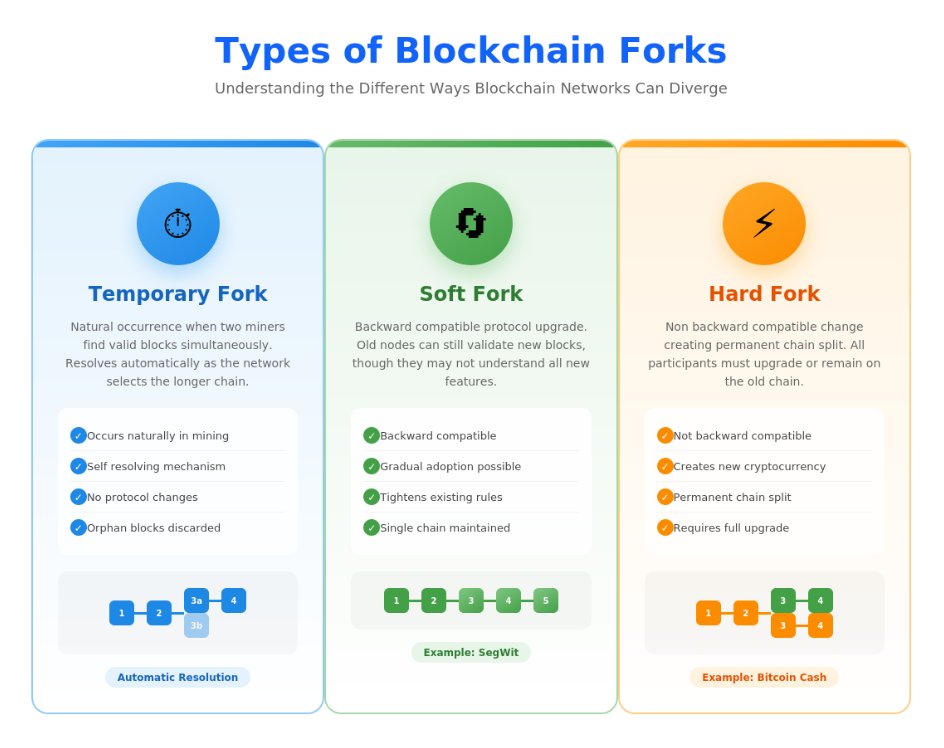
Blockchain networks like Bitcoin rely on consensus mechanisms to ensure all participants agree on the current state of the ledger. When two miners simultaneously discover valid blocks, a temporary fork naturally occurs as different parts of the network initially accept different blocks. These temporary forks resolve quickly as subsequent blocks are added, with the longer chain becoming the accepted version while orphaned blocks are discarded. This natural forking behavior represents a fundamental aspect of how proof of work blockchains maintain consistency across a distributed network.
However, the forks that capture headlines and spark community debates are intentional protocol forks, which come in two primary varieties: soft forks and hard forks. Both types involve changes to the network’s consensus rules, but they differ dramatically in their implementation requirements and implications for network participants. Understanding this distinction proves essential for grasping why hard forks represent such significant events in cryptocurrency history and why they often generate considerable controversy within blockchain communities.
What Is a Bitcoin Hard Fork?
A Bitcoin hard fork represents a radical change to the network’s protocol that renders previously invalid blocks and transactions valid, or vice versa. This fundamental alteration to the blockchain’s rules creates a permanent divergence from the previous version of the blockchain, resulting in two separate networks operating independently. Once a hard fork occurs, nodes running the old software will not recognize blocks produced under the new rules, and nodes running the updated software will reject blocks following the old rules. This mutual incompatibility forces network participants to choose which chain they wish to support.
The concept of a hard fork extends beyond simple software updates that users might encounter with traditional applications. When your smartphone app updates, the new version typically works seamlessly with previous data and server communications. In contrast, a blockchain hard fork fundamentally changes the rules governing what constitutes valid transactions and blocks. Imagine if a card game suddenly changed its rules so dramatically that players using the old rules couldn’t participate in games using the new rules, and vice versa. This analogy captures the essence of why hard forks create permanent blockchain splits rather than smooth transitions.
The permanence of hard forks distinguishes them from other network changes and explains why they carry such significant implications. Once a hard fork activates, the blockchain’s history up to that point remains shared between both chains, but all subsequent activity diverges. This means that anyone holding Bitcoin at the moment of the fork automatically possesses an equivalent balance on both the original chain and the newly forked chain. This characteristic has made hard forks simultaneously controversial and appealing, as they create new cryptocurrencies while preserving users’ original holdings.
Technical Definition of Hard Forks
From a technical standpoint, a hard fork constitutes a permanent divergence in the blockchain resulting from non backward compatible changes to the consensus rules. These consensus rules define the parameters that all network participants must follow, including block size limits, transaction validation criteria, mining difficulty adjustments, and reward structures. When developers propose modifying any of these fundamental parameters in ways that older software versions cannot accommodate, a hard fork becomes necessary to implement the changes.
The technical implementation of a hard fork typically involves specifying a block height or timestamp at which the new rules activate. All nodes wishing to follow the upgraded protocol must update their software before this activation point. Once the designated block arrives, nodes running the new software begin enforcing the modified rules while nodes running older software continue applying the original rules. This divergence creates two parallel blockchains sharing identical history up to the fork point but following different paths afterward. Understanding concepts like Bech32 address formats helps developers implement proper wallet support during such transitions.
The technical definition also encompasses the concept of rule loosening versus rule tightening. Hard forks that loosen rules, making previously invalid actions valid, cannot achieve backward compatibility because older nodes would reject the newly valid transactions or blocks. Conversely, soft forks tighten rules, making previously valid actions invalid, which allows older nodes to accept blocks from upgraded nodes even without understanding the new restrictions. This technical distinction underlies the fundamental difference between hard and soft forks and explains why hard forks require universal adoption to avoid permanent chain splits.
How Bitcoin Hard Forks Work
The mechanics of a Bitcoin hard fork involve several coordinated steps that unfold over weeks or months before the actual chain split occurs. The process typically begins with developers identifying a need for protocol changes that cannot be implemented through backward compatible soft forks. These proposals undergo extensive technical review, public discussion, and often contentious debate within the community. If sufficient support materializes, developers create updated software incorporating the proposed changes and announce an activation timeline, giving all network participants opportunity to prepare.
As the activation date approaches, the network enters a critical preparation phase where exchanges, wallet providers, miners, and individual users must decide how to position themselves. Major exchanges typically announce their policies regarding the fork, specifying whether they will support both chains, only the original chain, or only the new chain. These announcements significantly influence public perception and can affect which chain ultimately achieves greater adoption and value. Similar preparation considerations apply when implementing features like Replace by Fee functionality that affects transaction management.
When the designated block height arrives, the network effectively splits into two parallel universes. Miners directing their hash power toward the new chain begin producing blocks following the updated rules, while those supporting the original chain continue mining under the previous protocol. The blockchain’s entire transaction history up to the fork point remains identical on both chains, meaning all existing balances are duplicated. From this moment forward, however, each chain develops independently, with separate transaction histories, different block sequences, and potentially diverging security characteristics based on how mining power distributes between them.
Bitcoin Hard Fork Life Cycle
Phase 1
Proposal & Discussion
Phase 2
Development & Testing
Phase 3
Community Consensus
Phase 4
Activation & Split
Phase 5
Post Fork Stabilization
Hard Fork vs Soft Fork: Key Differences
Understanding the distinction between hard forks and soft forks represents essential knowledge for anyone navigating the cryptocurrency ecosystem. While both mechanisms enable protocol upgrades, they differ fundamentally in their implementation requirements, implications for network participants, and potential outcomes. Soft forks implement backward compatible changes, meaning nodes running older software can still participate in the network, albeit without access to new features. Hard forks, conversely, implement changes so fundamental that older software becomes entirely incompatible with the upgraded network.
The backward compatibility of soft forks arises from their approach to consensus rule changes. Soft forks tighten existing rules, making the set of valid transactions smaller than before. Older nodes accept blocks produced under stricter rules because these blocks still comply with the original, looser rules. For example, the Segregated Witness soft fork changed how transaction signatures are stored, but old nodes simply see smaller transactions that still follow traditional validity rules. This compatibility allows soft forks to achieve network wide adoption without requiring universal software updates, though full benefits only accrue to upgraded nodes.
| Parameter | Hard Fork | Soft Fork |
|---|---|---|
| Backward Compatibility | Not backward compatible | Backward compatible |
| Upgrade Requirement | All nodes must upgrade | Only miners need upgrade initially |
| Chain Split Risk | Permanent split likely | Temporary split possible |
| Rule Changes | Can loosen or change rules | Only tightens existing rules |
| New Cryptocurrency | Creates new coin on forked chain | No new cryptocurrency created |
| Implementation Complexity | Higher coordination required | Easier gradual adoption |
| Historical Examples | Bitcoin Cash, Bitcoin SV | SegWit, BIP66 |
Why Bitcoin Hard Forks Are Created
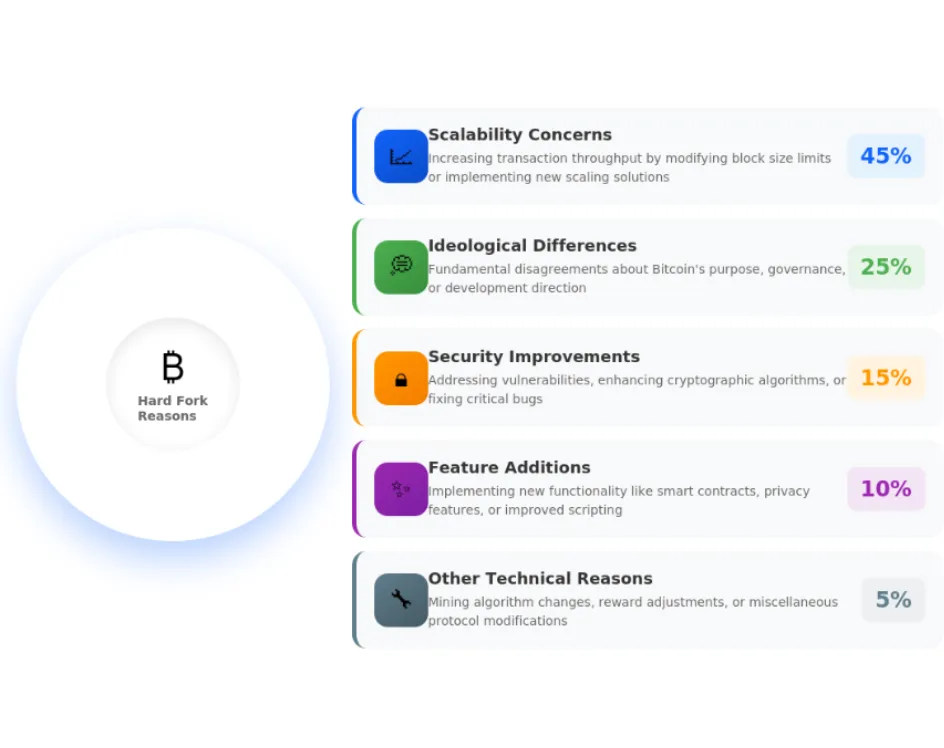
Bitcoin hard forks emerge from various motivations, ranging from technical necessity to philosophical disagreements about the network’s future direction. The most common catalyst involves scalability concerns, as Bitcoin’s original design limited block sizes to 1 megabyte, restricting transaction throughput and causing congestion during peak usage periods. When community factions disagree on the best approach to scaling, whether through larger blocks, layer two solutions, or other mechanisms, hard forks can result as different groups pursue their preferred visions independently.
Security vulnerabilities also prompt hard forks when discovered weaknesses require protocol changes incompatible with existing software. Although Bitcoin’s core protocol has proven remarkably robust, theoretical vulnerabilities or newly discovered attack vectors might necessitate urgent modifications. In such scenarios, the need to protect network integrity can override concerns about the disruption hard forks cause. Similarly, improvements to transaction efficiency, privacy features, or mining algorithms might require fundamental changes achievable only through hard forks. Proper implementation of standards like BIP 44 demonstrates how technical improvements enhance the ecosystem.
Beyond technical motivations, ideological differences frequently drive hard fork creation. Bitcoin’s decentralized nature means no single authority can dictate its development direction. When significant portions of the community hold fundamentally different views about Bitcoin’s purpose, whether as digital gold for value storage or as peer to peer electronic cash for daily transactions, these philosophical conflicts can manifest as competing hard forks. Each resulting chain then evolves according to its community’s vision, allowing the market and user adoption to ultimately determine which approach succeeds.
Backward Incompatibility in Hard Forks
Backward incompatibility represents the defining characteristic that distinguishes hard forks from other protocol upgrade mechanisms. When a hard fork activates, software running the previous protocol version cannot validate or relay blocks and transactions created under the new rules. This incompatibility isn’t a bug or oversight but rather an inherent consequence of implementing changes that fundamentally alter what the network considers valid. Understanding this incompatibility helps explain why hard forks require such extensive coordination and why they inevitably create permanent blockchain splits when not universally adopted.
The technical basis for backward incompatibility lies in how nodes validate incoming data. Each Bitcoin node maintains a complete copy of the blockchain and independently verifies every transaction and block against the consensus rules programmed into its software. When those rules change in ways that loosen restrictions or introduce entirely new transaction types, older nodes will reject the new data as invalid. For example, if a hard fork increases the maximum block size from 1 megabyte to 8 megabytes, nodes running old software will reject these larger blocks as violating the block size limit, even though newer nodes accept them as perfectly valid.
This incompatibility creates practical challenges for the entire cryptocurrency ecosystem. Exchanges must update their systems to support both chains or risk processing invalid transactions. Wallet providers need to implement replay protection to prevent transactions intended for one chain from being executed on another. Merchants accepting Bitcoin must ensure their payment processors support whichever chain their customers use. These widespread dependencies explain why successful hard fork coordination requires months of preparation and why contentious forks without broad support can fragment the network and its user base.
Role of Miners and Nodes in Hard Forks
Miners and node operators serve as the critical stakeholders whose decisions ultimately determine hard fork outcomes. Miners provide the computational power that secures the network and processes transactions, making their support essential for any chain’s viability. When a hard fork occurs, miners must choose which chain to direct their hash power toward, and this decision significantly influences which chain achieves greater security and reliability. A chain without adequate mining support becomes vulnerable to attacks and suffers from slow block production, potentially rendering it unusable.
Node operators, while not directly involved in block production, play an equally crucial role in network consensus. Full nodes independently verify all transactions and blocks, ensuring that only valid data propagates through the network. When a hard fork activates, node operators must decide whether to upgrade their software to the new protocol or continue running the original version. The distribution of nodes between chains affects network decentralization and the ability of users to verify transactions independently. Both considerations impact factors like Bitcoin transaction fees and overall network efficiency.
The interplay between miners and nodes during hard forks reveals the balance of power within decentralized networks. While miners might prefer one chain based on profitability calculations, node operators and users can influence outcomes by choosing which chain they accept for transactions. This dynamic creates a complex feedback loop where economic incentives, technical capabilities, and community preferences all influence the ultimate success or failure of forked chains. Historical hard forks demonstrate that neither mining power nor user adoption alone guarantees a chain’s long term viability; both factors must align for sustained success.
Consensus Changes in Bitcoin Hard Forks
Consensus changes form the technical heart of every Bitcoin hard fork, representing modifications to the rules all network participants must follow. These rules govern everything from how transactions are structured and validated to how new blocks are created and linked together. When hard forks alter consensus rules, they fundamentally change what the network considers valid, creating a new version of Bitcoin with different operational parameters. Understanding these consensus changes provides insight into what each hard fork attempts to achieve and how it differs from the original protocol.
Common consensus changes in Bitcoin hard forks include modifications to block size limits, alterations to mining algorithms, adjustments to block reward schedules, and changes to transaction formats. Block size increases represent perhaps the most contentious category, as they directly affect transaction throughput but also impact node operation requirements. Mining algorithm changes might aim to resist specialized hardware or improve energy efficiency. Reward schedule modifications could extend inflation periods or implement different distribution curves. Each change carries implications for network security, decentralization, and economic dynamics.
The process of implementing consensus changes requires careful coordination to prevent network fragmentation. Developers must clearly specify the exact block height at which new rules activate, ensuring all upgraded nodes switch simultaneously. Testing on specialized networks allows developers to identify and fix issues before deploying changes to the main network. Despite these precautions, the complexity of consensus changes means that unforeseen issues sometimes emerge post activation, requiring rapid response from development teams and potentially additional forks to address discovered problems.
Bitcoin Improvement Proposals and Hard Forks
Bitcoin Improvement Proposals serve as the formal mechanism through which protocol changes are proposed, discussed, and implemented within the Bitcoin ecosystem. These documents, commonly referred to as BIPs, provide structured specifications for suggested modifications, allowing the community to evaluate proposals on their technical merits. While most BIPs address changes implementable through soft forks or don’t affect consensus at all, some propose modifications so fundamental that hard forks become necessary for their implementation. Standards like BIP39 have transformed how wallets manage seed phrases.
The BIP process encourages transparent discussion and peer review of proposed changes, helping identify potential issues before implementation. Proposal authors must specify the motivation for their changes, provide detailed technical specifications, and address backward compatibility considerations. For hard fork proposals, this documentation becomes especially critical as the entire community needs to understand what changes will occur and why they require breaking compatibility with existing software. Well documented BIPs facilitate informed decision making by all stakeholders, from individual users to major exchanges.
However, the BIP process cannot guarantee consensus on controversial proposals. When community factions strongly disagree about a proposed change, no amount of documentation or discussion can force agreement. In such cases, hard forks might proceed with support from only a portion of the community, resulting in permanent chain splits. The history of Bitcoin hard forks demonstrates that the BIP process works best for technical improvements with broad support but struggles to resolve fundamental disagreements about Bitcoin’s purpose or optimal design parameters.
Famous Bitcoin Hard Forks: Bitcoin Cash and Bitcoin SV
Bitcoin Cash emerged on August 1, 2017, as the most significant hard fork in Bitcoin’s history, born from years of contentious debate about how to scale the network. Proponents of Bitcoin Cash believed that increasing the block size limit represented the best approach to improving transaction capacity, allowing more transactions per block and reducing fees during congestion. The fork increased the maximum block size from 1 megabyte to 8 megabytes, later expanded to 32 megabytes, enabling significantly higher transaction throughput compared to the original Bitcoin network.
Bitcoin SV, standing for “Satoshi Vision,” forked from Bitcoin Cash on November 15, 2018, further escalating the block size debate. Led by controversial figures claiming to represent Satoshi Nakamoto’s original vision, Bitcoin SV pushed for even larger blocks and restoration of certain original protocol features. The fork removed the 32 megabyte cap entirely, eventually allowing blocks of virtually unlimited size. This aggressive scaling approach generated intense controversy, with critics arguing that such large blocks would centralize mining and node operation among well resourced entities only.
| Characteristic | Bitcoin (BTC) | Bitcoin Cash (BCH) | Bitcoin SV (BSV) |
|---|---|---|---|
| Fork Date | Original Chain | August 2017 | November 2018 |
| Block Size | 1 MB (with SegWit) | 32 MB | Unlimited |
| Scaling Approach | Layer 2 (Lightning) | On chain scaling | Massive blocks |
| Primary Use Case | Store of value | Peer to peer cash | Enterprise blockchain |
| Market Position | #1 Cryptocurrency | Top 20 | Lower rankings |
Impact of Hard Forks on Bitcoin Holders
Bitcoin holders face unique opportunities and challenges when hard forks occur. The primary benefit comes from automatic receipt of equivalent coins on the forked chain, effectively providing free cryptocurrency to existing holders. If you held 10 Bitcoin before the Bitcoin Cash fork, you automatically possessed 10 Bitcoin Cash on the new chain in addition to your original Bitcoin. This “airdrop” effect has made hard forks attractive to some investors who see them as opportunities to accumulate additional assets without additional investment.
However, realizing value from forked coins requires active steps that many holders overlook or find technically challenging. Accessing forked coins typically requires using wallets that support the new chain, which might necessitate exporting private keys from existing wallets and importing them into new software. This process carries security risks if not performed carefully, as exposing private keys to new software could potentially compromise funds on both chains. Additionally, exchanges might not immediately support forked coins, limiting options for converting them to other currencies or the original Bitcoin.
The market dynamics surrounding hard forks create additional considerations for holders. Prices often fluctuate dramatically before and after forks as speculators position themselves. Some traders accumulate Bitcoin before forks to receive forked coins, then sell both assets afterward, creating downward pressure. Others believe specific forks will succeed and hold their positions long term. These varying strategies, combined with uncertainty about fork outcomes, generate significant volatility that can benefit active traders but threatens passive holders who prefer stable valuations. Utilizing proper cold storage practices becomes essential during such volatile periods.
Security Implications of Bitcoin Hard Forks
Hard forks introduce several security considerations that both individual users and the broader network must address. The most immediate concern involves replay attacks, which exploit the identical transaction format shared by both chains immediately after a fork. Without proper replay protection, a transaction broadcast on one chain could be captured and rebroadcast on the other chain, potentially causing unintended transfers. For example, if you send Bitcoin to an exchange after a fork, an attacker could replay that transaction on the forked chain, also sending your forked coins to an address they control.
Network security also faces challenges when hard forks split mining power between chains. The security of proof of work blockchains directly correlates with the computational power securing them. When miners divide between two chains, each chain becomes more vulnerable to majority attacks than the unified network was. This vulnerability proves especially problematic for the minority chain, which might retain only a small fraction of the original hash power. Attackers could potentially reorganize this chain’s recent history, enabling double spending attacks that would be impractical against the more secure majority chain.
Software vulnerabilities represent another security dimension of hard forks. Rushed implementations of new protocol rules might contain bugs that attackers can exploit. The complexity of blockchain software means that even carefully reviewed code can harbor unexpected vulnerabilities. When hard forks implement significant changes under time pressure, the risk of introducing exploitable flaws increases. Several forked cryptocurrencies have suffered attacks enabled by implementation bugs, highlighting the importance of thorough testing and conservative deployment schedules for consensus changes.
Economic and Market Impact of Hard Forks
The economic implications of Bitcoin hard forks extend far beyond the immediate creation of new cryptocurrencies. Markets respond to fork announcements with increased volatility as participants adjust their positions based on expectations about fork outcomes. Trading volumes typically spike as speculators attempt to profit from anticipated price movements. This activity affects not only Bitcoin but often the broader cryptocurrency market as traders rebalance portfolios and liquidity shifts between assets. Understanding these dynamics becomes part of any comprehensive Bitcoin growth strategy for businesses.
The value distribution between original and forked chains reflects market assessments of each chain’s long term prospects. Immediately after forks, markets must determine appropriate valuations for assets that didn’t previously exist, leading to price discovery processes characterized by extreme volatility. Over time, market prices stabilize as fundamental factors like development activity, merchant adoption, and network effects influence investor sentiment. Historical data shows that most forked coins decline significantly relative to Bitcoin over extended periods, though exceptions like Bitcoin Cash demonstrate that some forks can maintain substantial value.
Hard forks also impact the broader cryptocurrency ecosystem’s economics by fragmenting network effects and developer attention. Each successful fork creates a competing network that draws resources away from the original chain. Developers might choose to contribute to forked projects rather than the original, potentially slowing innovation on both chains. Merchants and payment processors must decide which chains to support, adding complexity and cost to cryptocurrency adoption efforts. These fragmentation effects represent hidden costs of hard forks that extend beyond the immediate market dynamics surrounding split events.
Community and Governance Challenges
Bitcoin’s decentralized nature creates unique governance challenges that hard forks bring into sharp focus. Unlike traditional software projects with clear decision making hierarchies, Bitcoin has no official authority capable of mandating protocol changes. Developers can propose modifications, but implementation requires voluntary adoption by miners, node operators, and users. This distributed governance model provides resilience against capture by any single interest but also complicates coordination when significant changes become necessary or desirable.
The debates preceding contentious hard forks often reveal deep divisions within cryptocurrency communities. Disagreements about technical approaches frequently mask underlying philosophical differences about a cryptocurrency’s fundamental purpose. Some participants prioritize decentralization and censorship resistance above all else, while others emphasize transaction speed and user experience. These value differences prove difficult to reconcile through technical discussion alone, as they ultimately reflect incompatible visions for the network’s future. When compromise proves impossible, hard forks allow different factions to pursue their preferred approaches independently.
Post fork community dynamics can become contentious as competing chains vie for legitimacy, users, and developer attention. Supporters of different chains sometimes engage in hostile behavior, including coordinated attacks on competing networks, aggressive marketing campaigns, and social media conflicts. These dynamics can damage the broader cryptocurrency ecosystem’s reputation and discourage potential adopters who find the infighting confusing or off putting. Successful cryptocurrency projects must navigate these governance challenges while maintaining sufficient cohesion to drive continued development and adoption.
Risks and Controversies Around Hard Forks
Hard forks carry significant risks that extend beyond the technical challenges of implementing protocol changes. Network fragmentation represents perhaps the most serious long term risk, as each successful fork divides the community, hash power, and development resources that previously supported a single network. This fragmentation can weaken all resulting chains compared to what a unified network might achieve, potentially undermining the value proposition that attracted users to the original cryptocurrency.
Controversial hard forks can also damage public trust in cryptocurrency stability and reliability. When users see blockchain networks splitting acrimoniously, with competing factions each claiming to represent the “true” version of a cryptocurrency, confidence in the ecosystem’s maturity and governance erodes. Businesses evaluating cryptocurrency integration might delay adoption until governance models prove more stable. Regulators might view governance controversies as evidence that cryptocurrency markets require increased oversight. These perception challenges compound the direct costs of fork related disruptions.
The proliferation of hard forks has also enabled opportunistic projects with questionable motivations. Some forks appear designed primarily to enrich their creators rather than to advance legitimate technical or philosophical goals. These projects might pre mine coins before announcing forks, implement changes that benefit insiders, or simply leverage the Bitcoin brand for marketing purposes without adding meaningful value. Distinguishing legitimate innovation from opportunistic exploitation requires careful evaluation, which many cryptocurrency investors lack the technical knowledge to perform independently.
Need Expert Guidance on Bitcoin and Blockchain Technology?
Partner with experienced blockchain professionals who understand the complexities of cryptocurrency networks, hard forks, and protocol upgrades.
Conclusion: Why Bitcoin Hard Forks Matter
Bitcoin hard forks represent one of the most significant phenomena in cryptocurrency evolution, embodying both the challenges and opportunities inherent in decentralized network governance. These blockchain splits demonstrate that open source, permissionless networks can adapt and evolve even without central authorities, though often through contentious processes that fragment communities and resources. Understanding hard forks equips cryptocurrency participants with essential knowledge for navigating an ecosystem where protocol changes can dramatically affect holdings, investment strategies, and technological infrastructure.
The history of Bitcoin hard forks provides valuable lessons about blockchain governance, community dynamics, and the tension between innovation and stability. Successful forks like Bitcoin Cash show that significant protocol changes can create viable alternative networks serving different use cases. Failed forks demonstrate the difficulty of achieving the critical mass of support necessary for long term viability. These examples collectively inform how future protocol disputes might unfold and what factors determine which chains ultimately thrive. Similar governance considerations affect emerging blockchain sectors including DAOs in DeFi Space where community coordination proves equally essential.
Looking forward, hard forks will likely remain part of Bitcoin’s evolution as technological advances, scaling challenges, and philosophical debates continue. The cryptocurrency ecosystem has developed more sophisticated mechanisms for coordinating protocol changes, but fundamental disagreements about Bitcoin’s optimal design will persist. Participants who understand hard fork mechanics, risks, and opportunities position themselves to navigate these events successfully, whether by protecting existing holdings, evaluating investment opportunities in forked assets, or contributing to governance discussions that shape the network’s future direction.
Frequently Asked Questions
Generally, you won’t lose your Bitcoin during a hard fork. Your coins exist on both chains after the split. However, you must ensure your wallet supports the new chain to access the forked coins. Using exchanges during fork events carries risks, so holding private keys is recommended. Always back up your wallet before any major network event.
To claim forked coins, ensure you held Bitcoin before the fork’s snapshot block. Export your private keys from the original wallet and import them into a wallet supporting the new chain. Never share private keys online. Wait until the new network stabilizes before attempting claims. Some exchanges automatically credit forked coins to users.
A hard fork activates at a specific block height, happening instantly. However, the preparation phase involving proposals, debates, and testing can take months or years. Post fork, network stabilization requires days to weeks. Full ecosystem support from exchanges and wallets may take several months to achieve completely.
Hard forks can significantly impact Bitcoin’s price through market uncertainty and speculation. Before forks, prices often rise as traders accumulate coins. After forks, prices may drop as some holders sell forked coins. Long term effects depend on the fork’s success and community adoption. Market sentiment plays a crucial role in price movements.
Tax treatment of forked coins varies by jurisdiction. In many countries, receiving forked coins creates taxable income at fair market value. Selling them triggers capital gains tax. Consult a tax professional familiar with cryptocurrency regulations in your region. Keep detailed records of all fork related transactions for accurate reporting.
Technically, reversing a hard fork requires another hard fork to undo changes. This rarely happens due to community fragmentation and technical complexity. Once miners and nodes adopt the new chain, reversal becomes practically impossible. The original chain continues independently if enough participants support it.
Hard forks fail when they lack sufficient miner support, community adoption, or developer commitment. Without adequate hash power, the new chain becomes vulnerable to attacks. Poor marketing, technical issues, or controversial changes drive users away. Successful forks need strong ecosystem support including exchanges, wallets, and merchants.
Exchanges typically announce their hard fork policies beforehand. Many pause deposits and withdrawals around fork time for safety. Some credit users with forked coins automatically while others don’t support new chains. Large exchanges influence fork success through their listing decisions. Always check your exchange’s specific fork handling policy.
Pending transactions may confirm on one or both chains depending on timing. Transactions broadcast before the fork usually process normally. Those sent during the fork might experience delays or require rebroadcasting. Using higher fees ensures faster confirmation. Avoid sending transactions near fork activation times.
Technically, anyone with programming knowledge can fork Bitcoin’s open source code. However, creating a successful fork requires substantial resources including developer teams, marketing, exchange listings, and community support. Most forks without significant backing fail to gain traction and eventually become worthless or abandoned projects.
Reviewed & Edited By

Aman Vaths
Founder of Nadcab Labs
Aman Vaths is the Founder & CTO of Nadcab Labs, a global digital engineering company delivering enterprise-grade solutions across AI, Web3, Blockchain, Big Data, Cloud, Cybersecurity, and Modern Application Development. With deep technical leadership and product innovation experience, Aman has positioned Nadcab Labs as one of the most advanced engineering companies driving the next era of intelligent, secure, and scalable software systems. Under his leadership, Nadcab Labs has built 2,000+ global projects across sectors including fintech, banking, healthcare, real estate, logistics, gaming, manufacturing, and next-generation DePIN networks. Aman’s strength lies in architecting high-performance systems, end-to-end platform engineering, and designing enterprise solutions that operate at global scale.