Blockchain technology has moved well beyond its early days as the engine behind Bitcoin. Today, it powers decentralized applications, smart contracts, lending platforms, NFT marketplaces, and entire financial ecosystems. But here is the thing that most people overlook: building a blockchain app is only half the battle. The other half is making sure it actually works the way it should, under every possible condition, before it goes live.
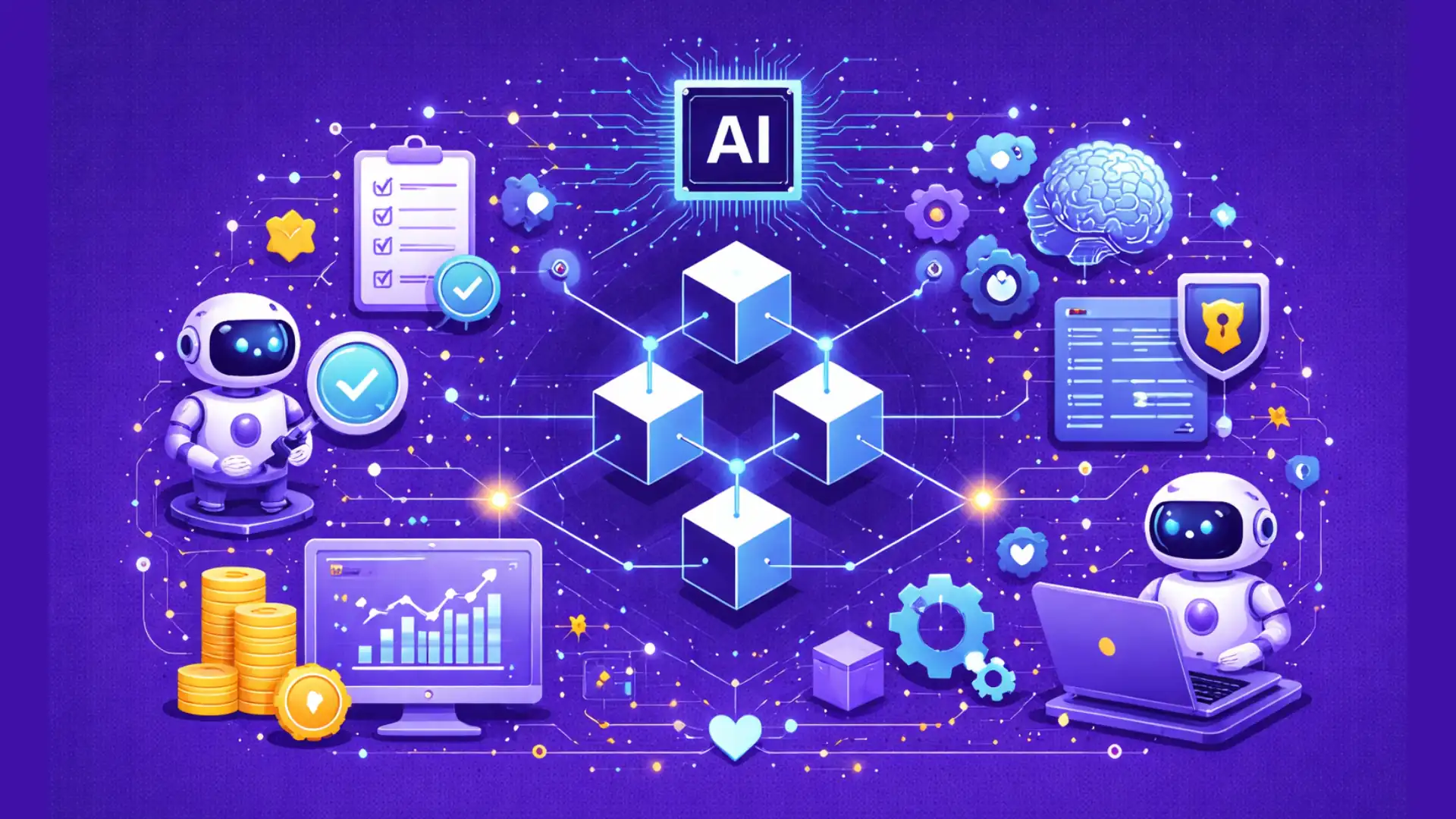
That is where AI testing tools step in. These platforms combine machine learning, natural language processing, and predictive analytics to test blockchain applications faster, smarter, and with far greater accuracy than traditional methods. And in a space where a single bug in a smart contract can drain millions of dollars overnight, this kind of testing is not optional. It is a baseline requirement.
This article breaks down exactly how AI testing tools are reshaping blockchain app development, what problems they solve, and why teams building in Web3 should pay close attention to this shift.
Key Takeaways
- AI testing tools automate smart contract validation, catching vulnerabilities like reentrancy attacks and integer overflows before deployment.
- Natural language test authoring allows non-technical team members, including product managers and compliance officers, to write and review test cases.
- Auto-healing capabilities reduce test maintenance by adapting to UI and logic changes without manual script updates.
- Cross-chain and cross-platform testing ensures DApps work consistently across Ethereum, Solana, BNB Chain, and other networks.
- AI-powered testing can reduce QA cycle times by up to 60%, enabling faster and more confident releases for blockchain teams.
- End-to-end testing across hybrid architectures covers smart contracts, off-chain services, APIs, and front-end interfaces in a single workflow.
- Predictive analytics and behavior-based test generation represent the next wave of autonomous QA for Web3 projects.
Why Blockchain Apps Need a Different Testing Approach
If you have worked with traditional web or mobile applications, you already know how important testing is. But blockchain applications introduce a set of challenges that go beyond what most QA teams are used to handling. The decentralized nature of these systems, combined with the financial stakes involved, creates a testing environment where mistakes are permanent and expensive.
Think about a smart contract deployed on Ethereum. Once that contract is live on the blockchain, you cannot patch it like you would a regular software update. If there is a logic flaw or a security hole, attackers will find it. The 2016 DAO hack, which resulted in a loss of roughly $60 million worth of Ether, is a reminder of what happens when smart contract testing falls short.
Beyond smart contracts, DApps also have to deal with distributed architecture, multiple wallet integrations, fluctuating gas fees, asynchronous event handling, and the absence of standardized testing frameworks across newer blockchain networks. Manual testing simply cannot keep up with this level of complexity. Even basic test automation struggles because the rigid scripts break every time a UI element shifts or a new wallet is supported.
This is not a minor inconvenience. It is a structural gap in the development process that AI testing tools are specifically designed to fill.
Core Challenges in Blockchain Application Testing
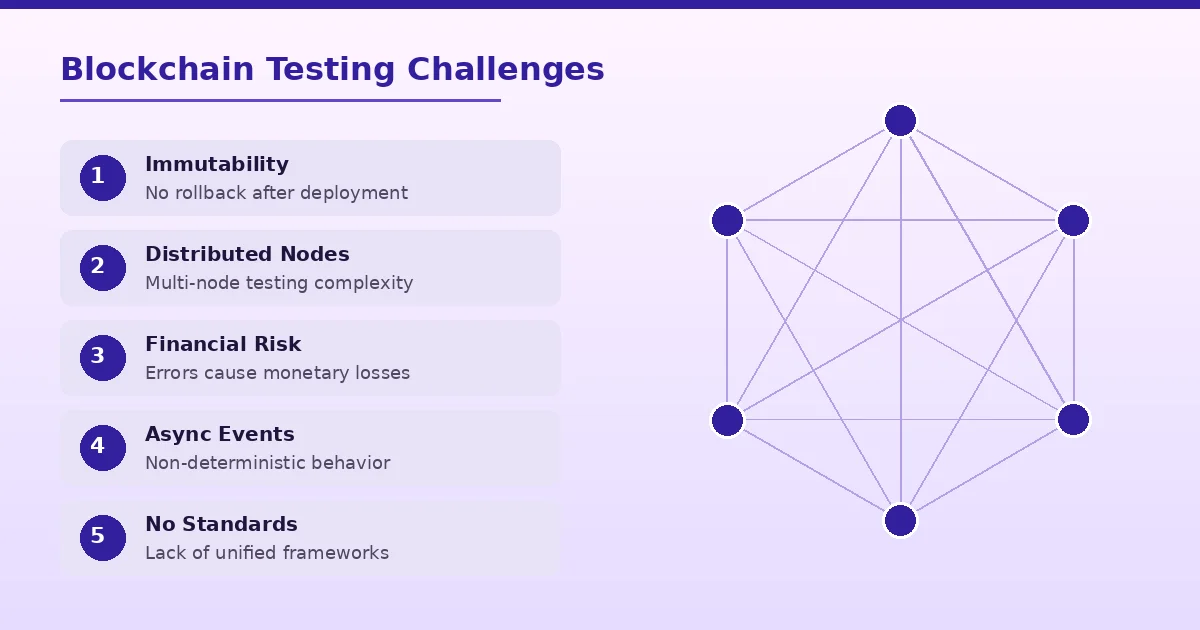
Before getting into how AI solves these issues, it helps to understand the specific pain points that blockchain developers face during the testing phase. Each of these challenges compounds the others, making the overall QA process significantly harder than in conventional software development.
| Challenge | What It Means | Impact on Development |
|---|---|---|
| Immutability | Smart contracts cannot be changed after deployment | Bugs become permanent; no hotfixes possible |
| Distributed Architecture | Apps run across multiple nodes and networks | Testing must cover network latency, node failures, consensus issues |
| Financial Exposure | DeFi apps handle real money and digital assets | A single exploit can drain millions in user funds |
| Asynchronous Events | Transactions depend on block confirmations and oracle data | Non-deterministic behavior makes test results inconsistent |
| No Unified Standards | Each chain has its own tools, languages, and environments | Testing strategies must be rebuilt for every ecosystem |
When you stack these challenges together, the case for intelligent, adaptive testing becomes clear. Traditional QA pipelines were not built for this kind of complexity, and trying to force them into the blockchain mold leads to missed bugs, delayed releases, and costly post-deployment fixes.
What Are AI Testing Tools and How Do They Work?
AI testing tools are software platforms that use artificial intelligence to improve every stage of the testing process. They go beyond simple script execution. Instead, they understand application behavior, predict where failures are most likely to occur, and adapt when the application changes.
At their core, these tools rely on three pillars of artificial intelligence: machine learning for pattern recognition and risk prediction, natural language processing for converting plain English instructions into executable test cases, and computer vision for identifying UI elements regardless of code-level changes.
Here is what that looks like in practice. A QA engineer writes a test instruction like: “Click on Connect Wallet, select MetaMask, approve the transaction, and verify the balance updates.” The AI testing platform parses that sentence, maps it to the actual application elements, executes the test, and records the results. If the developers later rename the button from “Connect Wallet” to “Link Wallet,” the tool detects the change and updates the test automatically, without anyone needing to rewrite a line of code.
This combination of understanding, execution, and self-maintenance is what sets AI testing apart from conventional test automation frameworks. And it is precisely what blockchain applications need, given how rapidly their interfaces and underlying logic evolve.
How AI Testing Tools Are Transforming Blockchain Development
The benefits of AI-powered testing for blockchain are not theoretical. Development teams across the Web3 space are already seeing measurable improvements in speed, accuracy, and release confidence. Let us walk through the most significant areas of impact.
Smarter Smart Contract Validation
Smart contracts are the backbone of virtually every blockchain application. They execute automatically, hold funds, and manage permissions. Because of their immutable nature, a vulnerability in a smart contract is not just a bug. It is a potential financial disaster.
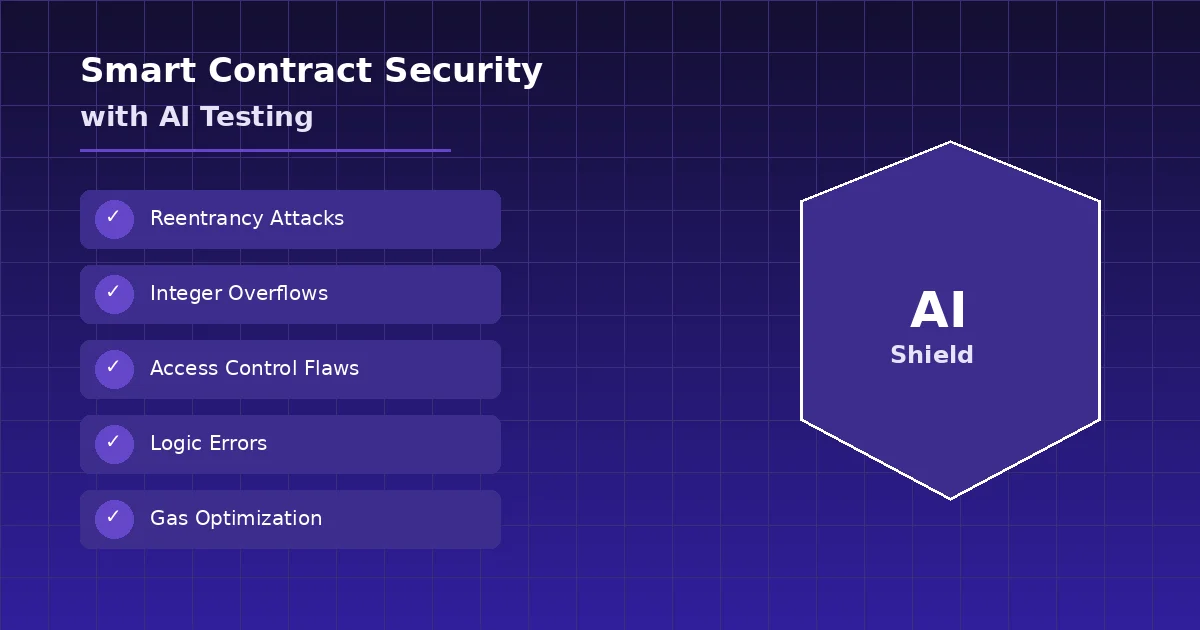
AI testing tools address this by simulating thousands of interactions with a contract across a wide range of edge cases. They combine static code analysis with dynamic runtime testing to identify vulnerabilities that a human tester or a basic automated script might overlook. Common issues these tools flag include reentrancy attacks, where a malicious contract repeatedly calls back into the vulnerable contract to drain funds, integer overflow and underflow errors, access control misconfigurations that allow unauthorized users to execute privileged functions, and logic errors where the contract behaves correctly in isolation but fails when interacting with other contracts.
What makes AI-driven validation especially valuable is its ability to prioritize. Not all parts of a contract carry equal risk. The AI analyzes the code structure, identifies functions that handle critical operations like fund transfers or permission changes, and focuses testing resources on those areas first. This risk-based approach ensures that the most dangerous bugs get caught before anything else.
Cross-Chain and Cross-Platform Regression Testing
Most serious blockchain projects do not operate on just one chain. A DeFi protocol might support Ethereum, Solana, Avalanche, and BNB Chain simultaneously. Each of these networks has its own transaction model, consensus mechanism, and performance characteristics. When you push an update to your DApp, regression testing needs to verify that everything still works correctly across all supported chains.
Doing this manually is impractical. Even with basic automation, the maintenance burden of keeping separate test scripts for each chain is enormous. AI testing tools solve this by allowing teams to write a single set of test scenarios that the platform then executes across multiple environments. The tool handles the differences in gas fee structures, block confirmation times, and wallet interactions behind the scenes.
For teams working on applications that span multiple AI use cases across industries, this kind of cross-platform capability is not just convenient. It is essential for maintaining product quality at scale.
Natural Language Test Authoring
One of the most practical advantages of AI testing tools is that they lower the barrier to writing tests. In a traditional setup, only developers or dedicated QA engineers with scripting knowledge can create and maintain test cases. This creates bottlenecks and limits how much testing actually gets done.
With natural language support, anyone on the team can contribute. A product manager can write a test case that says, “Navigate to the staking page, enter 100 tokens, click Stake, and verify the confirmation message appears.” The AI platform interprets this and turns it into an executable test. This does two important things. First, it speeds up test creation because you do not need to wait for an engineer to write the script. Second, it improves test accuracy because the person who understands the user story best is the one defining the test.
In blockchain projects, where teams are often distributed across time zones and include contributors with varying technical backgrounds, this kind of accessibility can make or break the QA process.
Auto-Healing for Rapidly Evolving Interfaces
Blockchain application interfaces change frequently. New wallet integrations, updated token listings, redesigned dashboards, and additional network support all trigger UI changes that can break existing test scripts. In a conventional automation setup, a developer has to go in, find the broken locator or element reference, and fix it manually. Multiply that by hundreds of test cases across multiple chains, and you are looking at a full-time maintenance job.
AI testing tools use machine learning and computer vision to detect when a UI element has changed and adjust the test accordingly. If a button is moved to a different position on the page, or if its label changes from “Approve Transaction” to “Confirm Swap,” the tool recognizes the intent behind the element and updates the test reference automatically. The test continues to pass without any manual intervention.
For Web3 development teams that push updates on tight schedules, this auto-healing capability saves a significant amount of time and keeps the testing pipeline running smoothly.
Traditional Testing vs. AI-Powered Testing for Blockchain
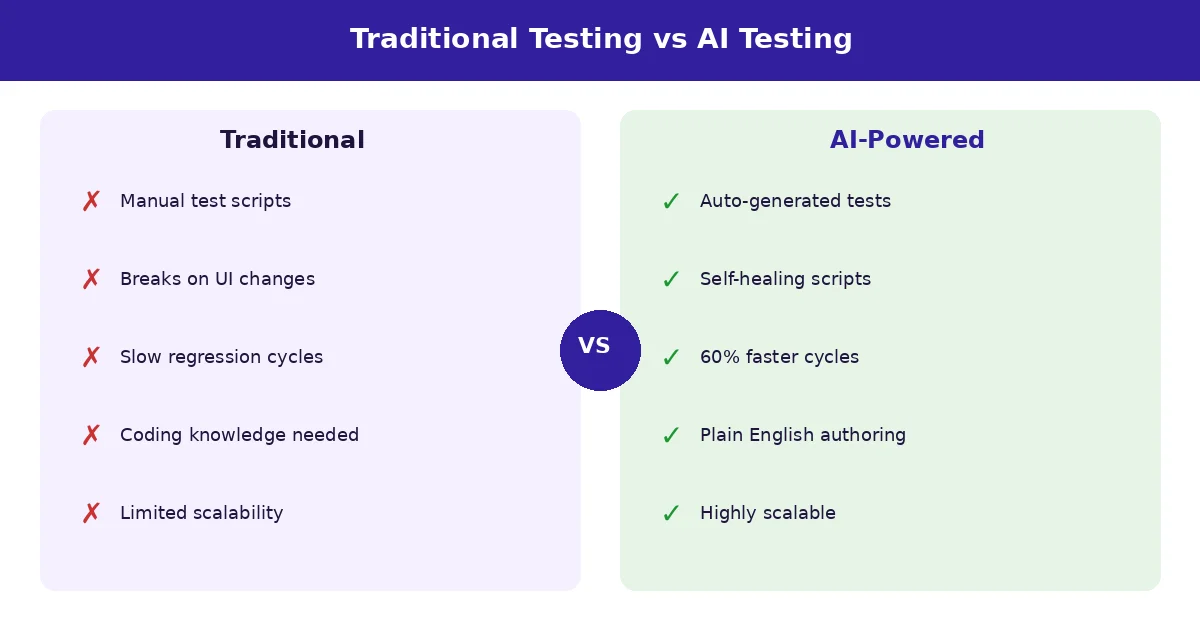
To put the difference in perspective, here is a side-by-side comparison of how traditional testing and AI-powered testing stack up when applied to blockchain app development.
| Parameter | Traditional Testing | AI-Powered Testing |
|---|---|---|
| Test Creation Speed | Hours to days per test suite | Minutes using natural language input |
| Maintenance Effort | High; scripts break with UI changes | Low; auto-healing adapts to changes |
| Cross-Chain Coverage | Requires separate scripts per chain | Reusable test scenarios across chains |
| Smart Contract Testing | Limited to predefined test cases | AI generates edge cases and prioritizes risky code |
| Collaboration | Requires coding knowledge to participate | Anyone can write tests in plain English |
| Regression Cycle Time | Days to complete full regression | Hours with parallel AI execution |
| Security Validation | Manual audits and periodic reviews | Continuous, automated vulnerability scanning |
| Scalability | Scales linearly with team size | Scales exponentially with minimal added resources |
The gap becomes even more pronounced as projects grow in complexity. A small DApp with one or two features might get by with manual testing. But the moment you add multi-chain support, staking, governance, oracle integrations, and NFT functionality, traditional testing hits a wall. AI testing tools are built for that kind of scale from the ground up.
The AI-Powered Blockchain Testing Lifecycle
Understanding how AI testing fits into the broader development workflow helps clarify why it is so effective. The testing lifecycle for a blockchain application, when powered by AI, follows a continuous loop that improves with every iteration.
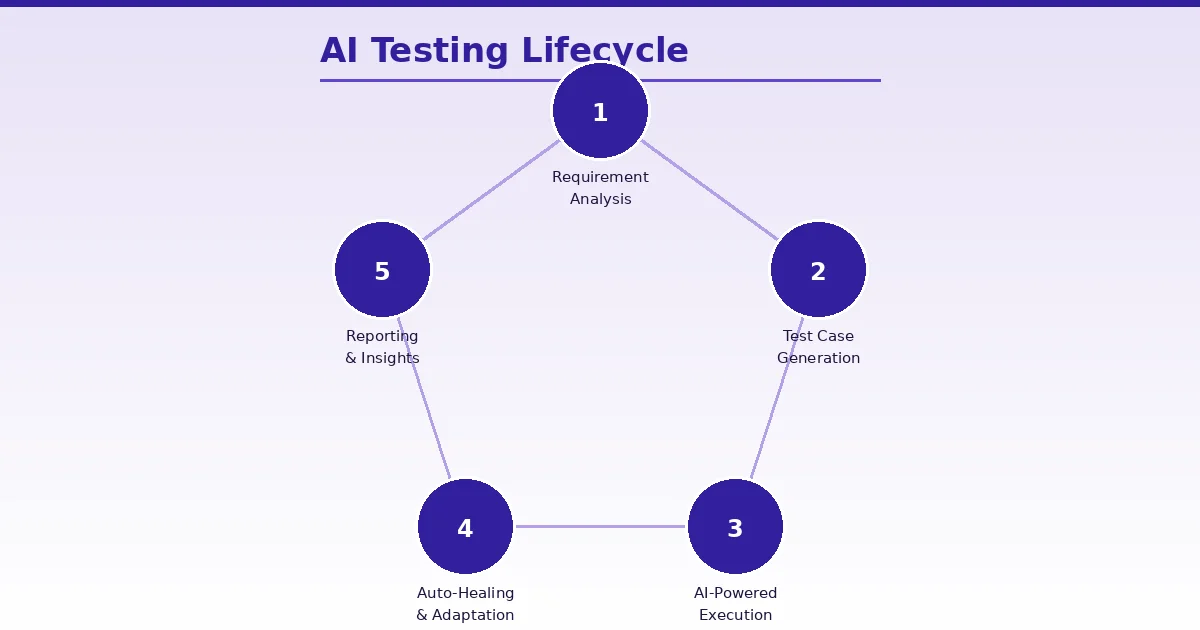
Stage 1: Requirement Analysis. The AI platform ingests project requirements, user stories, and smart contract specifications. It uses NLP to extract testable conditions and map them to functional areas of the application. This stage ensures that nothing in the requirements gets missed during test design.
Stage 2: Test Case Generation. Based on the analyzed requirements and historical data from previous test runs, the AI generates test cases automatically. It covers standard scenarios, edge cases, and security-focused tests. For smart contracts, this includes simulating a wide range of input values, permission levels, and interaction sequences.
Stage 3: AI-Powered Execution. The test cases run across the configured environments: multiple chains, wallets, browsers, and device types. The AI engine handles parallel execution, manages test data, and interacts with blockchain testnets and mainnets as needed. This stage is where the speed advantage is most visible, with full regression suites completing in hours rather than days.
Stage 4: Auto-Healing and Adaptation. When tests encounter changes in the application, the AI evaluates whether the change is intentional or a potential defect. If a UI element has been renamed or repositioned, the tool updates its reference and continues. If a smart contract function returns unexpected results, it flags the issue for review. This adaptive behavior dramatically reduces false failures and maintenance overhead.
Stage 5: Reporting and Insights. The final stage produces detailed reports that go beyond pass/fail results. AI-powered analytics show risk heatmaps, trend data on recurring issues, test coverage metrics, and actionable recommendations for the next release cycle. These insights help teams make informed decisions about where to invest their QA efforts going forward.
This lifecycle repeats with every release, and the AI gets smarter each time. It learns which areas of the application are most prone to defects, which test cases provide the most value, and where new coverage is needed. Over time, this creates a QA process that is not just automated but genuinely intelligent.
Security and Compliance Validation at Scale
Security is not a feature in blockchain development. It is a prerequisite. And regulatory compliance is catching up fast. Many jurisdictions now require blockchain applications, especially those in decentralized finance (DeFi), to comply with anti-money laundering (AML) and know-your-customer (KYC) regulations.
AI testing tools handle both sides of this equation. On the security front, they continuously scan for vulnerabilities across smart contracts, APIs, and UI layers. They identify common attack vectors and test for them automatically as part of every release cycle. On the compliance front, they validate user verification workflows, monitor for data leakage, confirm that encryption standards are met, and check that permission structures enforce the right access controls.
The reporting capabilities of AI tools also support audit readiness. Teams can generate detailed logs and compliance reports that document what was tested, when, and what the results were. This kind of documentation is increasingly important for projects that need to demonstrate regulatory compliance to auditors, investors, or regulatory bodies. If your team is working on AI-powered platforms that need to meet strict compliance standards, you might also want to explore the comprehensive guide to AI development services and providers for insights on building compliant systems from the ground up.
Build Smarter Blockchain Apps with AI-Driven Testing
Ready to eliminate bugs before deployment and cut your QA cycle time in half? Partner with experienced AI developers who understand blockchain from the inside out.
End-to-End Testing Across Hybrid Blockchain Architectures
It is a common misconception that blockchain applications live entirely on-chain. In reality, most production DApps use a hybrid architecture. The smart contracts handle the core logic and fund management on-chain, but there is usually a layer of off-chain services handling things like user authentication, data indexing, notification delivery, and interaction with external data feeds through oracles.
This hybrid setup means that testing just the smart contract is not enough. You need to verify that the entire user journey works end to end, from the moment a user connects their wallet in the browser to the point where a transaction is confirmed on-chain and the resulting state change is reflected in the application’s UI and backend systems.
AI testing tools are designed for exactly this kind of holistic coverage. They can interact with web and mobile interfaces, call APIs, query databases, trigger smart contract functions, and verify oracle responses, all within a single test flow. This eliminates the gaps that often exist between separately tested components and catches integration issues that would otherwise only surface in production.
For projects building complex ecosystems that blend blockchain with emerging technologies like virtual worlds or immersive experiences, understanding the costs and technical requirements is equally important. The AI-powered metaverse platform cost guide provides a useful breakdown of what goes into building and testing these kinds of large-scale platforms.
Real-World Scenario: How a DeFi Platform Scaled QA with AI
Consider a DeFi lending protocol that supports multiple wallet providers, offers staking and yield farming, integrates Chainlink oracles for price feeds, and releases feature updates every two to three weeks. Before adopting AI testing tools, the team’s QA process looked something like this: each release required dozens of manual test runs across different wallets and chains. Engineers spent hours writing and updating brittle test scripts. Minor UI changes broke existing tests and delayed deployments. The full regression cycle took three to five days, creating a bottleneck that slowed down the entire development pipeline.
After integrating an AI testing platform into their workflow, the results were measurable. Regression cycle time dropped by roughly 60 percent. Product managers began writing test cases in plain English, freeing up engineering time for feature development. The AI tool caught smart contract logic errors during the testing phase that would have previously made it to production. The team moved from monthly releases to biweekly releases without sacrificing quality or confidence.
This is not an isolated case. Across the blockchain industry, teams that adopt AI-driven QA consistently report faster release cycles, fewer production incidents, and better collaboration between technical and non-technical team members.
Essential Features to Look for in an AI Testing Tool for Blockchain
Not every AI testing platform is equipped to handle the demands of blockchain development. If you are evaluating options for your project, there are specific capabilities that should be on your checklist. Missing any of these could leave gaps in your testing coverage that compromise your application’s reliability and security.
| Feature | Why It Matters for Blockchain |
|---|---|
| Natural Language Test Authoring | Enables non-technical team members to write tests, covering nuanced user flows like wallet connections, staking, and gas fee validation |
| Cross-Chain Testing | Verifies consistent behavior across Ethereum, Solana, Avalanche, BNB Chain, and other supported networks |
| Smart Contract Validation | Tests contract logic, permissions, edge cases, and known vulnerability patterns before mainnet deployment |
| Auto-Healing | Adapts tests to UI and logic changes automatically, preventing false failures and reducing maintenance costs |
| CI/CD and Wallet Integration | Supports Jenkins, GitHub Actions, GitLab, and wallet providers like MetaMask, WalletConnect, and Phantom for continuous testing |
| Scalable Parallel Execution | Handles thousands of test cases simultaneously across staging, devnet, and mainnet environments |
The right tool should also provide detailed analytics and reporting that help your team identify patterns, track improvements over time, and make data-driven decisions about where to focus testing efforts. If it does not give you actionable insights alongside test results, it is only doing half the job.
The Role of AI Application Development in Blockchain Testing
Building an effective AI testing pipeline for blockchain is not just about picking the right tool off the shelf. It often requires custom integration work, especially for projects with unique smart contract architectures or non-standard wallet setups. This is where working with experienced AI application developers becomes important.
A skilled development team can help you configure AI testing tools to match your specific blockchain stack, integrate them into your existing CI/CD pipeline, and build custom test scenarios for complex workflows like multi-signature transactions, flash loan simulations, or cross-chain bridge testing. They can also set up the analytics layer so your QA data feeds back into development planning, creating a continuous improvement loop.
The point is that AI testing tools are powerful, but they deliver the most value when they are set up and maintained by people who understand both the AI side and the blockchain side of the equation. Investing in the right development support upfront saves a lot of trial and error down the line.
What Comes Next: The Future of AI-Driven QA for Web3
The current generation of AI testing tools already represents a major leap forward. But the technology is still evolving, and the next few years will bring capabilities that push autonomous QA even further.
Predictive failure analysis is one of the most promising areas. Instead of waiting for bugs to appear during testing, AI systems will analyze code changes, historical defect data, and usage patterns to predict where failures are most likely to occur before tests even run. This will allow teams to allocate resources proactively rather than reactively.
Behavior-based test generation is another area to watch. As AI tools collect more data on how users interact with blockchain applications, they will be able to generate test cases that mirror real-world usage patterns. This means tests will cover the scenarios that actual users encounter, not just the ones that testers imagine.
Self-optimizing test strategies will also become standard. AI systems will learn over time which tests provide the most coverage, which ones are redundant, and how to adjust the test suite for maximum efficiency. The result will be leaner, faster, and more effective QA cycles with less human intervention required.
For teams already investing in AI capabilities, the range of AI use cases across industries shows just how broad the impact of these technologies is becoming, and blockchain testing is one of the fastest-growing areas of adoption.
“The intersection of AI and blockchain testing is not just about finding bugs faster. It is about fundamentally changing how we think about quality in decentralized systems. When your testing platform can predict failures before they happen, adapt to changes without manual intervention, and generate coverage based on real user behavior, you are no longer running a QA process. You are running an intelligent quality system that improves with every cycle.”
Conclusion
Blockchain development operates under constraints that most other software domains do not face. Immutability means you cannot patch mistakes after deployment. Financial exposure means bugs have real monetary consequences. And the pace of innovation means applications are constantly evolving, making traditional testing methods unreliable at best and dangerous at worst.
AI testing tools address every one of these challenges head on. They automate test creation with natural language support, adapt to changes through auto-healing, validate smart contracts against known vulnerabilities, and scale across chains and platforms without proportional increases in effort or cost. They turn QA from a bottleneck into a competitive advantage.
For any team building in the blockchain space, whether it is a DeFi protocol, an NFT marketplace, a supply chain solution, or a Web3 gaming platform, integrating AI testing into the development lifecycle is one of the highest-return investments you can make. The tools are here. The question is whether your testing strategy is ready to use them.
Frequently Asked Questions
AI testing tools are software platforms that use machine learning, natural language processing, and predictive analytics to automate the testing of blockchain applications. They create test cases from plain English descriptions, simulate thousands of smart contract interactions, and adapt automatically when the application changes. For blockchain, they address unique challenges like immutability, cross-chain compatibility, and financial risk by providing deeper coverage and faster execution than manual or traditional automated testing methods.
AI testing tools improve smart contract security by combining static code analysis with dynamic runtime testing to identify vulnerabilities that manual reviews often miss. They simulate thousands of edge-case interactions and prioritize high-risk functions like fund transfers and access control. The tools detect common attack patterns such as reentrancy exploits, integer overflow errors, and permission misconfigurations. By focusing testing resources on the most vulnerable areas first, they significantly reduce the chance of deploying a contract with exploitable flaws.
Yes, that is one of the biggest practical advantages of AI testing tools. Natural language test authoring allows product managers, QA analysts, and compliance officers to write test cases in plain English without any coding knowledge. A team member can write something like “connect MetaMask wallet, navigate to staking, enter 50 tokens, and verify confirmation” and the AI platform converts it into an executable test. This speeds up test creation and improves accuracy because the people closest to the user experience define the tests.
Auto-healing refers to the ability of AI testing tools to detect changes in an application’s interface or logic and automatically update test references without manual intervention. For blockchain DApps, where UI elements frequently change due to new wallet integrations, token listings, or network updates, this is critical. Without auto-healing, test scripts break constantly and require engineers to manually fix element locators. Auto-healing keeps the testing pipeline running smoothly and reduces the maintenance burden significantly.
Teams that adopt AI-powered testing for blockchain applications typically report a 50 to 60 percent reduction in regression cycle time. Full regression suites that previously took three to five days can be completed in hours with AI tools running parallel test executions across multiple chains and environments. The speed improvement comes from automated test generation, auto-healing that eliminates manual script fixes, and intelligent test prioritization that focuses on the most critical and risk-prone areas of the application first.
Yes, cross-chain testing is a core capability of modern AI testing tools designed for blockchain. They allow teams to write a single set of test scenarios and execute them across multiple blockchain networks like Ethereum, Solana, BNB Chain, Avalanche, and Polkadot. The tools handle differences in gas fee structures, block confirmation times, and consensus mechanisms behind the scenes. This enables teams to verify that their DApp works consistently across all supported chains without maintaining separate test scripts for each network.
Reviewed & Edited By

Aman Vaths
Founder of Nadcab Labs
Aman Vaths is the Founder & CTO of Nadcab Labs, a global digital engineering company delivering enterprise-grade solutions across AI, Web3, Blockchain, Big Data, Cloud, Cybersecurity, and Modern Application Development. With deep technical leadership and product innovation experience, Aman has positioned Nadcab Labs as one of the most advanced engineering companies driving the next era of intelligent, secure, and scalable software systems. Under his leadership, Nadcab Labs has built 2,000+ global projects across sectors including fintech, banking, healthcare, real estate, logistics, gaming, manufacturing, and next-generation DePIN networks. Aman’s strength lies in architecting high-performance systems, end-to-end platform engineering, and designing enterprise solutions that operate at global scale.