
Key Takeaways
- Account Abstraction ERC-4337 replaces rigid externally owned accounts with programmable smart contract wallets that support custom validation, social recovery, and gasless transactions on Ethereum.
- ERC-4337 works entirely at the application layer without requiring changes to the Ethereum protocol, using a system of UserOperations, Bundlers, Paymasters, and the EntryPoint contract.
- Smart contract wallets ERC-4337 enable features like multi-factor authentication, batched transactions, session keys, and spending limits that are impossible with traditional EOA wallets.
- Gas abstraction through paymasters allows projects to sponsor transaction fees for users, accept alternative tokens for gas, and create seamless onboarding experiences for Web3 wallet infrastructure.
- Account Abstraction for blockchain developers opens up new design patterns for DeFi protocols, NFT marketplaces, DAO governance systems, and enterprise wallet solutions.
- ERC-4337 is compatible with all major EVM networks including Ethereum, Polygon, Arbitrum, Optimism, and Base, enabling cross-chain smart wallet deployments.
- Implementing ERC-4337 requires designing smart contract wallets, integrating EntryPoint contracts, configuring bundlers and paymasters, and conducting thorough security audits.
- Ethereum wallet innovation through Account Abstraction is driving institutional adoption and positioning smart contract wallets as the default Web3 account model by 2026 and beyond.
What is Account Abstraction in Ethereum?
If you have spent any time working with Ethereum, you know the experience is far from seamless. Users must safeguard seed phrases, maintain ETH balances just to pay gas fees, and every transaction requires a cryptographic signature from a single private key. Account Abstraction ERC-4337 fundamentally changes this by allowing smart contracts to serve as primary user accounts, replacing the rigid limitations of externally owned accounts with programmable, flexible, and user-friendly wallets.
At its simplest, what is Account Abstraction in Ethereum? It is a standard that decouples the concept of an “account” from a single private key. Instead of every account being controlled by one cryptographic key pair, Account Abstraction allows accounts to define their own rules for validating transactions, paying for gas, and managing access. This opens the door to features that traditional wallets simply cannot offer: social recovery, multi-signature authorization, gasless transactions, session keys, and much more.
The significance of this shift cannot be overstated. For years, the crypto industry has struggled with user experience. Losing a seed phrase means losing access to funds permanently. A single compromised private key means total loss. These are not just inconveniences; they are fundamental barriers to mainstream adoption. ERC-4337 explained in its essence is Ethereum’s answer to these challenges, and it arrives without requiring any changes to the core protocol itself.
Limitations of Traditional Ethereum Accounts (EOA vs Contract Accounts)
Ethereum has always had two types of accounts: Externally Owned Accounts (EOAs) and Contract Accounts. EOAs are controlled by private keys and are what most users interact with through wallets like MetaMask. Contract Accounts are smart contracts that contain code but cannot initiate transactions on their own. This rigid distinction creates several problems.
EOAs have a single point of failure: the private key. There is no built-in mechanism for recovery, no support for multi-factor authentication, and no way to customize transaction validation logic. If your private key is compromised, everything is lost. Contract Accounts, while programmable, cannot initiate transactions independently; they must be triggered by an EOA. This chicken-and-egg problem meant that even smart contract wallets still ultimately depended on an EOA to function.
Why Ethereum Needed Account Abstraction
The Ethereum ecosystem needed Account Abstraction because the existing account model was holding back both user adoption and builder innovation. Builders could not create wallets with custom security policies, users could not recover lost accounts, and dApps could not offer gasless interactions without complex workarounds. The Ethereum Account Abstraction guide that ERC-4337 provides solves these problems at the infrastructure level, giving builders the tools to create wallet experiences that rival traditional fintech applications.
Without Account Abstraction, every Web3 application has to work around the same fundamental constraints. With it, builders can design experiences where users never see a gas fee, never manage a seed phrase, and never worry about a single point of failure. This is not just an incremental improvement; it is a paradigm shift in how we think about Ethereum wallet infrastructure.
EIP-4337 vs ERC-4337 Explained
The distinction between EIP-4337 and ERC-4337 is straightforward but important. EIP stands for Ethereum Improvement Proposal, which is the formal document proposing a change or standard. ERC stands for Ethereum Request for Comments, which is the accepted and finalized standard. EIP-4337 was the proposal authored by Vitalik Buterin, Yoav Weiss, and others. Once the community accepted and implemented it, it became ERC-4337. In everyday usage, both terms refer to the same Account Abstraction framework, but technically, ERC-4337 is the correct term for the live, production-ready standard.
ERC-4337 Explained in Simple Terms
Core Concept Behind Ethereum Account Abstraction
The core concept behind Ethereum Account Abstraction is replacing the fixed rules of EOAs with programmable rules defined by smart contracts. Instead of the protocol enforcing that every transaction must be signed by a specific private key and paid for in ETH by the sender, ERC-4337 allows each account to define its own validation logic. This means an account could require two of three signatures, validate biometric authentication, accept gas payments in USDC, or implement any other custom logic the builder designs.
ERC-4337 achieves this through an elegant architecture that operates entirely at the application layer. It introduces a new type of object called a UserOperation, a separate mempool for these operations, specialized actors called Bundlers who process them, and Paymasters who can sponsor gas costs. All of this runs on top of the existing Ethereum protocol without requiring a hard fork or consensus change.
How ERC-4337 Changes Wallet Infrastructure
ERC-4337 fundamentally transforms Web3 wallet infrastructure. Traditional wallets are simple key management tools. Smart contract wallets ERC-4337 are programmable accounts that can implement sophisticated logic for access control, transaction processing, and fee management. This shift means wallets can now offer features like automatic token swaps before transactions, batched operations that execute multiple actions in a single click, and session keys that allow dApps limited permissions for a defined period.
For the broader ecosystem, this means that Ethereum wallet solutions can now compete with the convenience and security of traditional banking applications. Users can recover access through trusted contacts, set spending limits, schedule recurring payments, and interact with dApps without understanding gas mechanics. For teams building decentralized ledger systems, ERC-4337 provides the wallet layer needed to make these systems accessible to non-technical users.
Role of Smart Contract Wallets in ERC-4337
Smart contract wallets are the centerpiece of the ERC-4337 ecosystem. Each wallet is a smart contract that implements the IAccount interface, defining a validateUserOp function that determines whether a given UserOperation should be accepted. This function is where all the custom logic lives: signature verification, multi-sig checks, spending limits, time locks, and any other validation rules the wallet designer chooses to implement.
The beauty of this design is its flexibility. A personal wallet might use a simple single-signature scheme with social recovery. An enterprise wallet might require three of five signatures from authorized personnel with time-delayed execution for large transfers. A gaming wallet might use session keys that expire after a play session. All of these are possible because smart contract wallets ERC-4337 separate the “what can this account do” from the protocol layer and place it in the hands of builders.
Principle: Account Abstraction for blockchain developers is not just a wallet upgrade. It is a fundamental shift in how user identity, authorization, and transaction processing work on Ethereum. Every project building for end users should evaluate ERC-4337 integration as a core infrastructure decision.
How ERC-4337 Works in Ethereum
ERC-4337 Architecture Explained
Understanding the ERC-4337 architecture is essential for any builder working with Account Abstraction for blockchain developers. The system consists of four primary components that work together to process transactions without requiring changes to the Ethereum protocol. Let us walk through each component and understand its role in the overall flow.
UserOperation Structure
A UserOperation is a data structure that represents a user’s intent, similar to a traditional transaction but with additional fields that enable Account Abstraction features. It includes the sender (the smart contract wallet address), nonce, calldata (the action to perform), gas limits, and optional paymaster data. Unlike regular transactions, UserOperations are not sent to the standard Ethereum mempool. Instead, they go to a separate UserOperation mempool where bundlers pick them up for processing.
Role of Bundlers in ERC-4337
Bundlers are specialized actors that monitor the UserOperation mempool, collect multiple UserOperations, and package them into a single standard Ethereum transaction that calls the EntryPoint contract. Think of bundlers as intermediaries that bridge the gap between the ERC-4337 system and the regular Ethereum transaction processing. They earn fees for their service, creating an economic incentive for this critical infrastructure role. Bundlers validate UserOperations before inclusion, ensuring that they will not revert and waste gas.
Paymaster in ERC-4337
Paymasters are one of the most exciting components of ERC-4337 explained in the context of user experience. A Paymaster is a smart contract that agrees to pay gas fees on behalf of a user. This enables gasless transactions where the end user does not need to hold any ETH. Projects can use paymasters to subsidize user transactions, accept gas payments in ERC-20 tokens, or implement any other gas payment logic. This single feature eliminates one of the biggest barriers to Web3 adoption.
EntryPoint Smart Contract Mechanism
The EntryPoint is a singleton smart contract deployed on each supported chain that serves as the central coordinator for all ERC-4337 operations. When a bundler submits a bundle of UserOperations, the EntryPoint contract processes each one by calling the wallet’s validation function, executing the operation if validation passes, and handling gas accounting with paymasters if applicable. The EntryPoint is the only contract that needs to be trusted in the system, and it has been extensively audited and verified.
ERC-4337 Transaction Lifecycle
| Step | Component | Action | Result |
|---|---|---|---|
| 1 | User / dApp | Creates a UserOperation with intent, gas settings, and optional paymaster data | UserOperation submitted to alt mempool |
| 2 | Bundler | Validates and collects UserOperations from the mempool | Bundle of valid UserOperations ready |
| 3 | Bundler | Submits the bundle as a transaction to the EntryPoint contract | On-chain transaction initiated |
| 4 | EntryPoint | Calls validateUserOp on the user’s smart contract wallet | Validation passes or fails |
| 5 | Paymaster (optional) | Validates willingness to sponsor gas for the operation | Gas sponsorship confirmed |
| 6 | EntryPoint | Executes the UserOperation calldata on the wallet contract | Transaction executed on-chain |
| 7 | EntryPoint | Settles gas payments between wallet, paymaster, and bundler | Gas accounting finalized |
Gas Abstraction and Meta Transactions
Gasless Transactions Using ERC-4337
Gasless transactions are perhaps the most user-facing benefit of ERC-4337. Through the paymaster mechanism, users can interact with dApps without holding ETH for gas. The paymaster covers the gas cost, and the project can choose to absorb this cost as a customer acquisition expense, recover it through the dApp’s business model, or charge the user in an alternative token. This flexibility makes Web3 wallet infrastructure dramatically more accessible to mainstream users who may not understand or want to manage gas fees.
How Gas Abstraction Improves User Experience
Gas abstraction goes beyond simply hiding gas fees. It fundamentally changes the user experience by removing the need for users to estimate gas, wait for price fluctuations, or maintain ETH balances across multiple chains. With smart contract wallets ERC-4337, a user on a DeFi platform can execute a swap without worrying about whether they have enough ETH for gas. The transaction just works, similar to how traditional payment applications handle processing fees invisibly.
Sponsored Transactions in Web3
Sponsored transactions enable a business model where projects pay for their users’ gas fees, much like how web companies pay for server costs rather than charging users per API call. This is transformative for onboarding. A new user can download a wallet, receive tokens from a friend, and start using dApps without ever needing to acquire ETH first. For teams focused on Ethereum wallet infrastructure, sponsored transactions are a game-changing tool for reducing the barrier to entry.
Account Abstraction vs Traditional Ethereum Accounts
Externally Owned Accounts (EOAs) vs Smart Contract Wallets
EOA vs Smart Contract Wallet Comparison
| Feature | EOA (Traditional) | Smart Contract Wallet (ERC-4337) |
|---|---|---|
| Access Control | Single private key | Programmable (multi-sig, biometrics, social) |
| Recovery | Seed phrase only (no recovery if lost) | Social recovery, guardian-based recovery |
| Gas Payment | Must pay in ETH from same account | Paymaster sponsorship, ERC-20 tokens accepted |
| Transaction Batching | One action per transaction | Multiple actions in a single operation |
| Validation Logic | Fixed ECDSA signature | Custom logic (any signature scheme) |
| Spending Limits | Not supported | Configurable daily/per-tx limits |
| Session Keys | Not possible | Temporary permissions for dApps |
| Upgradability | Fixed, cannot upgrade | Upgradable via proxy patterns |
Security Differences
The security model of smart contract wallets ERC-4337 is categorically superior to EOAs. With EOAs, security relies entirely on a single private key. If that key is compromised through phishing, malware, or physical theft, all funds are immediately at risk. Smart contract wallets can implement multi-layered security: requiring multiple approvals, time-locking high-value transfers, limiting daily spending, and using hardware-based authentication. These features bring self-custodial wallets closer to the security standards expected by institutional users and regulated financial services.
Flexibility and Custom Logic
Account Abstraction ERC-4337 gives builders complete flexibility to implement custom transaction validation logic. This means a wallet can support any signature scheme (not just ECDSA), implement role-based access control, enforce geographic restrictions, or integrate with external identity providers. This flexibility is what makes Account Abstraction for blockchain developers such a powerful tool for building differentiated products and services.
Multi-signature and Social Recovery
Multi-signature and social recovery are two of the most requested features in Web3 wallet infrastructure. With ERC-4337, multi-sig is a native capability of the wallet contract. Social recovery allows users to designate trusted guardians who can collectively authorize access restoration if the primary key is lost. This eliminates the catastrophic risk of seed phrase loss while maintaining full self-custody. These features are critical for both consumer and enterprise adoption.
Benefits of Account Abstraction for Developers
Programmable Transaction Validation
Account Abstraction for blockchain developers means that transaction validation is no longer a black box controlled by the protocol. Developers can write custom validateUserOp functions that implement any business logic they need. This opens up entirely new categories of applications that were previously impossible or required complex workarounds.
Custom Authentication Mechanisms
ERC-4337 allows wallets to support authentication methods beyond traditional cryptographic signatures. This includes passkeys (WebAuthn), biometric verification, hardware security modules, and even multi-party computation. For teams building Ethereum wallet products, this means they can offer authentication experiences that match what users expect from modern mobile banking applications.
Web3 Authentication Improvements
The Ethereum Account Abstraction guide for authentication represents a major step forward for Web3 security. Instead of the “connect wallet, sign message” flow that dominates today, applications can implement richer authentication patterns. Session keys allow users to grant dApps limited permissions without signing every transaction. Time-bounded authorizations reduce the risk of persistent access. These improvements are essential for building Web3 wallet infrastructure that enterprise clients and regulated industries can trust. Understanding cross-chain communication protocols further enhances how these authentication models scale across networks.
Benefits of Account Abstraction for Web3 Projects
Enhanced Security in Self-Custodial Wallets
Multi-Factor Authentication
Smart contract wallets ERC-4337 can implement true multi-factor authentication at the protocol level. A wallet can require a combination of a device key, a biometric verification, and a hardware token before authorizing a high-value transfer. This layered security approach is standard in traditional finance but has been largely absent from self-custodial crypto wallets until now.
Decentralized Identity Integration
Account Abstraction enables seamless integration with decentralized identity (DID) standards. A smart contract wallet can verify credentials, check attestations, and enforce identity-based access policies as part of its validation logic. This is particularly valuable for enterprise blockchain wallet solutions and applications that require KYC compliance without sacrificing user privacy.
Better UX for DeFi and dApps
One-Click Transactions
With transaction batching, a DeFi operation that currently requires four separate transactions (approve, swap, deposit, stake) can be executed in a single UserOperation. This reduces friction, saves gas, and creates an experience that feels more like using a traditional financial application than interacting with a blockchain. This is the kind of UX improvement that drives mainstream adoption.
Subscription-Based Payments
ERC-4337 enables subscription-based payment models on Ethereum. A user can authorize a smart contract wallet to make recurring payments within defined limits without manual approval each time. This unlocks business models that are common in SaaS and streaming services but have been impossible to implement natively on blockchain. Projects can also build crypto exchanges with subscription-based premium features using this capability.
Layer 2 Ethereum Scaling Compatibility
Account Abstraction ERC-4337 is fully compatible with Ethereum Layer 2 networks including Arbitrum, Optimism, Base, and Polygon. In fact, the lower gas costs on L2s make smart contract wallet features even more practical and cost-effective. Many projects are choosing to deploy their ERC-4337 wallets on L2s first, where the economics of gasless transactions and paymaster sponsorship are more favorable.
Account Abstraction Use Cases in Web3
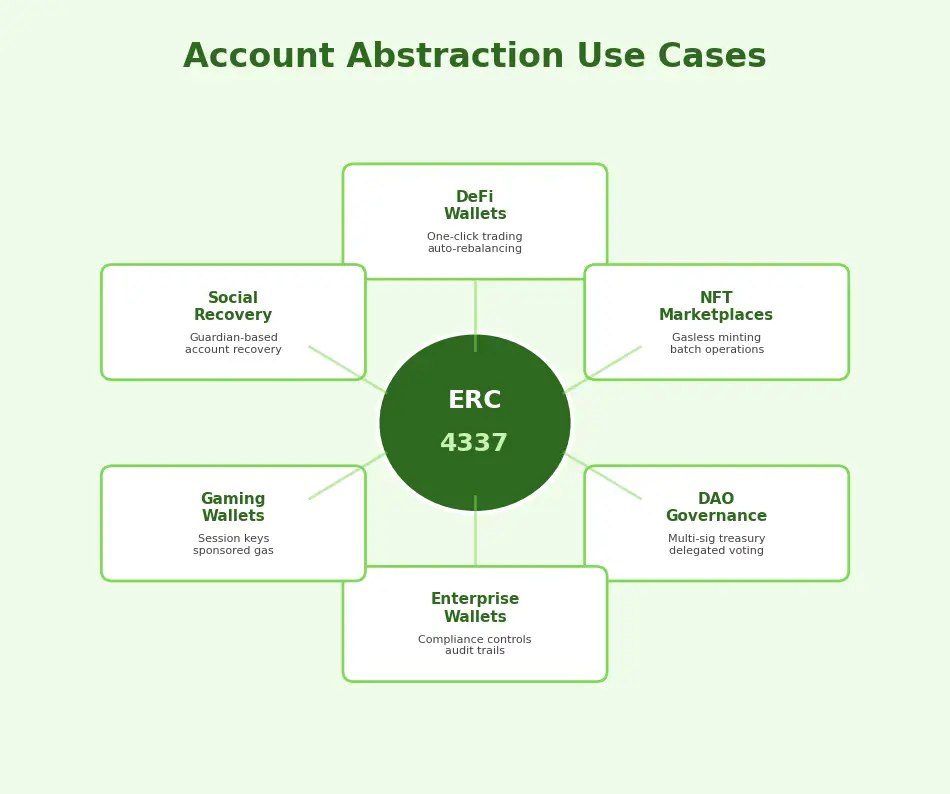
DeFi Wallet Integration
DeFi protocols can integrate ERC-4337 wallets to offer one-click trading, automatic portfolio rebalancing, and gasless interactions. Users can set up automated strategies that execute within predefined parameters without manual intervention for each step.
NFT Marketplaces
NFT platforms can use Account Abstraction to simplify minting, buying, and selling. Sponsored transactions mean new users can purchase their first NFT without first acquiring ETH. Batched transactions allow creators to mint entire collections in a single operation.
DAO Governance Systems
DAOs can leverage smart contract wallets for sophisticated governance mechanisms. Multi-sig wallets with time-locked execution for treasury management, delegated voting through session keys, and custom authorization policies for different governance actions all become straightforward to implement.
Enterprise Blockchain Wallet Solutions
Enterprises require wallet solutions with compliance features, access controls, audit trails, and integration with existing identity management systems. ERC-4337 provides the foundation for building these capabilities natively within the wallet itself. For organizations exploring enterprise blockchain applications, Account Abstraction is a critical enabler for user-facing wallet experiences.
Risk Warning: While ERC-4337 smart contract wallets offer superior features, they introduce smart contract risk. Bugs in wallet contract code can lead to loss of funds. Always ensure that wallet contracts undergo comprehensive security audits by reputable firms before deployment to production.
How to Implement ERC-4337
Steps for ERC-4337 Smart Contract Wallet Creation
Designing the Smart Contract Wallet
The first step is designing the wallet contract architecture. This includes deciding on the validation scheme (single key, multi-sig, passkey), access control policies, upgrade strategy (immutable vs proxy pattern), and module system for extensibility. The wallet must implement the IAccount interface and the validateUserOp function as specified by the ERC-4337 standard.
Integrating EntryPoint Contract
The wallet contract must integrate with the canonical EntryPoint contract deployed on the target chain. This integration involves configuring the wallet to accept calls from the EntryPoint for validation and execution, managing the deposit balance for gas, and implementing the correct interfaces for UserOperation processing.
Configuring Bundlers and Paymasters
Setting up bundler infrastructure involves either running your own bundler node or integrating with third-party bundler services. Paymaster configuration requires deploying or connecting to paymaster contracts that define gas sponsorship policies. This Ethereum Account Abstraction guide step is critical for delivering the seamless user experience that justifies the complexity of ERC-4337 integration.
Testing and Security Audits
Comprehensive testing is non-negotiable. This includes unit testing all wallet functions, integration testing with the EntryPoint and bundler, stress testing under various gas conditions, and formal security audits by independent audit firms. The Tarality platform case study demonstrates how thorough testing and auditing processes lead to secure, production-ready blockchain wallet implementations.
ERC-4337 Implementation Lifecycle
| Phase | Activities | Timeline | Deliverables |
|---|---|---|---|
| 1. Discovery | Requirements analysis, architecture design, feature scoping | 1-2 weeks | Technical specification, architecture diagram |
| 2. Smart Contract Design | Wallet contract coding, IAccount implementation, module system | 3-5 weeks | Wallet contracts, test suite |
| 3. Infrastructure Setup | Bundler integration, paymaster deployment, EntryPoint configuration | 2-3 weeks | Working infrastructure, API endpoints |
| 4. Frontend Integration | SDK integration, UI/UX implementation, wallet connection flow | 2-4 weeks | User-facing wallet interface |
| 5. Security Audit | Third-party audit, vulnerability remediation, formal verification | 3-6 weeks | Audit report, remediation evidence |
| 6. Deployment & Launch | Mainnet deployment, monitoring setup, gradual rollout | 1-2 weeks | Live production wallet system |
Custom ERC-4337 Implementation for Businesses
Choosing the Right Ethereum Blockchain Company
Implementing ERC-4337 requires deep expertise in Ethereum smart contract architecture, security best practices, and the specific nuances of the Account Abstraction standard. When selecting a partner, look for teams with demonstrated experience in smart contract wallet creation, bundler and paymaster infrastructure, and production deployments of ERC-4337 systems. A proven blockchain solutions will have a portfolio of wallet projects and a thorough understanding of the security considerations unique to Account Abstraction.
Compliance and Secure Blockchain Wallet Solutions
For businesses operating in regulated markets, compliance is a critical consideration when implementing ERC-4337 wallets. Smart contract wallets can embed compliance logic directly into their validation functions, including transaction screening, geographic restrictions, and integration with on-chain identity attestation services. The right implementation partner will understand both the technical and regulatory dimensions of building compliant Web3 wallet infrastructure for global markets.
Smart Wallet Model Selection Criteria
Choosing the right smart wallet architecture depends on your project’s specific needs. Here is a framework for evaluating the key decision points when implementing Account Abstraction ERC-4337.
Wallet Architecture Selection Framework
| Criteria | Consumer Wallet | Enterprise Wallet | Gaming / dApp Wallet |
|---|---|---|---|
| Auth Method | Passkeys, biometrics | Multi-sig, HSM, role-based | Session keys, social login |
| Recovery | Social recovery, email/phone | Admin recovery, timelocked | Social recovery, backup key |
| Gas Strategy | Paymaster-sponsored | Company-funded paymaster | Fully sponsored by game |
| Key Feature | Simple UX, spending limits | Compliance, audit trails | Low friction, batch operations |
| Target Network | L2 (Optimism, Base) | Ethereum mainnet + L2 | L2 (Arbitrum, Polygon) |
Future of Ethereum Wallets with Account Abstraction
Web3 Wallet Innovation 2026
Next Generation Crypto Wallets
The next generation of crypto wallets powered by Account Abstraction ERC-4337 will look fundamentally different from today’s wallet applications. Expect wallets that use passkeys stored on your device instead of seed phrases, support automatic portfolio management strategies, integrate directly with fiat on-ramps and off-ramps, and offer plug-and-play modules for specific use cases. Ethereum wallet solutions are evolving from simple key managers to comprehensive financial platforms.
Account Abstraction Adoption 2026 Trends
In 2026, we are seeing accelerating adoption of Account Abstraction across the ecosystem. Major wallet providers are migrating to smart contract wallets as the default account type. Layer 2 networks are offering native Account Abstraction support with optimized gas costs. Enterprise clients are building production systems on ERC-4337 for treasury management, employee access, and customer-facing applications. The Ethereum Account Abstraction guide is becoming required reading for any serious Web3 builder.
Why Account Abstraction is the Future of Ethereum Wallet Solutions
Scalability and Gas Optimization
Account Abstraction contributes to Ethereum scalability by enabling more efficient transaction processing. Batched UserOperations reduce the total number of transactions on the network. L2 compatibility means that smart contract wallet operations can be processed at a fraction of mainnet gas costs. As Ethereum continues to scale through rollups and danksharding, Account Abstraction for blockchain developers will become even more efficient and cost-effective.
Institutional Adoption
Institutional adoption of blockchain technology is accelerating, and ERC-4337 is playing a central role. Financial institutions, asset managers, and enterprise organizations require wallet infrastructure with compliance controls, multi-party authorization, audit trails, and integration with existing IT systems. Smart contract wallets ERC-4337 provide all of these capabilities natively, making institutional Web3 wallet infrastructure a reality rather than a vision.
Build Secure ERC-4337 Smart Contract Wallets with Experts
Partner with our blockchain development company to implement Account Abstraction (ERC-4337), build secure smart contract wallets, and deliver next-generation Web3 wallet solutions.
Launch Your Exchange Now
Account Abstraction Services
ERC-4337 Wallet Company Solutions
Smart Contract Wallet Services
Professional smart contract wallet services cover the full spectrum of ERC-4337 implementation: from initial architecture design and smart contract coding through security auditing and production deployment. This includes custom validation logic, module systems for extensibility, proxy-based upgrade mechanisms, and integration with bundler and paymaster infrastructure. Each wallet is designed to meet the specific requirements of the project’s use case and target audience.
Web3 Wallet Infrastructure Services
Beyond the wallet contract itself, comprehensive Web3 wallet infrastructure requires bundler nodes, paymaster contracts, SDK integrations, monitoring systems, and analytics dashboards. A full-service approach to Ethereum wallet creation ensures that every component of the ERC-4337 ecosystem is properly configured, tested, and maintained for production reliability.
Blockchain Wallet Company Expertise
Choosing a blockchain wallet company with deep ERC-4337 expertise means partnering with teams that understand both the technical intricacies of Account Abstraction and the business requirements of modern Web3 projects. This expertise spans smart contract security, gas optimization, cross-chain deployment, compliance integration, and UX design for wallet interfaces. The right partner transforms ERC-4337 from a technical standard into a competitive advantage for your project, delivering Web3 wallet infrastructure that is secure, scalable, and ready for the demands of a global user base.
Next Step: Account Abstraction ERC-4337 is not just a technical upgrade. It is the foundation of the next era of Ethereum wallet solutions. Whether you are building a consumer wallet, an enterprise treasury system, or a dApp with embedded wallet functionality, ERC-4337 provides the programmable, secure, and user-friendly account layer that Web3 has been waiting for.
Frequently Asked Questions
Account Abstraction ERC-4337 is a standard that transforms how accounts function on Ethereum by allowing smart contracts to act as user accounts. Instead of relying solely on externally owned accounts controlled by private keys, Account Abstraction enables programmable wallets with custom validation logic, gas sponsorship, and social recovery. This fundamentally improves both security and usability for everyday blockchain users.
EIP-4337 refers to the Ethereum Improvement Proposal, which is the formal specification document submitted for community review and discussion. ERC-4337 is the finalized standard that emerged from that proposal and is now implemented in production. In practice, both terms refer to the same Account Abstraction framework, but ERC-4337 specifically denotes the accepted and deployed standard.
ERC-4337 explained simply: it works entirely at the application layer without requiring any changes to the Ethereum consensus protocol. It introduces a separate mempool for UserOperations, which are processed by bundlers who package them into regular transactions. This clever architecture avoids the need for a hard fork while still delivering the full benefits of Account Abstraction.
Smart contract wallets ERC-4337 are wallet accounts that are controlled by smart contract logic rather than a single private key. These wallets can implement custom rules for transaction validation, support multiple signers, enable social recovery mechanisms, and even allow gasless transactions through paymasters. They represent a significant upgrade over traditional externally owned accounts.
Yes, ERC-4337 introduces the concept of paymasters, which are smart contracts that can sponsor gas fees on behalf of users. This means end users can interact with dApps without holding ETH for gas, dramatically improving the onboarding experience. Projects can subsidize transaction costs for their users, or accept gas payments in alternative tokens.
Account Abstraction provides enhanced security features compared to traditional EOAs, including multi-signature authorization, time-locked transactions, spending limits, and social recovery. These features make smart contract wallets ERC-4337 suitable for enterprise-grade applications where security and access control are critical requirements. Multiple audit firms have reviewed the core contracts.
Reviewed & Edited By

Aman Vaths
Founder of Nadcab Labs
Aman Vaths is the Founder & CTO of Nadcab Labs, a global digital engineering company delivering enterprise-grade solutions across AI, Web3, Blockchain, Big Data, Cloud, Cybersecurity, and Modern Application Development. With deep technical leadership and product innovation experience, Aman has positioned Nadcab Labs as one of the most advanced engineering companies driving the next era of intelligent, secure, and scalable software systems. Under his leadership, Nadcab Labs has built 2,000+ global projects across sectors including fintech, banking, healthcare, real estate, logistics, gaming, manufacturing, and next-generation DePIN networks. Aman’s strength lies in architecting high-performance systems, end-to-end platform engineering, and designing enterprise solutions that operate at global scale.